Glaucoma Care in Gurgaon

Glaucoma is the leading cause of irreversible blindness worldwide. It is a progressive optic nerve disease that can silently damage vision much before symptoms become obvious. Early diagnosis, OCT imaging, visual field testing, and long-term monitoring are essential to reducing the risk of irreversible vision loss.

Superspecialty glaucoma care means catching that damage early, tracking it precisely, and making treatment decisions that are built around your individual risk, not a standard protocol.

Glaucoma Care in Gurgaon: Diagnosis, Treatment, and Second Opinions

Most people who arrive at a glaucoma consultation did not expect to be there.

Perhaps a routine eye check flagged your optic nerve. Maybe a parent lost vision to glaucoma and you want to know your own risk. Perhaps you have been on drops for years and something still doesn’t feel right. Whatever brought you here, you are asking the right question at the right time, because in glaucoma, timing is everything.

The nerve fibres that glaucoma destroys do not regenerate. Vision lost to this disease does not return. But vision that has not yet been lost can almost always be protected, if the disease is identified accurately, monitored carefully, and managed by a specialist with the training to interpret what the tests are actually showing.

This is what superspecialty glaucoma care means in practice.


What Glaucoma Actually Is

Glaucoma is not a single disease. It is a family of conditions that share one defining feature: progressive damage to the optic nerve, the cable that carries visual information from your eye to your brain.

In most forms of glaucoma, elevated intraocular pressure — the fluid pressure inside the eye — is the primary driver of that damage. But pressure is not the whole story. Roughly a third of glaucoma patients have pressures that fall within the normal range. In these patients, the nerve is vulnerable for reasons that go beyond simple mechanics — vascular supply, structural anatomy, and systemic factors all play a role.

This is why glaucoma cannot be managed by pressure alone. It requires a trained eye on the nerve itself.

The most common forms of glaucoma

Primary open-angle glaucoma is the most prevalent form globally and in India. It develops slowly, painlessly, and without warning. By the time peripheral vision is affected, significant nerve damage has usually already occurred.

Normal tension glaucoma is systematically underdiagnosed in India. Patients with pressures in the normal range are often reassured and discharged — while damage continues. Identifying this condition requires looking beyond the pressure reading.

Angle-closure glaucoma is more common in Asian populations. It can present as a sudden, painful emergency — or develop slowly and silently in the chronic form. A detailed anterior segment assessment is essential to detect the anatomical risk before a crisis occurs.

Childhood and secondary glaucomas require specialist evaluation. Secondary glaucomas — arising from inflammation, steroid use, trauma, or systemic conditions — are frequently missed or mismanaged without subspecialty input.


Why Superspecialty Training Changes Outcomes

A general ophthalmologist is trained to detect glaucoma and initiate treatment. A fellowship-trained glaucoma subspecialist is trained to do something more precise: to distinguish true progression from test variability, to select the right intervention at the right disease stage, and to manage the full complexity of a condition that evolves over decades.

The difference becomes most visible in three situations.

When the diagnosis is uncertain. Glaucoma suspects — patients with suspicious optic nerves or borderline pressures who do not yet meet diagnostic criteria — require careful longitudinal monitoring. The decision of when to treat, and how aggressively, requires experienced clinical judgement.

When progression occurs despite treatment. Patients who worsen on drops are not simply non-compliant. They may have nocturnal pressure spikes, inadequate pressure targets, or structural vulnerability that requires a different therapeutic approach entirely.

When surgery is on the table. The glaucoma surgical landscape has changed significantly with the advent of MIGS — minimally invasive glaucoma surgery. Knowing when MIGS is appropriate, which device fits which patient, and when conventional filtration surgery remains the better option requires a surgeon who operates across the full spectrum.


What to Expect at This Practice

My approach to glaucoma care is built around four principles.

Catch it before it matters. Early detection requires looking beyond the standard pressure check — at the optic nerve structure, the retinal nerve fibre layer on OCT, and the visual field pattern over time. I look for the signal before the symptom.

Track it with precision. A single test is a photograph. Glaucoma management requires a series of photographs — read by someone who understands what change looks like, and what normal variation looks like. I review trends, not snapshots.

Treat it at the right stage. Not every glaucoma patient needs surgery. Not every glaucoma patient can be managed on drops alone. The treatment plan is built around your disease stage, your lifestyle, your pressure target, and your individual risk of progression.

Protect the ocular surface. Long-term glaucoma drops affect the surface of the eye in a significant proportion of patients. Ocular surface disease reduces comfort, affects adherence, and is frequently undertreated. I address it as part of glaucoma management — not as a separate problem.

Glaucoma Care Covered in This Practice

Diagnosis and Detection

Medical Management

Monitoring and Progression

Surgery

Local and General

When to Come In

Book a superspecialty consultation if any of the following apply:

  • You have been told your optic nerve looks “suspicious” or “cupped”
  • You have a parent or sibling with glaucoma
  • You are on glaucoma drops and have never had a formal progression assessment
  • Your visual fields are worsening despite treatment
  • You have been recommended surgery and want a second opinion
  • You have high myopia — a significant independent risk factor for glaucoma
  • You use steroid drops, inhalers, or nasal sprays regularly

Glaucoma does not announce itself. By the time you notice something is wrong, the window for easy intervention may already be narrowing. Early assessment costs very little. Late diagnosis costs vision.


Frequently Asked Questions

What is the difference between a glaucoma specialist and a general eye doctor?

A glaucoma specialist has completed a dedicated fellowship — one to two years of focused training in glaucoma diagnosis, medical management, laser, and surgery — beyond standard ophthalmology residency. This training matters most in uncertain diagnoses, complex progression, and surgical planning.

How often should I have my eyes checked if I have glaucoma?

Most patients with established glaucoma require review every three to six months, including IOP measurement, OCT, and periodic visual field testing. The exact frequency depends on your disease stage, stability, and treatment response. Suspects require annual or biannual monitoring.

Can glaucoma be cured?

Glaucoma cannot currently be cured — but in the vast majority of patients, it can be controlled well enough to preserve functional vision for life. The key is early detection, accurate monitoring, and treatment that is adjusted as the disease evolves.

Is glaucoma hereditary?

Yes. First-degree relatives of glaucoma patients have a four to nine times higher risk of developing the condition. Screening siblings and adult children of affected patients is one of the most cost-effective interventions in glaucoma prevention.

What is MIGS and am I a candidate?

MIGS — minimally invasive glaucoma surgery — is a family of procedures designed to lower eye pressure with a safer profile than traditional filtration surgery. It is most appropriate for mild to moderate glaucoma. Not every patient is a candidate; appropriate selection requires subspecialty assessment.

You may want to listen to Dr Bhartiya answer some frequently asked questions here.


About the Author

This article was written by Dr Shibal Bhartiya, fellowship-trained glaucoma specialist and Mayo Clinic Research Collaborator, Clinical Director at Marengo Asia Hospitals, Gurugram, known for ethical, patient-centred glaucoma care and independent glaucoma second opinions. She is also the Program Director for Community Outreach & Wellness; and for the Marengo Asia International Institute of Neuro and Spine.

She has published peer-reviewed research on glaucoma management, examining how treatment decisions should balance medical evidence, patient preferences, and long-term vision outcomes.

As Editor-in-Chief of Clinical and Experimental Vision and Eye Research and Executive Editor of the Journal of Current Glaucoma Practice (Pubmed Indexed, official journal of the International Society of Glaucoma Surgery), Dr Shibal Bhartiya brings editorial and research depth to every clinical decision. Her 200+ publications, including 90+ PubMed-indexed publications and 28 edited textbooks span glaucoma biology, surgical outcomes, health equity, and emerging diagnostics.

1500+ Five Star Patient Reviews Google Business Profile

If you are unable to come to Dr Bhartiya’s clinic: Read more about teleconsultation for glaucoma

Read her research on PubMed | Google Scholar | ResearchGate | ORCID

Upload your reports for a structured review.| www.drshibalbhartiya.com | +91 88826 38735

Leave a review on Google


Here are some patient stories

The English Teacher Who Began Painting Again

How to do visual fields

Uveitic glaucoma

OCT Scan Explained

An OCT scan (Optical Coherence Tomography) is a non-invasive imaging test that shows detailed cross-sections of the retina and optic…

Glaucoma Diagnosis in Gurgaon

Glaucoma Diagnosis in Gurgaon: What to expect

Glaucoma steals vision silently. Most patients feel no pain and notice no changes, until significant nerve damage has already occurred.

Early diagnosis changes everything. In, Gurgaon, Dr. Shibal Bhartiya offers a complete glaucoma diagnostic workup using advanced imaging and functional testing.

If you have a family history of glaucoma, are over 40, or have been told your eye pressure is high, this page explains exactly what your evaluation involves.

Why Early Glaucoma Detection Matters

Vision lost to glaucoma cannot come back. But when you catch it early, treatment halts further damage. That is why a thorough diagnostic evaluation is essential, not optional.

Early detection matters most if you have:

💡 Research shows that South Asians have a higher risk of angle-closure glaucoma. A screening examination can identify this risk before any symptoms appear.

7 Tests Used to Diagnose Glaucoma

Dr Shibal Bhartiya is a fellowship-trained glaucoma specialist and Mayo Clinic Research Collaborator with over 25 years of experience. Her approach focuses on identifying risk before damage is irreversible, simplifying treatment decisions, and protecting vision long-term. Emphasis on early detection, risk assessment, and continuity of care. She is rated 5 stars across 1,500+ patient reviews on Google.

Dr. Bhartiya uses a structured, evidence-based protocol. Each test answers a different question about the health of your optic nerve and visual system.

1. Intraocular Pressure (IOP) Measurement

High eye pressure is the most well-known glaucoma risk factor. Dr. Bhartiya measures IOP using Goldmann applanation tonometry, the gold-standard technique.

Normal IOP: 10–21 mmHg. Readings above this range trigger further evaluation. However, some patients develop glaucoma at normal pressures (normal-tension glaucoma), so IOP alone is never enough.

The test is quick and painless. It takes less than a minute per eye.

💡 IOP fluctuates through the day. Dr. Bhartiya may check your pressure at different times if she suspects normal-tension glaucoma.

2. OCT- Optic Nerve and RNFL Imaging

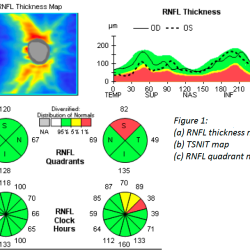
Optical Coherence Tomography (OCT) is the most important advance in modern glaucoma diagnosis. It gives Dr. Bhartiya a detailed cross-sectional scan of your optic nerve and retinal nerve fibre layer (RNFL).

OCT detects structural nerve damage up to 6 years before visual field loss becomes visible. This makes it the cornerstone of early detection.

OCT measures:

  • RNFL thickness, thinning here signals glaucoma damage
  • Optic nerve head parameters, including the cup-to-disc ratio
  • Ganglion cell complex, a sensitive early marker of nerve loss

The scan is non-contact, takes about 5 minutes, and requires no eye drops in most cases.

💡 Dr. Bhartiya’s research background in optic nerve imaging means she reads OCT results with particular depth, looking beyond the machine’s colour codes and interpreting the raw data.

3. Visual Field Testing (Perimetry)

Glaucoma damages peripheral vision first. A visual field test maps exactly which parts of your vision are affected, and how severely. You sit in front of a dome-shaped screen and press a button each time you see a light flash. The test takes 5–7 minutes per eye.

Visual field testing answers three questions:

  • Is there functional vision loss,  and where?
  • How fast is the damage progressing?
  • Is current treatment working?

Results compare against age-matched norms. Serial testing over time is especially important, a single test shows the current state; repeated tests reveal the trend.

💡 Reliable results require full concentration. Bhartiya’s team explains the test carefully so your first attempt is accurate. But if there are too many false positives or negatives, they will request a repeat!

4. Corneal Pachymetry

Pachymetry measures the thickness of your cornea. This single measurement significantly changes how Dr. Bhartiya interprets your eye pressure.

Here is why. IOP measurements are affected by corneal thickness. A thin cornea makes pressure read falsely low. A thick cornea makes it read falsely high.

Average corneal thickness: ~545 microns. Corneas below 500 microns carry a significantly higher risk of glaucoma progression, even when IOP appears normal.

The test is painless and takes under 2 minutes. A small probe touches the cornea gently after numbing drops.

💡 Pachymetry is especially important if glaucoma is progressing despite treatment, and for patients with borderline IOP readings.

5. Gonioscopy: Examining the Drainage Angle

Gonioscopy is the only way to directly examine the drainage angle of the eye, where fluid exits. This examination determines whether your glaucoma is open-angle or angle-closure. That distinction drives every treatment decision.

Dr. Bhartiya places a specialised mirrored lens gently on your eye (after numbing drops) to visualise structures that are otherwise invisible.

Gonioscopy reveals:

💡 Many patients in India have narrow drainage angles without knowing it. Gonioscopy at your first visit can prevent a potentially blinding acute angle-closure attack.

6. Diurnal IOP Monitoring and the Water Drinking Test

Eye pressure is not constant. It fluctuates throughout the day and night, typically peaking around 4 AM and varying by as much as 6–8 mmHg over 24 hours. A single pressure reading in clinic captures only one moment in that cycle.

This matters because peak IOP, not average IOP, is what damages the optic nerve. A patient whose pressure appears well-controlled at a morning clinic visit may have dangerously high peaks overnight.

24-hour IOP monitoring records pressure every two hours over a full day and night. It is the most comprehensive method but is cumbersome and expensive. It is reserved for complex cases where standard clinic measurements are insufficient.

The Water Drinking Test is a practical alternative. Eye pressure is measured at baseline, then you drink approximately 10 ml per kg body weight of water over five minutes. Pressure is then recorded every 15 minutes for one hour. The test gives a reasonable estimate of peak IOP, pressure fluctuation, and how quickly your eye recovers to baseline.

If a water drinking test has been scheduled, carry a one-litre bottle of water. There are no other specific preparations.

💡 Dr Bhartiya has published peer-reviewed research on 24-hour IOP monitoring, target IOP, and continuous pressure recording in glaucoma patients. This is an area of active clinical research at this practice.


7. Optic Disc Photography

A high-resolution photograph of your optic nerve is taken and stored in your record. This image becomes one of the most important documents in your long-term glaucoma care.

The reason is straightforward. Glaucoma causes slow, progressive changes to the optic disc — changes that are often difficult to detect at any single visit. A photograph taken today gives your doctor a precise baseline to compare against at every future visit. Subtle changes that would otherwise go unnoticed become visible when images from different years are placed side by side.

Disc photography requires no drops in most cases. You sit in front of a fundus camera, look at a fixation target, and a bright flash takes the image. It takes under two minutes.

💡 Serial disc photography over years is one of the most powerful tools for detecting glaucoma progression — and one of the most underused in routine practice.

What to Expect at Your Glaucoma Evaluation

A complete glaucoma workup takes approximately 60–90 minutes. Here is the sequence:

  1. Brief history: symptoms, family history, current medications
  2. Visual acuity and refraction
  3. IOP measurement (both eyes)
  4. Pachymetry
  5. Gonioscopy
  6. Dilated fundus examination and optic nerve evaluation
  7. OCT imaging
  8. Visual field testing (where indicated)
  9. Detailed consultation: results, diagnosis, and treatment options

Dilation drops may be used during the examination. Your vision may be blurred for 3–4 hours afterwards. Plan not to drive yourself home.

Seeking a Second Opinion on Glaucoma?

Many patients come to Dr. Bhartiya after receiving a diagnosis elsewhere, unsure whether they need surgery, or concerned about a treatment recommendation.

A second opinion review includes a full re-evaluation of all existing tests, a fresh examination, and an honest, unhurried discussion of your options. Dr. Bhartiya brings her research expertise to every such case.

💡 Bring all previous reports, OCT scans, visual field printouts, and prescription history. The more information you bring, the more specific the guidance.

Book Your Glaucoma Diagnosis in Gurgaon

Do not wait for symptoms. Glaucoma gives no warning until significant damage is done.

Book a comprehensive glaucoma evaluation with Dr. Shibal Bhartiya at Gurgaon.

📞  Call or WhatsApp: +91 8882638735

🔗  Also read: Glaucoma Surgery in Gurgaon  |  Glaucoma Second Opinion About Dr. Shibal Bhartiya

Frequently Asked Questions

Is glaucoma diagnosis painful?

No. All five tests are painless. IOP measurement, OCT, and visual field testing involve no contact with the eye. Pachymetry and gonioscopy use numbing drops first, so you feel minimal discomfort.

How often should I get screened?

If you have risk factors — family history, high eye pressure, thin corneas, or age over 40 — annual screening is advisable. For diagnosed patients, Dr. Bhartiya sets a personalised review schedule based on disease stage and stability.

My eye pressure is normal. Can I still have glaucoma?

Yes. Normal-tension glaucoma is well-recognised and common in Asian populations. Dr. Bhartiya evaluates optic nerve structure and visual function alongside IOP — because pressure alone does not tell the whole story.

Can glaucoma be detected before symptoms appear?

Yes, and this is the entire point of a diagnostic evaluation. OCT detects structural nerve damage years before you notice any visual change. Early detection is the single most important factor in protecting your long-term vision.

What is the difference between open-angle and angle-closure glaucoma?

Open-angle glaucoma develops slowly and painlessly as drainage channels lose efficiency over time. Angle-closure glaucoma occurs when the drainage angle narrows or blocks — it can cause sudden pain, redness, and rapid vision loss. Gonioscopy distinguishes between the two and guides treatment.

How long does the full diagnostic evaluation take?

Approximately 60–90 minutes for a first-visit comprehensive workup. Follow-up visits for monitoring are usually shorter, 30–45 minutes.

How should I prepare for my glaucoma tests?

No specific preparation is needed. A few things will help:

Read a little about glaucoma beforehand and write down any questions you want to ask. Get a good night’s sleep before your visual field test, fatigue significantly affects results. Have a light meal before you arrive, as some tests take time. Continue all previously prescribed medications unless told otherwise.

If a water drinking test has been scheduled, carry a one-litre bottle of water. If dilation has been planned, arrange for someone to drive you home, your vision may be blurred for 3–4 hours after dilating drops. Bring something to read while you wait. Glaucoma investigations are painless, but they are time-consuming.


I have been advised gonioscopy. What does it involve?

Gonioscopy is used to examine the drainage angle of your eye, the area where fluid exits. It determines whether your glaucoma is open-angle or angle-closure, which drives every treatment decision.

Your doctor will apply numbing drops first, so the procedure is painless. A small mirrored lens is then placed gently on the eye. You will be asked to look in a specific direction while the doctor examines the angle with the slit lamp. The room lights are usually dimmed for better visibility.

Most people tolerate gonioscopy well. Occasionally, the procedure stimulates the vagus nerve and causes brief dizziness, this passes quickly. The whole examination takes a few minutes.


The visual field test sounds difficult. Any tips?

It is one of the harder tests to do well, but a few things help.

You will sit in front of a dome-shaped screen and press a button each time you see a flash of light. Keep looking at the central fixation light throughout, do not track the flashes. Press the button even if you are only partially sure you saw something.

Pace yourself. If you feel fatigued, tell the operator and take a break. If your eyes feel dry, blink or use your lubricant drops before continuing. Do not rush, pressing quickly to finish the test produces unreliable results and may mean you need to repeat it.

There is a learning curve. Your doctor may ask you to repeat the test at a subsequent visit, this is normal and not a cause for concern.


How is eye pressure measured?

The standard method is Goldmann applanation tonometry. Your doctor applies numbing drops and a small amount of orange dye, then brings a probe into gentle contact with the cornea. The test is painless and takes under a minute per eye.

Some clinics use a non-contact tonometer, the air-puff machine, which requires no drops and no contact. Both methods are accurate when performed correctly.


How does the doctor examine my optic nerve?

The optic nerve sits at the back of the eye and cannot be seen without special equipment. Your doctor will use one of two methods: an ophthalmoscope (a handheld light and lens), or a high-powered lens at the slit lamp. Dilating drops are often used to widen the pupil and allow a clearer view.

What the doctor looks for is the size and shape of the optic cup relative to the disc (the cup-to-disc ratio), the colour and rim tissue of the nerve, and any asymmetry between the two eyes. These findings, combined with OCT and visual field data, form the basis of diagnosis.

Read the research articles

This article was written by Dr Shibal Bhartiya, fellowship-trained glaucoma specialist and Mayo Clinic Research Collaborator, Clinical Director at Marengo Asia Hospitals, Gurugram, known for ethical, patient-centred glaucoma care and independent glaucoma second opinions. This article was edited in April 2026.

She has published peer-reviewed research on glaucoma management, examining how treatment decisions should balance medical evidence, patient preferences, and long-term vision outcomes.

As Editor-in-Chief of Clinical and Experimental Vision and Eye Research and Executive Editor of the Journal of Current Glaucoma Practice (Pubmed Indexed, official journal of the International Society of Glaucoma Surgery), Dr Shibal Bhartiya brings editorial and research depth to every clinical decision. Her 200+ publications, including 90+ PubMed-indexed publications and 28 edited textbooks span glaucoma biology, surgical outcomes, health equity, and emerging diagnostics.

Available on Pubmed and Google Scholar

Dr Shibal Bhartiya
Glaucoma • Second Opinion • Advanced Care

www.drshibalbhartiya.com
+91 88826 38735

Patient reviews Google Business Profile

Upload your reports for a structured review.