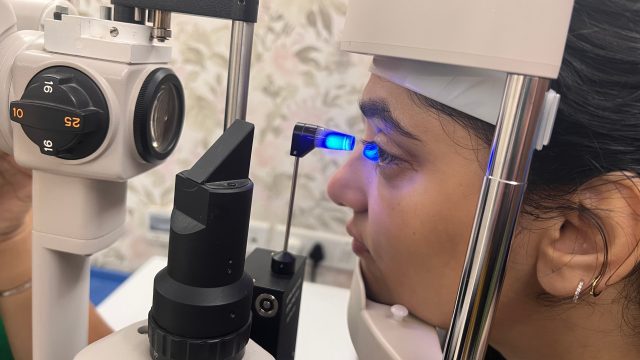
An eye pressure test, called tonometry, measures the fluid pressure inside your eye. In Gurgaon, I use Goldmann applanation tonometry, the gold standard, to evaluate your glaucoma risk, and I correlate it to your optic nerve health.
Your doctor has asked for an eye pressure check. Many people feel nothing wrong with their eyes. That is the point. High eye pressure causes no symptoms, and glaucoma damage starts silently.
What is tonometry?
Your eye is a closed ball of fluid. Tonometry estimates the pressure of that fluid. The result is your intraocular pressure, or IOP, in millimetres of mercury (mmHg).
High eye pressure can damage the optic nerve, causing a disease called glaucoma. Lowering IOP is the proven way to slow glaucoma. That makes this measurement central to glaucoma diagnosis and management.
Note:
You can have glaucoma with normal eye pressures also. To know more please read Glaucoma with Normal Eye Pressures. On the other hand, high eye pressure does not always mean glaucoma. To know more please read Ocular Hypertension, or High IOP but Normal Optic Nerve.
Why do you need an eye pressure test?
- You are screening for glaucoma. Pressure is one of the first risk factors we check.
- You have glaucoma. We compare your readings with your target pressure.
- Glaucoma runs in your family. Your risk is higher, so regular checks matter.
- You use steroids. Any steroid can raise IOP. This includes drops, nasal sprays, skin creams, inhalers, and tablets.
- You have had an eye injury, inflammation, or surgery. Pressure can change in each of these.
- Your optic nerve looks damaged, but your pressure is normal. This may be normal tension glaucoma.
How I measure eye pressure in Gurgaon
I use Goldmann applanation tonometry, the gold standard. Numbing drops go in first. A flat, blue-lit probe touches the front of your eye for a moment. You feel no pain.
I never read pressure alone. Normal pressure does not rule out glaucoma. I assess your optic nerve and visual function alongside every reading.
I also check your corneal thickness. A thin cornea can make the reading look lower than the true pressure.
Please read more about your first glaucoma review at my clinic in Gurgaon, and Does My Eye Pressure Change Through the Day and Night?
What your eye pressure test reading means
| Reading | What it means | What usually happens next |
|---|---|---|
| 10 to 21 mmHg | Within the usual range. Glaucoma can still occur at these pressures. | Optic nerve and visual field checks decide. |
| Above 21 mmHg | Higher risk. This alone is not a diagnosis. | Repeat the reading, then check corneal thickness, OCT, fields, and the drainage angle. |
| Normal in clinic, but your nerve is worsening | Pressure may peak outside clinic hours. | Consider water drinking test or 24-hour IOP monitoring. |
| Lower after treatment | Treatment is working. | Compare with your target pressure. |
Why one eye pressure test is not enough
Eye pressure is not constant. It rises and falls through the day and night. Peak pressure, not average pressure, damages the optic nerve. A single clinic reading can miss the peak.
When glaucoma worsens despite good office readings, I look further. Options include the water drinking test and 24-hour IOP monitoring. I use a contact lens sensor for continuous recording. The Triggerfish lens sensor received DCGI clearance for clinical use in India, for a clinical study protocol led by me in 2012 .
Read more: Eye Pressure Variations and What Is Target IOP?.
Types of eye pressure tests
Every tonometer makes assumptions about your cornea. Knowing which device measured your pressure helps you read the number.
| Test | How it works | Best use and limits |
|---|---|---|
| Goldmann applanation | A slit-lamp prism flattens a small area of the cornea. It needs numbing drops and dye. | The gold standard. It assumes a corneal thickness of about 520 microns. A thin cornea reads falsely low, and a thick one reads falsely high. |
| Air puff (non-contact) | A pulse of air indents the cornea. No drops and no contact. | Fast, comfortable screening. Less precise. Blinking, corneal hydration and anxiety change the reading. |
| Rebound (iCare) | A light probe bounces off the cornea. | Useful when Goldmann is hard to do. Some versions work for home monitoring. |
| Perkins | The Goldmann principle in a handheld device. | Children under anaesthesia, operating theatres and patients who cannot sit at a slit lamp. |
| TonoPen | A handheld electronic device touching a tiny area of the cornea. | Useful in scarred or irregular corneas. Repeat readings vary slightly, so I allow for that. |
| Dynamic contour (Pascal) | A contact device that senses pressure directly. It also records ocular pulse amplitude. | Less affected by corneal thickness and curvature than Goldmann. |
| Diaton | Measures pressure through the eyelid. | Used for corneal disease or after corneal surgery. |
My group compared the TonoPen AVIA, Goldmann and non-contact tonometers. Goldmann stayed the gold standard, and the devices were not interchangeable. In a separate comparison of the Diaton and Goldmann, readings correlated but did not agree closely enough to swap. We also studied test-retest variability of the TonoPen.
I worked on the altitude studies with colleagues across centres in Mexico and the United States. In one of them, Perkins and Goldmann agreed well under standard conditions. Changes in atmospheric pressure at altitude affected both devices. In two studies I co-authored, altitude affected Goldmann and dynamic contour readings differently. This matters if you live at altitude or travel there.
What this means for you: Ask which device measured your pressure. Ask whether anyone measured your corneal thickness. If your readings look inconsistent, or you have had corneal surgery, ask for a second method.
I choose the method for your eye, depending on what is required. I rely on Goldmann tonometry for decisions that change treatment.
How to prepare for Tonometry
- Remove contact lenses before your visit if possible.
- Continue your regular eye drops, unless I advise otherwise.
- Breathe normally during the test. Holding your breath raises the reading.
- Bring earlier eye reports.
When to see a doctor
See a doctor urgently
Go the same day if you have:
- Sudden severe eye pain with a red eye
- Halos around lights
- Sudden blurred vision
- Headache with nausea or vomiting
These can signal an acute angle-closure attack, when pressure rises very high.
See a doctor
Book a check if you:
- Are over 40 and have not had a recent glaucoma check
- Have a family history of glaucoma
- Use steroids for a long time
- Have had an eye injury
- Have glaucoma and worsening results despite normal readings
What this means for you
An eye pressure test takes minutes. It gives us your starting point about your glaucoma risk. It also shows whether glaucoma treatment is adequate to protect your optic nerve.
Why I write about 24-hour eye pressure
I have published on 24-hour eye pressure since 2012. My early review argued that the goal of treatment is a target pressure with minimal swing across the day.⁴ In angle-closure eyes, my review found that most patients swung by more than 5 mmHg. Peak pressure often occurred around 4 am, a time when no clinic measures it.³
Many glaucoma decisions still rest on one or two readings.² In 2019 I reviewed the tools that now measure pressure at home and overnight.¹ These include rebound tonometry and contact lens sensors.
The Triggerfish contact lens sensor records pressure through sleep without waking you. It reports relative pressure, not absolute pressure, and that limit matters. I obtained DCGI clearance for its clinical use in India for the first clinical study in the country, and presented the first results (PAC and PACG before and after laser iridotomy) at ARVO Orlando in 2014. Whether this monitoring improves visual outcomes needs more study.
If your clinic pressures look fine and your nerve still progresses, a 24-hour view may explain why.
Frequently asked questions
Is an eye pressure test painful?
No. Numbing drops remove any discomfort. You may feel gentle contact. The air puff test can feel startling but does not hurt.
What is a normal eye pressure?
The usual range is 10 to 21 mmHg. Some people develop glaucoma within this range, so your optic nerve matters too. Similarly, all eye pressures above 21 do not mean glaucoma.
Does a normal reading rule out glaucoma?
No. Normal tension glaucoma occurs at normal pressure. Pressure can also peak outside clinic hours.
Is the air puff test accurate?
It is a useful screening tool. It is less precise than Goldmann tonometry. I use Goldmann when a decision depends on the number.
Is an eye pressure test available in Gurgaon?
Yes. I measure eye pressure with Goldmann tonometry in Gurgaon, as part of every comprehensive glaucoma evaluation.
How often should I have my eye pressure checked?
Most healthy adults need a pressure check at routine eye exams. You need closer follow-up if you have a family history of glaucoma, a suspicious optic nerve, high pressure or diabetes. If you have glaucoma, I set the interval for pressure checks, OCT scans and visual fields.
Book an eye pressure test or glaucoma evaluation in Gurgaon
If you need a pressure check, or your glaucoma is worsening despite normal readings, book a visit at my clinic in Gurgaon . You can also request a glaucoma second opinion.
Book an Appointment:
📍 Gurgaon 📞 +91 88826 38735 | 🌐 Contact Us | Second Opinion Form for teleconsults
Dr Shibal Bhartiya’s Pubmed Indexed, Published research on eye pressure
- The Need to Maintain IOP Over 24 Hours
- 24-Hour IOP Monitoring: The Way Ahead
- Diurnal Intraocular Pressure Fluctuation in Eyes with Angle-Closure
- Diurnal Variation of IOP in Angle Closure Disease: Are We Doing Enough?
- New perspectives on target intraocular pressure.
This page is a part of the Glaucoma Hub. you may want to read about Glaucoma Progression, and Risk Stratification in Glaucoma. You may want to read more about OCT and Visual Field, Glaucoma Tests Explained, Normal OCT but Vision Symptoms and How to Understand Your OCT Better. Also of help could be Why Do I Need a Visual Field Test? Glaucoma Diagnosis in Gurgaon, Get a Glaucoma Second Opinion in Gurgaon and Get an Online Glaucoma Consult.
About the Author
This article was written by Dr Shibal Bhartiya, fellowship-trained glaucoma specialist and Mayo Clinic Research Collaborator, Clinical Director at Marengo Asia Hospitals, Gurugram, known for ethical, patient-centred glaucoma care and independent glaucoma second opinions. She is also the Program Director for Community Outreach & Wellness; and for the Marengo Asia International Institute of Neuro and Spine.
Dr Bhartiya has published peer-reviewed research onglaucoma management, examining how treatment decisions should balance medical evidence, patient preferences, and long-term vision outcomes. She is also a committed patient advocate and mainstream medical columnist, translating complex ophthalmic evidence into actionable public health insights across leading national platforms including NDTV and OnlyMyHealth
As Editor-in-Chief of Clinical and Experimental Vision and Eye Research and Executive Editor of the Journal of Current Glaucoma Practice (Pubmed Indexed, official journal of the International Society of Glaucoma Surgery). Her 200+ publications, including 90+ PubMed-indexed publications and 28 edited textbooks span glaucoma biology, surgical outcomes, health equity, and emerging diagnostics.
1600+ Five Star Patient Reviews Google Business Profile
If you are unable to come to Dr Bhartiya’s clinic: Read more about teleconsultation
Read her research on PubMed | Google Scholar | ResearchGate | ORCID | Github | Wikidata
📋Upload your reports for a structured review.| 🌐 Contact Us| 📞 +91 88826 38735
⭐ Helped by this article? Leave a Google review — it helps other patients find reliable eye care.
Last Reviewed: October 2026