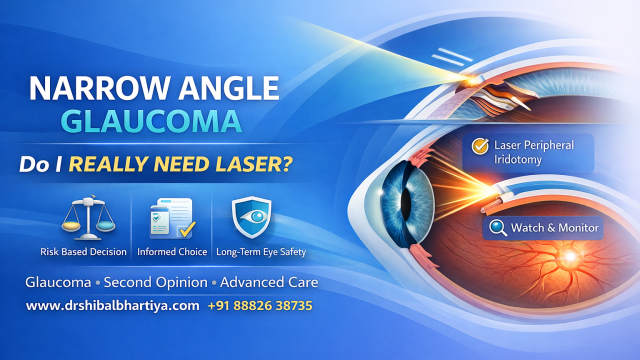
Narrow Angle Glaucoma: What It Is, Who Is at Risk, and When to Act
Most people who develop closed angle glaucoma do not start with glaucoma. They start with something much quieter: narrow angles. This is a common anatomical finding where the drainage space inside the eye is crowded. Vision may be normal. Eye pressure may be normal. But a risk exists, and glaucoma care is largely about identifying and managing that risk before damage occurs. Dr Shibal Bhartiya, fellowship trained glaucoma specialist, explains.
Key Facts at a Glance
- Narrow angles are a risk condition, not a diagnosis of glaucoma.
- Most patients with narrow angles never develop an acute attack.
- The greater danger is the silent, slow form that develops when narrow angles go undetected.
- Not every narrow angle requires laser treatment.
- The goal is to prevent damage, not just to react to it.
Dr Shibal Bhartiya is a fellowship-trained glaucoma specialist and Mayo Clinic Research Collaborator with over 25 years of experience. Her approach focuses on identifying risk before damage is irreversible, simplifying treatment decisions, and protecting vision long-term. Emphasis on early detection, risk assessment, and continuity of care. She is rated 5 stars across 1,500+ patient reviews on Google.
What Are Narrow Angles?
Inside the eye is a drainage channel called the anterior chamber angle. This is where fluid exits the eye to maintain normal pressure. In some people, this space is naturally narrower than average. This is called a narrow angle, or primary angle closure suspect (PACS).
At this stage:
- The angle is narrow but not closed
- Eye pressure may still be normal
- The optic nerve is undamaged
- Vision is unaffected
Narrow angles are not glaucoma. They are a risk condition that deserves monitoring, and, in some cases, timely intervention.
What Is Closed Angle Glaucoma?
Closed angle glaucoma occurs when the drainage angle becomes blocked enough to raise pressure and damage the optic nerve. This damage is irreversible. It can develop:
- Suddenly, in an acute attack with severe pain and redness
- Slowly and silently, the most common and most missed form
- Intermittently, with brief episodes that resolve on their own
The dramatic acute attack receives attention, but most vision loss in angle closure happens gradually, when narrow angles are not recognised or monitored over time. This is called Primary Angle Closure Glaucoma (PACG).
Narrow Angle vs Closed Angle Glaucoma: The Key Difference
Narrow angle = risk stage. We are preventing disease.
Closed angle glaucoma = damage stage. We are managing disease.
This distinction determines how we approach care; and explains why identifying narrow angles early is a priority in good glaucoma practice.
Why Narrow Angles Are Often Missed
How to detect narrow angles or closed angles? Routine eye examinations typically assess spectacle power, cataract, retinal health, and eye pressure. Narrow angles require a specific test called gonioscopy, in which the drainage angle is directly examined using a special lens.
Patients with narrow angles are frequently told their eyes are normal because:
- Pressure is within the normal range
- Vision is unaffected
- No symptoms are present
This is not negligence. It reflects the fact that glaucoma risk often hides in details that standard screening does not capture. A glaucoma-specific evaluation is needed to assess the angle directly.
Who Is at Higher Risk of Narrow Angle Glaucoma?
Anatomical factors:
- Plus (hyperopic) spectacle power
- Smaller eye size
- Shallow anterior chamber
- Thickening natural lens with age
- Early cataract development
Demographic factors:
- Age above 40
- Female sex
- Asian ethnicity
- Family history of glaucoma
None of these factors confirm glaucoma. They identify who deserves a closer look.
Symptoms of Early Narrow Angle Glaucoma
Most patients have no symptoms at all. When symptoms occur, they tend to be subtle and easily attributed to other causes:
- Eye fatigue by evening
- Mild headache after reading or screen time
- Halos around lights, especially at night
- Intermittent blurred vision
- Difficulty seeing clearly in dim light
These are commonly mistaken for dry eye, screen strain, or age-related fatigue. Sometimes they are. Sometimes they are early warning signals of a narrowing angle.
Symptoms of an Acute Angle Closure Attack
An acute attack is a medical emergency, and can be potentially sight threatening. Seek immediate help if you experience:
- Severe eye pain
- Sudden significant blurring of vision
- Red eye
- Coloured halos around lights
- Headache, nausea, or vomiting
Importantly: most patients with narrow angles never experience an acute attack. The purpose of evaluation is to identify risk early enough to prevent emergencies from occurring.
EMERGENCY CONTACT: +91 9818700269 | +91 88826 38735 | www.drshibalbhartiya.com
How Doctors Decide Whether Treatment Is Needed
Not every narrow angle requires treatment. The decision depends on a careful assessment of individual risk:
- How narrow the angle is on gonioscopy
- Whether the optic nerve shows any early changes
- Whether eye pressure fluctuates abnormally
- How much the natural lens is contributing to crowding
- Patient age and ability to attend follow-up
Good glaucoma care is not about doing everything possible. It is about doing what is necessary and appropriate for each individual.
Treatment Options for Narrow Angle Glaucoma
Observation and Monitoring
When risk is assessed as low and reliable follow-up is possible, careful monitoring may be the most appropriate initial approach. This is not inaction. It is structured, informed surveillance.
Laser Peripheral Iridotomy (LPI)
A small laser opening is made in the iris to allow fluid to bypass a potential blockage. This reduces the risk of angle closure. It is a brief outpatient procedure, but it is not universally necessary for all narrow angles.
Cataract Surgery
In patients where a thickening natural lens is contributing significantly to angle crowding, early cataract surgery can address both the lens and the angle simultaneously. This may be a better long-term option than laser in selected patients.
Do All Narrow Angles Need Laser?
No. Not all narrow angles need a laser procedure. This is one of the most common concerns patients bring to a glaucoma consultation.
Laser helps many patients. But some benefit more from careful observation, and some are better served by lens surgery later in their course. The right decision is based on individual anatomy and risk assessment, not simply on the label “narrow angle.”
Why Patients Often Seek a Second Opinion
Angle closure management involves clinical judgment rather than urgency in most cases. Patients commonly want clarity on:
- Whether laser is truly necessary at this stage
- Whether watchful waiting is a safe choice
- Whether cataract surgery would be a better intervention
- Whether glaucoma has already begun
Seeking a structured second opinion in this context is entirely reasonable. The best glaucoma decisions are not rushed, they are explained.
When to Seek a Dedicated Glaucoma Evaluation
Consider a formal glaucoma assessment with a glaucoma specialist in Gurgaon if:
- You have narrow angles
- Laser advised, but you are uncertain whether it is necessary
- You have a family history of glaucoma
- Eye pressure borderline or fluctuating
- You are developing a cataract and want integrated advice
- You would like a structured risk assessment and a clear management plan
Early clarity is always easier than late correction.
www.drshibalbhartiya.com
+91 88826 38735
Frequently Asked Questions
Is narrow angle glaucoma the same as glaucoma?
No. Narrow angle is a risk condition. Glaucoma refers to optic nerve damage. The goal of evaluating narrow angles is to prevent glaucoma from ever developing.
Can narrow angles be present even if eye pressure is normal?
Yes. Normal eye pressure does not exclude a narrow angle. The two must be assessed separately.
Will I definitely lose vision if I have narrow angles?
Not necessarily. Many patients with narrow angles never develop glaucoma or experience an acute attack. The value of early evaluation is to determine your individual risk and plan accordingly.
What is gonioscopy?
Gonioscopy is a painless examination. In this, a special contact lens is placed on the eye to visualise the drainage angle directly. It is the only way to accurately assess whether the angle is narrow, and how narrow.
Is laser peripheral iridotomy painful?
No. The procedure is performed under topical anaesthetic drops. Most patients experience mild discomfort at most and return to normal activities the same day.
The best outcome in glaucoma is not a successful treatment. It is damage that never happens.
Narrow angles matter because they identify who may develop disease, before they do. That is the foundation of modern glaucoma care.
Narrow Angle and Closed Angle Glaucoma Evaluation in Gurgaon
Diagnosed with narrow angles, angle closure, borderline eye pressure? Advised laser? A second opinion, or a structured glaucoma evaluation can provide:
- An accurate assessment of your actual risk level
- Clarity on whether treatment is necessary at this stage
- A personalised monitoring or management plan
Note: Continuous IOP Monitoring in Angle Closure Glaucoma
Triggerfish® contact lens sensor is a specialised diagnostic contact lens used in glaucoma care to monitor intraocular pressure (IOP)–related changes over 24 hours. Unlike routine pressure measurements taken during clinic hours, the Triggerfish lens (Sensimed Triggerfish) helps detect pressure fluctuations that may occur at night or outside OPD visits, which can sometimes explain progression despite apparently controlled readings. It does not measure pressure directly in mmHg but records circumferential corneal changes related to IOP patterns, helping glaucoma specialists better understand individual risk profiles and treatment needs in selected patients.
Dr Shibal Bhartiya was the first doctor in India to use the Triggerfish® contact lens sensor for Continuous IOP Monitoring in clinical practice. Her initial experiences on Intraocular pressure (IOP) related pattern in patients with primary angle closure (PAC) and primary angle closure glaucoma (PACG) before and after laser peripheral iridotomy (LPI) was presented at ARVO, in Orlando Florida in 2014
IOP fluctuation is a particular concern in angle closure disease, where pressure spikes can be steep and are frequently missed by routine daytime readings. Dr Bhartiya’s published research has examined this directly. A 2015 study in the Journal of Current Glaucoma Practice, Diurnal Intraocular Pressure Fluctuation in Eyes with Angle-Closure (Bhartiya S, Ichhpujani P; PMID: 26997828), investigated IOP fluctuation across the day in 77 newly diagnosed angle closure patients and documented the range and pattern of diurnal variation in this group. A 2019 review in the Romanian Journal of Ophthalmology, Diurnal Variation of IOP in Angle Closure Disease: Are We Doing Enough? (Bhartiya S et al.; PMID: 31687621), went further — finding that many clinical decisions in angle closure glaucoma management are based on only one or two IOP measurements, and arguing that this is insufficient given the established circadian rhythm of IOP and its direct correlation with glaucoma progression. Taken together, these papers make the case that angle closure patients may be among the most undertreated precisely because their worst pressure moments are the least observed.
Related Reading
Get an Online Glaucoma Consult
Why Do I Need a Visual Field Test?
Understanding Your OCT Report in Glaucoma
Visual Field and OCT: Structure & Function Correlation
Glaucoma Progression: What It Means and How to Slow It
Get a Glaucoma Second Opinion in Gurgaon
Read the research articles
This article was written by Dr Shibal Bhartiya, fellowship-trained glaucoma specialist and Mayo Clinic Research Collaborator, Clinical Director at Marengo Asia Hospitals, Gurugram, known for ethical, patient-centred glaucoma care and independent glaucoma second opinions. This article was edited in April 2026.
She has published peer-reviewed research on glaucoma management, examining how treatment decisions should balance medical evidence, patient preferences, and long-term vision outcomes.
As Editor-in-Chief of Clinical and Experimental Vision and Eye Research and Executive Editor of the Journal of Current Glaucoma Practice (Pubmed Indexed, official journal of the International Society of Glaucoma Surgery), Dr Shibal Bhartiya brings editorial and research depth to every clinical decision. Her 200+ publications, including 90+ PubMed-indexed publications and 28 edited textbooks span glaucoma biology, surgical outcomes, health equity, and emerging diagnostics.
Her work can be accessed on Pubmed, Google Scholar, ResearchGate and ORCID.
Dr Shibal Bhartiya
Glaucoma • Second Opinion • Advanced Care
www.drshibalbhartiya.com
+91 88826 38735
1500+ Five Star Patient Reviews Google Business Profile