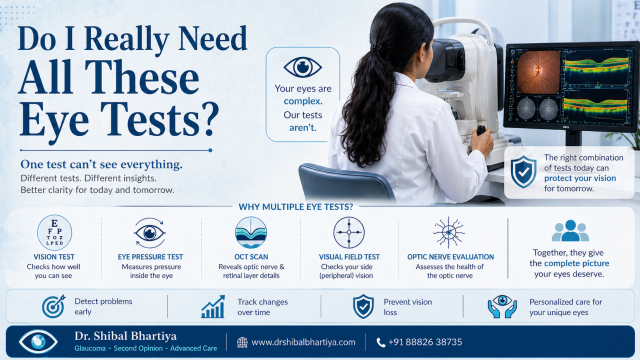
Not all eye tests are unnecessary—but not all are essential either. The key is understanding what each test looks for, and whether it actually changes your care, explains Dr Shibal Bhartiya.
If you’ve ever walked out of an eye clinic thinking,
“Why so many tests for one problem?” you’re not alone.
Most patients expect a quick vision check and a prescription. But modern eye care, especially for conditions like glaucoma, doesn’t work that way.
Because here’s the uncomfortable truth: One eye test can look completely normal, while something important is still being missed.
Dr Shibal Bhartiya is a fellowship-trained glaucoma specialist and Mayo Clinic Research Collaborator with over 25 years of experience. Her approach focuses on identifying risk before damage is irreversible, simplifying treatment decisions, and protecting vision long-term. Emphasis on early detection, risk assessment, and continuity of care. She is rated 5 stars across 1,500+ patient reviews on Google.
What Most People Assume
- If I can read the chart, my eyes are fine
- One scan should be enough
- More tests = overtesting or upselling
These assumptions come from how we expect medicine to work: simple problem, single answer.
But the eye doesn’t behave like that.
Why Multiple Tests Are Often Necessary
Each eye test looks at a different layer of the same system.
Think of it like this:
- One test checks vision clarity
- Another checks eye pressure
- Another looks at the optic nerve structure
- Another checks how your field of vision is functioning
Individually, each test is incomplete. Together, they tell a story.
The Real Issue: No Single Test Can Rule Out Disease
This is especially true for glaucoma.
You can have:
- Normal eye pressure but early glaucoma
- Normal scans but functional vision loss
- Good vision but progressive nerve damage
If you rely on just one test, you risk false reassurance.
So Why Does It Feel Like “Too Much”?
Because from the patient side:
- Tests feel repetitive
- Results are not always explained clearly
- The connection between tests isn’t obvious
And when that happens, it starts to feel unnecessary, even when it isn’t.
When Multiple Tests Are Actually Essential
You genuinely need a full test panel if:
- There is suspicion of glaucoma
- Your optic nerve looks borderline
- Your family history is positive
- Your symptoms don’t match basic test results
- Your doctor is trying to track change over time
In these situations, multiple tests are not excess. They are risk protection.
When You Can Question the Need
It’s reasonable to pause and ask questions if:
- The same test is repeated too frequently without explanation
- There is no change in your condition, but testing keeps escalating
- You are not told how the test result will change management
A good rule: Every test should answer a specific question.
If that question isn’t clear, ask.
Please also read Why Follow-Up Matters Even When Glaucoma Feels Stable.
The Bigger Picture: Eye Care Is Moving From Snapshot to Timeline
Earlier, eye care was:
- One visit
- One test
- One decision
Now, it’s about:
- Tracking patterns
- Detecting early change
- Preventing irreversible loss
That shift naturally means more data, not less.
What You Should Ask Your Doctor
Instead of asking “Do I need this test?”, ask:
- What exactly are you looking for with this test?
- How is this different from the others I’ve done?
- Will this change my treatment plan?
- How often do I actually need to repeat this?
These questions don’t challenge your doctor. They align you with the decision-making process.
Bottom Line
You don’t need every test. But you also can’t depend on just one.
The goal is not more testing. It’s the right combination of tests, done for the right reason, at the right time.
That’s where good eye care lives.
FAQs: Do I Really Need All These Eye Tests?
Q1: Why does my eye doctor need so many tests just to check my eyes?
Each eye test looks at a different part of the visual system. Vision clarity, eye pressure, optic nerve structure, and peripheral vision are all separate measurements. No single test covers all of them. A problem can be invisible on one test but clearly visible on another, so a combination gives your doctor the full picture.
Q2: Is it normal to need repeat eye tests at every visit?
For stable conditions, testing frequency is usually reduced. Repeat tests are most appropriate when your doctor is tracking a change over time, monitoring a treated condition, or investigating a symptom that hasn’t been fully explained. If tests are repeating without a clear reason, it is reasonable to ask what specifically is being looked for.
Q3: Can glaucoma be missed if only one test is done?
Yes. Glaucoma is one of the conditions where a single normal test result can be genuinely misleading. Eye pressure can be normal even with active glaucoma. An OCT scan can appear stable while functional vision loss is progressing. This is why glaucoma assessment always requires more than one test.
Q4: What questions should I ask before agreeing to more eye tests?
Ask: What are you looking for with this test? How is it different from tests I have already done? Will the result change my treatment? How often will I need to repeat it? These questions help you understand the purpose of each test and stay informed about your own care.
Q5: Are there situations where I can reasonably say no to an eye test?
Yes. If a test has been done recently with no change in your condition, if no explanation is given for why it is needed, or if the result will not affect any treatment decision, it is reasonable to ask for clarification before proceeding. A good doctor will always be able to explain what a test is for and why it is being requested now.
About the Author
This article was written by Dr Shibal Bhartiya, fellowship-trained glaucoma specialist and Mayo Clinic Research Collaborator, Clinical Director at Marengo Asia Hospitals, Gurugram, known for ethical, patient-centred glaucoma care and independent glaucoma second opinions. She is also the Program Director for Community Outreach & Wellness; and for the Marengo Asia International Institute of Neuro and Spine.
She has published peer-reviewed research on glaucoma management, examining how treatment decisions should balance medical evidence, patient preferences, and long-term vision outcomes.
As Editor-in-Chief of Clinical and Experimental Vision and Eye Research and Executive Editor of the Journal of Current Glaucoma Practice (Pubmed Indexed, official journal of the International Society of Glaucoma Surgery), Dr Shibal Bhartiya brings editorial and research depth to every clinical decision. Her 200+ publications, including 90+ PubMed-indexed publications and 28 edited textbooks span glaucoma biology, surgical outcomes, health equity, and emerging diagnostics.
1600+ Five Star Patient Reviews Google Business Profile
If you are unable to come to Dr Bhartiya’s clinic: Read more about teleconsultation
Read her research on PubMed | Google Scholar | ResearchGate | ORCID | Github
📋Upload your reports for a structured review.| 🌐 Contact Us| 📞 +91 88826 38735
⭐ Helped by this article? Leave a Google review — it helps other patients find reliable eye care.
Related Reading
Get an Online Glaucoma Consult
Why Do I Need a Visual Field Test?
Understanding Your OCT Report in Glaucoma
Visual Field and OCT: Structure & Function Correlation