Risk stratification in glaucoma is how doctors estimate how fast your glaucoma is likely to progress. It guides how closely we monitor you and how strongly we treat.
I use my L.I.F.T.S.™ Framework for this. Its five steps are Longitudinal Record Integration, Independent Diagnostic Re-Evaluation, Functional Rate-of-Progression Analysis, Target IOP and Lifetime Risk Profiling, and Proportional and Sustainable Management Planning.
Most glaucoma decisions are not about what your reports show today. They are about what your eyes are likely to do over the next 5–10 years.
Risk stratification in glaucoma helps decide who needs treatment, who can be safely monitored, and who may be at risk of silent progression, even when tests appear normal. Dr Bhartiya explains.
Please also read Myths About Eye Pressure, Does High Eye Pressure (Ocular Hypertension) Mean I Have Glaucoma? and Glaucoma Visual Symptoms in Real Life.
Dr Shibal Bhartiya is a fellowship-trained glaucoma specialist and Mayo Clinic Research Collaborator with over 25 years of experience. Her approach focuses on identifying risk before damage is irreversible, simplifying treatment decisions, and protecting vision long-term. Emphasis on early detection, risk assessment, and continuity of care. She is rated 5 stars across 1,500+ patient reviews on Google.
What Does Risk Mean?

Why glaucoma care is not one-size-fits-all
Two patients can have similar reports, and very different futures.
- One may remain stable for years
- Another may lose vision slowly without obvious warning
Risk stratification is the process of identifying this difference early. It helps answer the most important question: What is likely to happen if we do nothing?
Please also read Glaucoma in Older Adults: When To See a Glaucoma Specialist?
What Most People Get Wrong About Glaucoma Risk
Why reports alone don’t tell the full story
Many glaucoma decisions are based only on:
These are important, but incomplete.
Because:
- Structural damage can begin before symptoms
- Functional loss appears late
- Test results can fluctuate
- “Normal” does not always mean “safe”. This is where many patients are either over-treated unnecessarily, or under-treated until it’s too late
To understand more about what glaucoma vision feels like, please read:
- Glaucoma Patients Don’t Notice Vision Loss
- Glaucoma Visual Symptoms Feel Like in Real Life
- Why Even Intelligent, Health-Conscious People Miss Early Glaucoma?
How is Risk Assessed?
What we look at beyond individual test results. Please also read Are Your Eye Tests Being Interpreted Together.
Risk stratification considers patterns over time, not isolated numbers.
1. Structural changes
Subtle optic nerve or OCT changes that may precede symptoms
2. Functional trends
Visual field patterns, even when still within “normal” range
3. Rate of change
How quickly (or slowly) things are evolving
4. Individual risk factors
- Family history
- Age
- Central Corneal Thickness (Pachymetry)
- Baseline nerve health
- Can Poor Blood Flow to the Eye Cause Glaucoma?
5. Life context
How much vision loss would affect your daily function. This is not just diagnosis. It is future risk prediction.
Dr Bhartiya, along with her associates, write about the current perspectives in tackling glaucoma blindness. These include raising awareness, enhancing early detection programs, and access to care, particularly in underserved populations. Pubmed.
Please read Why Do I Need an Eye Pressure Test (Tonometry) in Gurgaon? Please read more about your first glaucoma review at my clinic in Gurgaon, and Does My Eye Pressure Change Through the Day and Night? Please also read Can AI Detect Glaucoma Early, and Will It Save My Sight?
Three Common Scenarios
When we treat, when we monitor, and when we watch closely
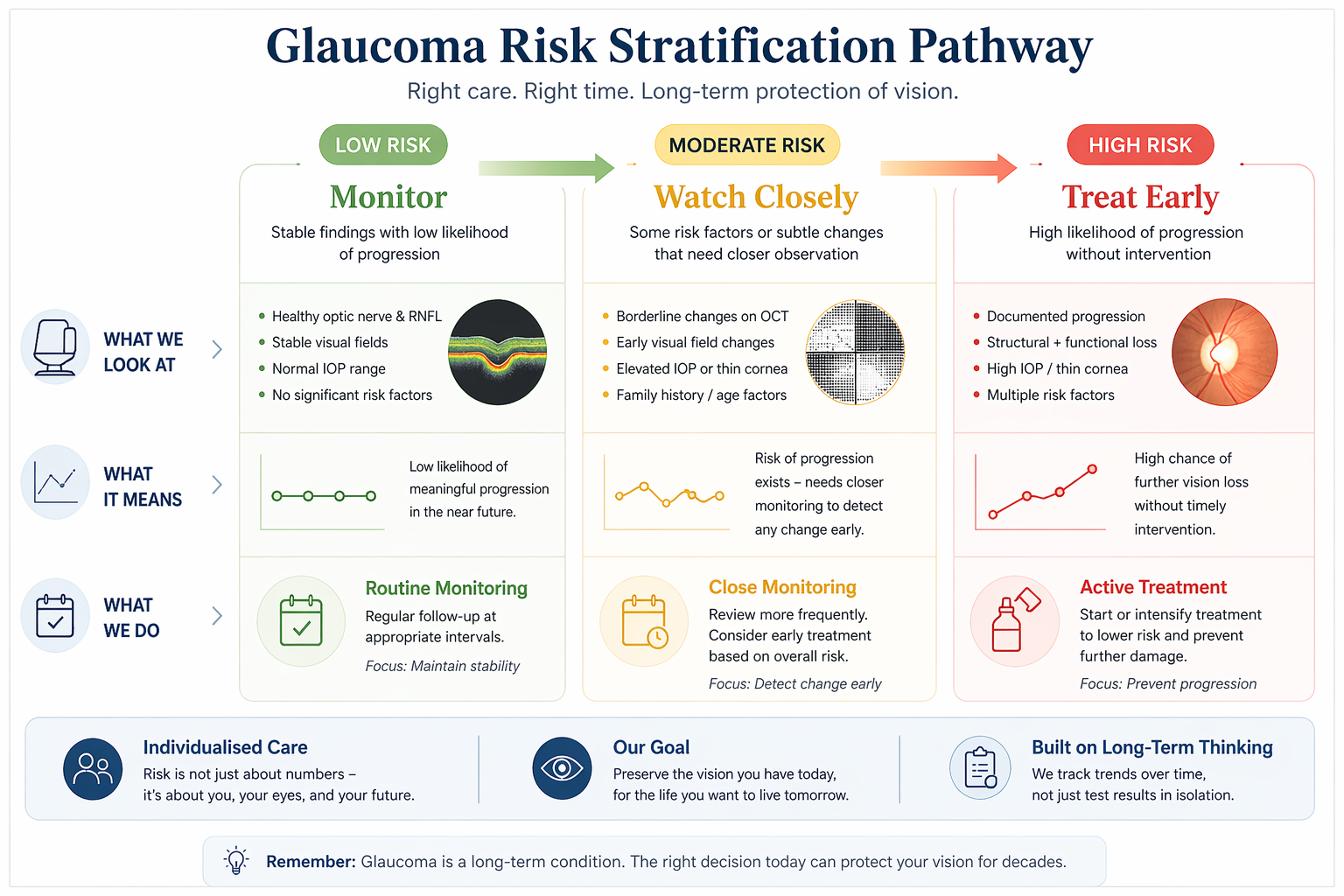
🟢 Low risk
- Stable findings
- No clear progression
👉 Regular follow-up is usually enough.
🟡 Moderate risk
- Suspicious changes
- Uncertain progression
👉 Close monitoring or early treatment depending on context
🔴 High risk
- Clear progression
- Structural + functional change
👉 Treatment is recommended to prevent further loss
The goal is not to treat everyone. The goal is to treat the right patients at the right time.
The Long Arc View of Glaucoma Management
Why early clarity matters more than late intervention
Glaucoma does not usually cause sudden symptoms. It progresses quietly. Patients may feel:
- Slight reading difficulty
- Reduced contrast
- Night discomfort
- Slower visual processing
By the time vision feels obviously affected, damage is often already established. Risk stratification in glaucoma allows intervention before this stage.
What You Must Remember
| Component | What It Means for You |
|---|---|
| Optic nerve status | Structural damage and vulnerability define baseline risk |
| Eye pressure (IOP) | Important driver, but must be interpreted in context |
| OCT findings | Early structural loss may signal higher future risk |
| Visual fields | Functional impact and progression tracking |
| Corneal thickness | Influences true pressure interpretation and risk |
| Type of glaucoma | Normal tension vs high-pressure behave differently |
| Systemic factors | Sleep apnoea, BP fluctuations, diabetes may influence progression |
| Rate of change | Faster progression = higher risk category |
| Adherence to treatment | Inconsistent use increases real-world risk |
| Follow-up pattern | Regular monitoring allows timely risk recalibration |
| Big picture | Risk stratification guides target pressure, treatment intensity, and follow-up frequency |
The L.I.F.T.S.™ Framework is a structured approach to evaluating glaucoma diagnosis, progression, and personalised treatment decisions
Clinical Reality (What’s not always obvious)
Risk stratification is not about labels—it’s about deciding how closely to monitor and how aggressively to treat over time.
Risk in glaucoma is dynamic, not fixed—it changes with time, response to treatment, and systemic health.
The same eye pressure can be “safe” for one patient and damaging for another depending on optic nerve susceptibility.
Test results don’t always align—OCT, fields, and clinical exam may show different pieces of the puzzle.
Systemic factors (blood pressure dips, vascular instability, obstructive sleep apnea) can silently shift risk.
WHY SECOND OPINIONS MATTER HERE
When it’s worth taking a step back
You may benefit from a second opinion if:
- You’ve been advised long-term treatment without clarity
- You’ve been told to “just monitor” without explanation
- Your reports seem normal, but symptoms persist
- Your treatment keeps changing
Sometimes, the issue is not the test. It is the interpretation. Please also read Are Your Eye Tests Being Interpreted Together.
A glaucoma second opinion can confirm the diagnosis, identify the true rate of progression, and determine whether current treatment is appropriate. The L.I.F.T.S.™ Framework provides a structured evaluation to guide personalised glaucoma care and lifelong vision preservation.
Read more at Where Can I Get an OCT Eye Scan in Gurgaon? and Perimetry (Visual Fields) at Gurgaon.
Need clarity about your glaucoma risk?
You don’t need more reports. You need to understand what they mean over time. At my clinic in Gurgaon, I help patients understand their true risk and make confident, evidence-based decisions about their eye health. Request a Second Opinion Consultation
Known for her structured approach to glaucoma risk assessment and progression analysis, Dr Shibal Bhartiya provides trusted second opinions for patients seeking clarity before major treatment decisions. Both, in person, and online.
Book an Appointment:
📍 Gurgaon 📞 +91 88826 38735 | 🌐 Contact Us | Second Opinion Form for teleconsults
Frequently Asked Questions
What is risk stratification in glaucoma?
It is the process of assessing how likely glaucoma is to progress over time, based on multiple factors, not just current test results.
Can glaucoma be present even if tests are normal?
Yes. Early glaucoma may not show clear changes on routine tests, especially in the initial stages.
Does everyone with glaucoma need treatment?
No. Some patients can be safely monitored, while others need early intervention depending on their risk profile.
How often should glaucoma be monitored?
This depends on individual risk. Some patients need frequent follow-up, while others can be reviewed less often.
Why do different doctors give different advice?
Because glaucoma management involves judgement, not just reports. Different interpretations of risk can lead to different recommendations.
This page is a part of the Glaucoma Hub. you may want to read about Glaucoma Progression, Advanced Glaucoma Care in Gurgaon, What Good Glaucoma Care Actually Optimises For, What Happens If Glaucoma Is Left Untreated?, More Glaucoma Eye Drops is Not Better Glaucoma Care, 5 Mistakes Patients Make in Glaucoma Care, Glaucoma Tests Explained, and Do You Really Need Treatment for Glaucoma?
About the Author
This article was written by Dr Shibal Bhartiya, fellowship-trained glaucoma specialist and Mayo Clinic Research Collaborator, Clinical Director at Marengo Asia Hospitals, Gurugram, known for ethical, patient-centred glaucoma care and independent glaucoma second opinions. She is also the Program Director for Community Outreach & Wellness; and for the Marengo Asia International Institute of Neuro and Spine.
Dr Bhartiya has published peer-reviewed research onglaucoma management, examining how treatment decisions should balance medical evidence, patient preferences, and long-term vision outcomes. She is also a committed patient advocate and mainstream medical columnist, translating complex ophthalmic evidence into actionable public health insights across leading national platforms including NDTV and OnlyMyHealth
Dr Bhartiya is the Editor-in-Chief of Clinical and Experimental Vision and Eye Research and Executive Editor of the Journal of Current Glaucoma Practice (Pubmed Indexed, official journal of the International Society of Glaucoma Surgery). Her 200+ publications, including 90+ PubMed-indexed publications and 28 edited textbooks span glaucoma biology, surgical outcomes, health equity, and emerging diagnostics.
1700+ Five Star Patient Reviews Google Business Profile
If you are unable to come to Dr Bhartiya’s clinic: Read more about teleconsultation
Read her research on PubMed | Google Scholar | ResearchGate | ORCID | Github | Wikidata
📋Upload your reports for a structured review.| 🌐 Contact Us| 📞 +91 88826 38735
⭐ Helped by this article? Leave a Google review — it helps other patients find reliable eye care.
Last Reviewed: November 2026