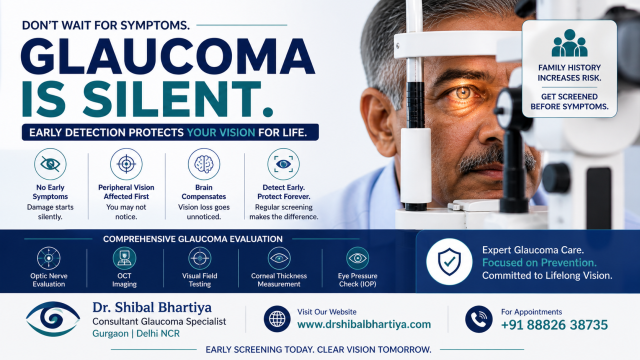
Quick Answer: Yes, most glaucoma causes no symptoms in the early and middle stages. Only an eye examination with the right tests finds it early enough to protect your vision.
Dr Shibal Bhartiya is a fellowship-trained glaucoma specialist and Mayo Clinic Research Collaborator with over 25 years of experience. Her approach focuses on identifying risk before damage is irreversible, simplifying treatment decisions, and protecting vision long-term. Emphasis on early detection, risk assessment, and continuity of care. She is rated 5 stars across 1,600+ patient reviews on Google.
Most people expect a warning, such as pain, redness or blurred vision. With the common forms of glaucoma, that warning rarely comes. By the time something feels wrong, nerve damage is usually well established.
This page covers who needs testing, what the tests find, and the one form that does cause symptoms. To learn why your brain hides the loss, read Glaucoma Patients Don’t Notice Vision Loss.
Why Does Early Glaucoma Cause No Symptoms?
The optic nerve carries images from your eye to your brain. Glaucoma damages its fibres slowly. The damage usually starts at the edges of your vision, while the centre stays sharp. The common forms cause no pain and no redness.
Your brain and your better eye also cover for the missing areas. In one study of 50 patients with field loss in both eyes, 26% were completely unaware of it (Crabb et al, Ophthalmology 2013). I describe what patients do notice in What Does Glaucoma Vision Actually Feel Like?
Which Type of Glaucoma Causes Symptoms?
Acute angle-closure glaucoma is the exception. The drainage angle closes suddenly and eye pressure rises fast. You get severe eye pain, headache, nausea, vomiting, blurred vision and halos around lights.
This is an emergency that needs same-day treatment. Angle closure that develops slowly can still be silent. Read more about narrow angle glaucoma.
Who Should Be Tested for Glaucoma, Even Without Symptoms?
You need a comprehensive glaucoma evaluation if any of these apply to you:
- You are 40 or older and have never had a glaucoma check.
- A parent, brother or sister has glaucoma. This raises your risk roughly four to nine times. Read about family history and screening.
- You have narrow drainage angles. Angle-closure glaucoma is more common in Asian populations, including India.
- You have myopia, especially high myopia of minus 6 dioptres or more.
- You have diabetes.
- You use steroids long term, as drops, tablets or injections. Read about steroid-induced glaucoma.
- You had an eye injury in the past.
- You have thin corneas, or high eye pressure on an earlier test.
If none of these apply, I still advise a baseline check at 40, following the American Academy of Ophthalmology. Without risk factors, it then repeats every 2 to 4 years until 54, every 1 to 3 years until 64, and every 1 to 2 years from 65. With risk factors, I advise shorter intervals.
Read Are You at Risk for Glaucoma?
How Do Doctors Find Glaucoma Before You Notice It?
A vision chart does not detect glaucoma. A comprehensive examination checks eye pressure, the optic nerve, the drainage angle, corneal thickness and the visual field.
An OCT scan measures the nerve fibre layer. It can show thinning before a visual field defect appears. A visual field test maps loss you cannot sense. I read the results together. I look for a large or lopsided optic cup, thinning of the nerve rim, small bleeds at the nerve head and nerve fibre defects on OCT.
There is no cure for glaucoma, and lost vision does not return. Treatment can stop further loss. Read Can Glaucoma Be Cured?, Glaucoma Test Results Explained and Can Routine Eye Tests Miss Glaucoma?
Can I Check for Glaucoma at Home?
No. You cannot measure your eye pressure or see your optic nerve. Covering one eye at a time can show whether one eye sees less than the other. It cannot rule out glaucoma, because the brain hides early field loss.
Everyday problems such as missing steps or struggling at night can be late clues. Read Could My Everyday Vision Problems Be Glaucoma?
What Do Patients Often Assume About Glaucoma?
| What You Notice | What It May Mean | What To Do About It |
|---|---|---|
| Your eyes feel normal | The common forms of glaucoma cause no pain or redness | Test based on your risk, not on how your eyes feel. |
| You read and see clearly | Side vision goes first, and reading vision stays until late | Book a visual field test. |
| Daily life feels normal | Your brain and your better eye cover the damaged areas | Keep regular checks even when everything feels fine. |
| A routine check said your eyes are fine | A chart test and a glasses check do not test for glaucoma | Ask for a comprehensive glaucoma examination with OCT and visual fields. |
| One test came back normal | Glaucoma shows as change over time | Keep a baseline and repeat the tests. |
| Sudden severe eye pain with headache or nausea | Possible acute angle-closure glaucoma | Go to an emergency eye service now. |
When Should I See a Doctor?
See a Doctor Urgently
- Sudden severe eye pain, especially with headache, nausea or vomiting
- Halos around lights with a red, hazy eye
- Sudden loss of vision in one eye
See a Doctor
- You are 40 or older and have no baseline glaucoma check
- A close relative has glaucoma
- You have a risk factor and no recent comprehensive eye examination
- You bump into objects on one side
- You were told your eye pressure or optic nerve looks borderline, and nobody followed up
Frequently Asked Questions
What are the early symptoms of glaucoma?
Usually there are none. The common form, open-angle glaucoma, causes no pain, redness or blur in its early and middle stages. Acute angle-closure glaucoma is the exception. It causes sudden severe pain, headache, nausea and halos, and needs emergency care.
Can you have glaucoma with normal vision?
Yes. Many patients read the 6/6 line and still have optic nerve damage. Central vision is affected late. Glaucoma takes the side vision first, which a chart does not test.
If my eye pressure is normal, can I still have glaucoma?
Yes. Normal-tension glaucoma damages the optic nerve even when pressure sits in the normal range. It is common in Asian populations. A pressure check alone cannot rule it out. You also need optic nerve imaging and a visual field test.
How often should I get checked for glaucoma?
With no risk factors, have a baseline exam at 40. Then repeat it every 2 to 4 years until 54. Repeat every 1 to 3 years until 64, and every 1 to 2 years from 65. These are American Academy of Ophthalmology intervals. With risk factors, you need checks more often, and your doctor sets the schedule.
Is blurred vision an early sign of glaucoma?
Not usually. Blur is uncommon in the early stages. Patients with moderate loss often describe patchy blur. Sudden blur with eye pain is different. It can signal acute angle closure and needs emergency care.
What happens if glaucoma goes undetected?
Side vision narrows first. Central vision fails later. End-stage glaucoma can cause blindness, and lost vision does not return. This usually takes years, which is why testing gives you time. Read What Happens If Glaucoma Is Left Untreated?
Key Takeaways
- Most glaucoma causes no symptoms until the damage is advanced.
- Acute angle-closure glaucoma is the exception, and it is an emergency.
- Your risk factors and age, not your symptoms, decide when you need testing.
- A vision chart and a glasses check do not detect glaucoma.
- OCT and a visual field test find damage before you can feel it.
Book a Consultation
Glaucoma often develops without noticeable symptoms until permanent vision loss has already occurred. If you have a family history of glaucoma, elevated eye pressure, diabetes, or simply want reassurance about your eye health, a comprehensive glaucoma evaluation can help detect the disease before vision is affected.
At her clinic in Gurgaon, Dr Shibal Bhartiya provides evidence-based, personalised glaucoma care using advanced diagnostic techniques to detect glaucoma early, monitor progression, and develop a treatment plan tailored to your needs. Early diagnosis remains the most effective way to preserve vision.
Book an Appointment →
📍 Gurgaon 📞 +91 88826 38735 | 🌐 Contact Us | Second Opinion Form for teleconsults
This page is a part of the Glaucoma Hub. you may want to read about Glaucoma Progression, and Risk Stratification in Glaucoma. Also of help could be Why Do I Need a Visual Field Test? Glaucoma Diagnosis in Gurgaon, Get a Glaucoma Second Opinion in Gurgaon and Get an Online Glaucoma Consult.
This is a part of the Glaucoma Symptoms hub. Please also read Early Glaucoma Symptoms: The Definitive Guide, Can Routine Eye Tests Miss Glaucoma?, Glaucoma Symptoms — A Silent Disease, What Are the Symptoms of Glaucoma?, Glaucoma Patients Don’t Notice Vision Loss, Glaucoma Visual Symptoms Feel Like in Real Life, Glaucoma Visual Symptoms in Real Life, Why Even Intelligent, Health-Conscious People Miss Early Glaucoma?, Understanding Glaucoma, Glaucoma and Blindness: Risk and Prevention and Do Glaucoma Patients Go Blind?
Also of interest may be Common Myths About Glaucoma and Common Myths About Glaucoma Debunked
You may want to read about a patient who was diagnosed as glaucoma, following a routine test, when she had no symptoms at all.
About the Author
This article was written by Dr Shibal Bhartiya, fellowship-trained glaucoma specialist and Mayo Clinic Research Collaborator, Clinical Director at Marengo Asia Hospitals, Gurugram, known for ethical, patient-centred glaucoma care and independent glaucoma second opinions. She is also the Program Director for Community Outreach & Wellness; and for the Marengo Asia International Institute of Neuro and Spine.
Dr Bhartiya has published peer-reviewed research onglaucoma management, examining how treatment decisions should balance medical evidence, patient preferences, and long-term vision outcomes. She is also a committed patient advocate and mainstream medical columnist, translating complex ophthalmic evidence into actionable public health insights across leading national platforms including NDTV and OnlyMyHealth
Dr Bhartiya is the Editor-in-Chief of Clinical and Experimental Vision and Eye Research and Executive Editor of the Journal of Current Glaucoma Practice (Pubmed Indexed, official journal of the International Society of Glaucoma Surgery). Her 200+ publications, including 90+ PubMed-indexed publications and 28 edited textbooks span glaucoma biology, surgical outcomes, health equity, and emerging diagnostics.
1700+ Five Star Patient Reviews Google Business Profile
If you are unable to come to Dr Bhartiya’s clinic: Read more about teleconsultation
Read her research on PubMed | Google Scholar | ResearchGate | ORCID | Github | Wikidata
📋Upload your reports for a structured review.| 🌐 Contact Us| 📞 +91 88826 38735
⭐ Helped by this article? Leave a Google review — it helps other patients find reliable eye care.
Last Reviewed: November 2026