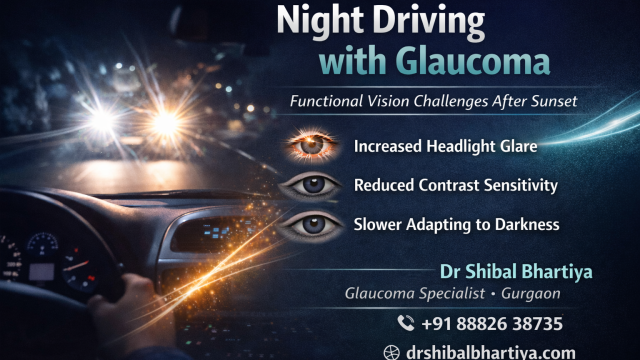
Yes, most people with glaucoma can continue driving safely, as long as their vision meets legal requirements and their visual field is not significantly affected. However, many patients struggle with glare, and decreased contrast sensitivity. Driving is not just about seeing clearly on a chart. It’s about seeing safely across your full field of vision. Glaucoma often preserves central vision until late, so patients may read the 6/6 line and still have dangerous blind spots that affect lane awareness, night driving, and reaction time. Dr Bhartiya explains more.
Many patients want to know: Can I drive at night with glaucoma? For many glaucoma patients, the first real-life difficulty they notice is not reading or watching television. it is driving at night.
You may still see the eye chart clearly, yet feel increasingly uncomfortable with:
- Headlight glare
- LED brightness
- Poorly lit roads
- Vehicles approaching from the side
- Difficulty judging distances
Many patients describe it this way:
“My vision is clear, but night driving feels stressful.”
This happens because glaucoma affects functional vision long before it affects central sharpness of sight.
The real question is therefore not:
“Can you read 6/6?”
It is:
“Is your vision processing fast and reliable enough for real-world situations?”
Dr Shibal Bhartiya is a fellowship-trained glaucoma specialist and Mayo Clinic Research Collaborator with over 25 years of experience. Her approach focuses on identifying risk before damage is irreversible, simplifying treatment decisions, and protecting vision long-term. Emphasis on early detection, risk assessment, and continuity of care. She is rated 5 stars across 1,500+ patient reviews on Google.
How Glaucoma Affects Night Driving
Glaucoma damages the optic nerve and affects how visual information is processed by the brain. These changes become most noticeable in low light, glare and fast-response environments like driving.
Three functional changes are especially important.
1 Increased Glare Sensitivity
Many glaucoma patients notice:
- Halos around headlights
- Starburst patterns around lights
- Temporary visual washout after bright exposure
- Difficulty looking toward bright sources
Common contributing factors include:
- Ocular surface dryness from long-term drops
- Tear film instability
- Early lens changes
- Reduced neural signal efficiency
Often, glare symptoms are worsened not just by glaucoma itself but by untreated ocular surface disease.
This is why glaucoma care today includes protecting the eye surface, not just lowering pressure.
2 Reduced Contrast Sensitivity (An Early Warning Sign)
One of the earliest functional losses in glaucoma is reduced contrast sensitivity.
This affects your ability to distinguish objects from their background.
This may affect detection of:
- Pedestrians in dark clothing
- Road dividers
- Lane markings
- Speed breakers
- Vehicles approaching from the side
Patients often say:
“I can see clearly… but I don’t see quickly.”
This difference between visual clarity and visual safety is central to glaucoma management.
3 Slower Adaptation Between Light and Dark
Glaucoma can affect how quickly your visual system adapts to lighting changes.
You may notice difficulty when:
- Entering a basement parking area
- Driving through tunnels
- Moving between well-lit and poorly lit roads
- Driving during dusk
- Temporary visual hesitation
- Delayed clarity after glare exposure
- Increased driving fatigue
These subtle changes often appear before major visual field loss.
Tips to Improve Night Driving Comfort with Glaucoma
If your doctor has cleared you for driving, simple strategies can help. And if your disease is not advanced, you can safely drive at night with glaucoma. Here are some tips:
Use Anti-Reflective Glasses
Good quality anti-reflective coating helps reduce:
- Headlight glare
- Reflection artifacts
- Light scatter
This is particularly useful for patients using prescription glasses.
Treat Dry Eye Proactively
Dry eye significantly worsens glare and blur.
Using preservative-free lubricating drops before driving may:
- Improve clarity
- Reduce light scatter
- Improve comfort
- Stabilise the tear film
This is especially important in polluted or dry environments.
Keep Your Visual Interfaces Clean
Dirty surfaces dramatically increase glare.
Maintain:
- Clean windscreen
- Clean mirrors
- Clean spectacles
Even small smudges can worsen visual scatter at night.
Modify Driving Habits Slightly
Simple adjustments improve safety:
- Drive slightly slower at night
- Increase following distance
- Avoid direct fixation on high beams
- Briefly shift gaze toward lane markings during glare
These are risk-reduction strategies, not restrictions.
When Should Glaucoma Patients Reconsider Night Driving?
The decision is not based only on visual acuity. More important indicators include functional stability and visual field performance.
You should seek reassessment if you notice:
- Missing vehicles approaching from the side
- Difficulty detecting road signs
- Increasing night driving anxiety
- Near misses
- Increased hesitation at intersections
- Avoiding night driving altogether
Patients often notice these changes before tests show major decline. This is clinically important information.
Can Treatment Optimisation Improve Night Vision?
Sometimes yes.
Adjustments that may help include:
- Reducing drop toxicity affecting the ocular surface
- Switching to preservative-free medication
- Selective Laser Trabeculoplasty (SLT)
- Medication simplification
- Treating dry eye
- Addressing early cataract if present
The goal is not just pressure control.
It is preserving usable, reliable vision.
Tests That Help Assess Driving Safety in Glaucoma
Important evaluations may include:
- Visual field testing (perimetry)
- OCT progression analysis
- Contrast sensitivity testing
- Glare testing
- Ocular surface assessment
Routine vision chart testing alone is not enough to assess driving safety.
Key Takeaway
Glaucoma does not automatically mean you must stop driving.
But it does mean you should monitor functional vision changes early.
If night driving feels harder, this is not something to ignore — even if your vision chart still looks normal.
Often this is an early signal that treatment optimisation may help.
Known for her structured approach to glaucoma risk assessment and progression analysis, Dr Shibal Bhartiya provides trusted second opinions for patients seeking clarity before major treatment decisions. Both, in person, and online.
Frequently Asked Questions About Glaucoma and Night Driving
Is it safe to drive at night if I have glaucoma?
It depends on your visual field, contrast sensitivity and functional vision stability, not just your visual acuity. Many glaucoma patients can safely drive with regular monitoring.
Why do headlights bother me more after glaucoma diagnosis?
Glaucoma can reduce contrast sensitivity and increase glare sensitivity. Dry eye from glaucoma drops may also worsen this.
Can glaucoma cause halos around lights?
Yes. This may occur due to tear film instability, surface disease, early lens changes or neural processing changes.
Does glaucoma affect night vision first?
Often functional night vision changes appear before central vision loss because glaucoma affects peripheral processing and contrast detection. this determines if you can drive at night with glaucoma.
Can treatment improve night driving ability?
Sometimes. Optimising drops, treating dry eye, laser treatment or medication adjustments may improve comfort and functional vision.
Should I stop driving if I have glaucoma?
Not necessarily. This depends on severity and functional testing. Regular monitoring helps guide safe decisions.
What tests determine if I am safe to drive?
Visual field testing, contrast sensitivity testing and clinical assessment of functional vision are most important.
Glaucoma Care is About Preserving Independence
The goal of glaucoma treatment is not just preventing blindness.
It is preserving:
- Independence
- Confidence
- Functional safety
- Quality of life
Early optimisation always protects more than late rescue.
Read the research articles
This article was written by Dr Shibal Bhartiya, fellowship-trained glaucoma specialist and Mayo Clinic Research Collaborator, Clinical Director at Marengo Asia Hospitals, Gurugram, known for ethical, patient-centred glaucoma care and independent glaucoma second opinions. She is also the Program Director for Community Outreach & Wellness; and for the Marengo Asia International Institute of Neuro and Spine.
She has published peer-reviewed research on glaucoma management, examining how treatment decisions should balance medical evidence, patient preferences, and long-term vision outcomes.
As Editor-in-Chief of Clinical and Experimental Vision and Eye Research and Executive Editor of the Journal of Current Glaucoma Practice (Pubmed Indexed, official journal of the International Society of Glaucoma Surgery), Dr Shibal Bhartiya brings editorial and research depth to every clinical decision. Her 200+ publications, including 90+ PubMed-indexed publications and 28 edited textbooks span glaucoma biology, surgical outcomes, health equity, and emerging diagnostics.
Access her work on Pubmed, Google Scholar, ResearchGate and ORCID.
Dr Shibal Bhartiya
Glaucoma • Second Opinion • Advanced Care
www.drshibalbhartiya.com
+91 88826 38735
1500+ Five Star Patient Reviews Google Business Profile
Upload your reports for a structured review.
If you are unable to come to Dr Bhartiya’s clinic: Read more about teleconsultation for glaucoma