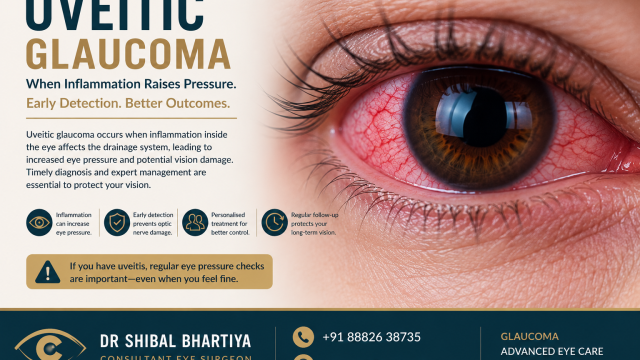
Uveitic glaucoma is a form of glaucoma caused by eye inflammation, where pressure damage and inflammation can both threaten vision. Treatment often needs to control not just eye pressure—but also the underlying inflammation and long-term risk of optic nerve damage.
Uveitic glaucoma is one of the most complex secondary glaucomas. Chronic intraocular inflammation alters the eye’s natural drainage pathways, and standard surgical interventions — including multiple trabeculectomies and tube shunts — frequently fail. When all conventional options are exhausted, management pivots to aggressive inflammatory control and microscopic pressure regulation. For young professionals navigating severe visual field constriction, preserving the remaining central island of vision requires clinical precision alongside genuine human investment.
Dr Shibal Bhartiya is a fellowship-trained glaucoma specialist and Mayo Clinic Research Collaborator with over 25 years of experience. Her approach focuses on identifying risk before damage is irreversible, simplifying treatment decisions, and protecting vision long-term. Emphasis on early detection, risk assessment, and continuity of care. She is rated 5 stars across 1,500+ patient reviews on Google.
Protecting Sight and Rebuilding Futures in Advanced Uveitic Glaucoma
In the most advanced stages of glaucoma, we are no longer fighting a disease in isolation. We are fighting for millimetres of survival.
He came to me in his early 30s — a brilliant young computer engineer carrying an almost unbearable clinical history. He had aggressive uveitic glaucoma, a secondary glaucoma born from chronic internal eye inflammation. One eye had already lost all light perception. In his remaining eye, his visual field was severely constricted. He was navigating the world and his entire career through a narrow, precious tunnel of sight.
He had already endured six complex surgeries elsewhere: three failed trabeculectomies and two failed tube shunts. After multiple attacks of uveitis, he had come to me. I started him on biologics, under the supervision of a rheumatologist, and the infalmaation was controlled.
His glaucoma surgery is failing, and he needs additional anti glaucoma medication to control his eye pressures, but he is bright and cheerful. And very compliant with his medication.
When a young patient is down to their final island of vision, the clinical tightrope is extraordinarily narrow. While he was in our clinic updating his visual field mapping so we could calibrate his pressure and inflammation management, something unexpected happened.
The Light At The End Of The Tunnel
Sitting just outside the diagnostic room was another long-term patient of mine — a gentleman I have monitored as a glaucoma suspect for nearly ten years. His optic discs are highly suspicious. His family history is significant. Through meticulous tracking, we have kept him stable without aggressive treatment. In his professional life, he is the Founder of a serious tech company.
I walked over and asked him a simple question: “Are you going to help one of my glaucoma boys?”
He did not hesitate. I introduced them right there in the clinic corridor. The CEO looked at him and said: “I cannot hand you a job. But I can give you an interview.”
My boy took that single opportunity and ran with it. He walked into a high-stakes technical interview, demonstrated his mastery of JavaScript and Python — the exact languages their infrastructure required — and cleared it entirely on his own merit.
Today, he is a working engineer at the global firm.
Medicine, at its truest, is not just about the eye in front of you. It is about the life behind it.
Lesson Learnt
Uveitic glaucoma is not simply high eye pressure with inflammation—it is often a balancing act between controlling inflammation and protecting the optic nerve. Eye pressure may rise because of inflammation itself, steroid treatment, or damage to the eye’s drainage system, and vision can feel unpredictably better or worse over time.
Treatment is usually more than adding drops and may require careful adjustment of anti-inflammatory treatment, glaucoma medications, or systemic therapy. Surgery can be more complex than routine glaucoma surgery because inflamed eyes may scar, heal differently, and need the eye to be quiet before intervention whenever possible. Long-term outcomes often depend not only on lowering pressure, but on maintaining calm, stable control of inflammation over time.
FAQs
What is uveitic glaucoma?
Uveitic glaucoma is glaucoma that develops because of eye inflammation (uveitis) and/or its treatment. Both inflammation and raised eye pressure can contribute to vision loss if not managed carefully.
What are biologics and when are they used in uveitis?
Biologics are targeted medicines used to control inflammation when uveitis is severe, recurrent, or not responding well to standard treatment. They may help reduce repeated inflammation and protect long-term vision.
Can biologics help reduce glaucoma risk in uveitis?
Controlling inflammation early and consistently may reduce the pressure fluctuations, steroid exposure, and structural damage that contribute to uveitic glaucoma.
Are biologics used instead of glaucoma treatment?
No. Biologics manage the inflammatory part of the disease. Eye pressure control, glaucoma monitoring, medicines, laser, or surgery may still be needed depending on the individual situation.
What makes uveitic glaucoma harder to treat than primary open-angle glaucoma?
Uveitic glaucoma is driven by active, recurrent intraocular inflammation. Inflammatory debris and scar tissue physically block the trabecular meshwork. Because the tissue is inherently inflamed, surgical options like trabeculectomies and tube shunts carry a significantly higher risk of scarring over and failing. A specialist must constantly balance anti-inflammatory therapy with pressure control.
Can a computer engineer or programmer work effectively with severe tunnel vision?
Yes. Patients with constricted visual fields retain their central visual acuity — the ability to see fine detail directly in front of them. With high-contrast coding environments, screen magnification, tailored monitor positioning, and regular clinical monitoring to prevent further field loss, highly technical professionals can continue to excel in demanding engineering roles.
This page is part of the Advanced Glaucoma Care hub. Read about the full spectrum of glaucoma diagnosis and treatment. Please also read about Glaucoma Surgery in Gurgaon, and Steroid Induced Glaucoma.
About the Author
This article was written by Dr Shibal Bhartiya, fellowship-trained glaucoma specialist and Mayo Clinic Research Collaborator, Clinical Director at Marengo Asia Hospitals, Gurugram, known for ethical, patient-centred glaucoma care and independent glaucoma second opinions. She is also the Program Director for Community Outreach & Wellness; and for the Marengo Asia International Institute of Neuro and Spine.
She has published peer-reviewed research on glaucoma management, examining how treatment decisions should balance medical evidence, patient preferences, and long-term vision outcomes.
As Editor-in-Chief of Clinical and Experimental Vision and Eye Research and Executive Editor of the Journal of Current Glaucoma Practice (Pubmed Indexed, official journal of the International Society of Glaucoma Surgery), Dr Shibal Bhartiya brings editorial and research depth to every clinical decision. Her 200+ publications, including 90+ PubMed-indexed publications and 28 edited textbooks span glaucoma biology, surgical outcomes, health equity, and emerging diagnostics.
1500+ Five Star Patient Reviews Google Business Profile
If you are unable to come to Dr Bhartiya’s clinic: Read more about teleconsultation
Read her research on PubMed | Google Scholar | ResearchGate | ORCID
Upload your reports for a structured review.| www.drshibalbhartiya.com | +91 88826 38735
Leave a review on Google