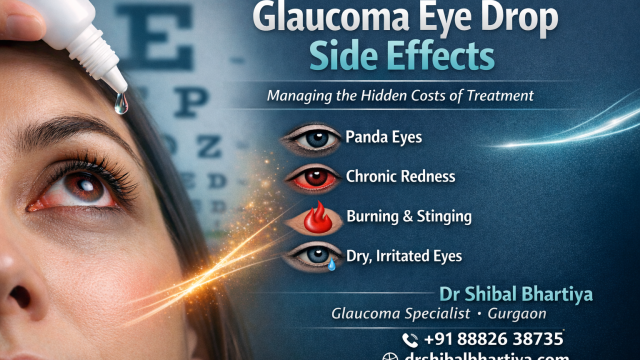
Mild redness or stinging in the first weeks is common, but swollen lids, dark skin or breathlessness need review. Do not stop your drops on your own, because your doctor can usually fix the problem.
Most people tolerate glaucoma drops well. Some notice side effects and wonder whether to mention them. Please do. A side effect is a reason to adjust your treatment, not a sign that you are failing it.
You may notice:
- Redness or stinging
- Darker skin or a deeper fold around the eye
- Longer eyelashes
- Itchy, swollen eyelids
- Tiredness or a slow pulse
- Wheezing or breathlessness
Dr Shibal Bhartiya is a fellowship-trained glaucoma specialist and Mayo Clinic Research Collaborator with over 25 years of experience. Her approach focuses on identifying risk before damage is irreversible, simplifying treatment decisions, and protecting vision long-term. Emphasis on early detection, risk assessment, and continuity of care. She is rated 5 stars across 1,600+ patient reviews on Google.
Known for her structured approach to glaucoma risk assessment and progression analysis, Dr Shibal Bhartiya provides trusted second opinions for patients seeking clarity before major treatment decisions. Both, in person, and online.
What Is Normal, and What Is Not?
Usually normal early on
Mild redness, a short sting and brief blur after a drop are common. Most settle over a couple of weeks.
Needs a review
- Redness or stinging that lasts beyond a few weeks
- Changes in the skin or eyelids
- Itchy, swollen lids that start months into treatment
- Drops you skip because they hurt
Burning and dry eye
Burning, grit and watering often come from the preservative or a dry surface. That has its own page: Why Do My Eyes Burn Since Starting Glaucoma Drops? For the switch itself, read preservative-free glaucoma drops in India.
Why Do Glaucoma Drops Cause Side Effects?
The medicine itself
Each drug class acts differently, so each has its own side effects. Prostaglandin drops can cause redness and eyelash growth. Beta blockers can affect the heart or lungs in some people. Read the full list by drug class.
The preservative
Many multi-dose bottles contain a preservative, usually benzalkonium chloride (BAK). It keeps the bottle sterile. It can also irritate the eye surface after years of use. See preservative-free glaucoma drops in India for what a switch involves.
Years of use and several drops
The more drops you use, the more your eye surface is exposed. People on two or three medicines report surface symptoms more often.
Dry eye you already have
Many people with glaucoma already have dry eye, blepharitis or meibomian gland dysfunction. The drops then make existing symptoms worse. Treating the surface often makes glaucoma treatment far easier to live with.
Which Side Effect Comes From Which Glaucoma Drop?
| Symptom | Likely cause | When to worry |
|---|---|---|
| Redness in the first weeks of a prostaglandin | The drug itself | Call if it lasts beyond a few weeks or comes with pain. |
| Red, itchy, swollen lids months after starting | Allergy, often to brimonidine | Needs a change of drop. Call soon. |
| Burning, grit or watering | Preservative or dry surface | See the dry eye page. Review if you skip doses. |
| Darker skin, deep eyelid fold, sunken look | Prostaglandin drops | Review early. Fat loss may only partly reverse. |
| Tiredness, drowsiness, dry mouth | Brimonidine | Tell your doctor. |
| Bitter or metallic taste | Dorzolamide or brinzolamide | Harmless, but tell your doctor. |
| Wheeze, breathlessness, very slow pulse | Timolol or another beta blocker | Urgent. See below. |
Read the full list by drug class.
Side Effects Beyond the Eye
Some of a drop drains through the tear duct into your nose and body. That is why a few drops affect more than the eye.
Beta blockers such as timolol
These can slow your pulse and cause wheezing or breathlessness. The risk is higher with asthma, lung disease or heart block. Tell your doctor about these conditions before you start.
Brimonidine
It can cause drowsiness and dry mouth. Some people develop an eye allergy months later.
Tell your doctor every medicine you take
Include tablets, inhalers and other eye drops. Your doctor chooses your glaucoma drops around your general health.
Dark Circles and Sunken Eyes From Prostaglandin Drops
Latanoprost, bimatoprost and travoprost are among the most effective glaucoma medicines. Some people develop prostaglandin-associated periorbitopathy (PAP). Your skin darkening may be linked to it.
What you may notice
- Darker skin around the eyes
- A sunken look
- A deeper upper eyelid fold
- Longer, thicker eyelashes
- Mild eyelid tightness
Will it reverse?
Skin darkening and eyelash growth often improve after a switch. Fat loss around the eye may only partly reverse. That is why early review matters.
What Can I Do About Side Effects of Glaucoma Eye Drops?
Close your eyes and press the inner corner
After each drop, close your eyes gently. Press the inner corner for one to two minutes. This keeps more of the drop in the eye and less in the body.
Wipe away the extra drop
Dab your eyelids with a clean tissue. This helps protect the skin from irritation and darkening.
Leave five minutes between drops
Wait at least five minutes between different drops, so one does not wash out the other. If you use preservative-free tears, always use them at least 15 minutes after your glaucoma eye drops.
Ask about a switch, fewer drops, laser or surgery
Your doctor may change the drug, move you to a combination bottle, or offer a preservative-free option. In India, innovator glaucoma drops do not come preservative free. A PF option usually means a generic. Read the generic versus branded evidence. SLT or MIGS may cut the number of drops you need.
Chronic dry eye is assessed at the Gurgaon clinic with The C.L.E.A.R.™ Framework, a 5-step protocol using meibography and biomarker profiling to target root-cause therapy beyond lubricants.
What Doctors Often Miss
- A new allergy after months of trouble-free use. Late red, itchy lids are often put down to dry eye.
- A general health history. Asthma, a slow pulse or heart block should shape which drop you get.
- Skipped doses. If drops are uncomfortable enough that you miss them, your treatment needs review. That is a treatment problem, not a discipline problem.
When to See a Doctor
See a Doctor Urgently
- Seek same-day care if you have:
- Wheezing, breathlessness or chest tightness after your drops
- A very slow pulse, fainting or severe dizziness
- Swelling of the face or lips, or trouble breathing
- Severe eye pain with redness or a sudden drop in vision
See a Doctor
- Book a review if you have:
- Redness that lasts beyond a few weeks
- Burning with every dose
- Itchy, swollen eyelids
- Blurred vision that comes and goes
- New skin darkening or a deeper eyelid fold
- Drops you skip because they hurt
What This Means for You
Do not stop your drops on your own. Glaucoma damage is permanent, and it rarely gives warning. Most side effects can be fixed by changing the drug, the formulation or the number of drops. The question is not whether your pressure is controlled today. It is whether you can keep this treatment up for the next 20 years.
Frequently Asked Questions
Do glaucoma eye drops cause permanent dark circles?
Skin darkening often improves after a change of drop. Fat loss around the eye may only partly reverse.
Will the redness go away?
Redness often settles over a couple of weeks of use. If it persists, or appears after years of trouble-free use, see your doctor.
Can glaucoma drops affect my heart or breathing?
Beta blocker drops such as timolol can slow the pulse and trigger wheezing in some people. Tell your doctor about asthma, lung disease or heart problems before you start.
Should I stop my drops if they burn?
No. Call your doctor, who may change the drop or offer a procedure like SLT. Read more on burning after glaucoma drops.
Are preservative-free glaucoma drops better?
They are often easier on the eye surface. In India, innovator brands are not available preservative free, so a switch means a generic.
Book a Consultation
Has your eye pressure drop left your eyes red, dry or sore? Bring your list of drops to Dr Bhartiya for a structured review at her clinic in Gurgaon
Book an Appointment:
📍 Gurgaon 📞 +91 88826 38735 | 🌐 Contact Us | Second Opinion Form for teleconsults
This article is part of a series of articles on Using Eyedrops, which aim to help you use your eye drops as required. You may want to read How to remember your glaucoma medication, Tips and tricks on how to use your eye drops, Whether refrigerating eye drops helps, How to manage side effects of glaucoma drops, Why my dry eye drops are not working, How to reduce glaucoma drops, Glaucoma drops not working, Should I Switch to Preservative Free Eye Drops for Glaucoma and Glaucoma progressing despite eye drops. You may want to read about Glaucoma, Glaucoma Progression, and Risk Stratification in Glaucoma.
You may also want to learn how to put eyedrops here.
About the Author
This article was written by Dr Shibal Bhartiya, fellowship-trained glaucoma specialist and Mayo Clinic Research Collaborator, Clinical Director at Marengo Asia Hospitals, Gurugram, known for ethical, patient-centred glaucoma care and independent glaucoma second opinions. She is also the Program Director for Community Outreach & Wellness; and for the Marengo Asia International Institute of Neuro and Spine.
Dr Bhartiya has published peer-reviewed research onglaucoma management, examining how treatment decisions should balance medical evidence, patient preferences, and long-term vision outcomes. She is also a committed patient advocate and mainstream medical columnist, translating complex ophthalmic evidence into actionable public health insights across leading national platforms including NDTV and OnlyMyHealth
As Editor-in-Chief of Clinical and Experimental Vision and Eye Research and Executive Editor of the Journal of Current Glaucoma Practice (Pubmed Indexed, official journal of the International Society of Glaucoma Surgery). Her 200+ publications, including 90+ PubMed-indexed publications and 28 edited textbooks span glaucoma biology, surgical outcomes, health equity, and emerging diagnostics.
1600+ Five Star Patient Reviews Google Business Profile
If you are unable to come to Dr Bhartiya’s clinic: Read more about teleconsultation
Read her research on PubMed | Google Scholar | ResearchGate | ORCID | Github | Wikidata
📋Upload your reports for a structured review.| 🌐 Contact Us| 📞 +91 88826 38735
⭐ Helped by this article? Leave a Google review — it helps other patients find reliable eye care.
Last Reviewed: October 2026