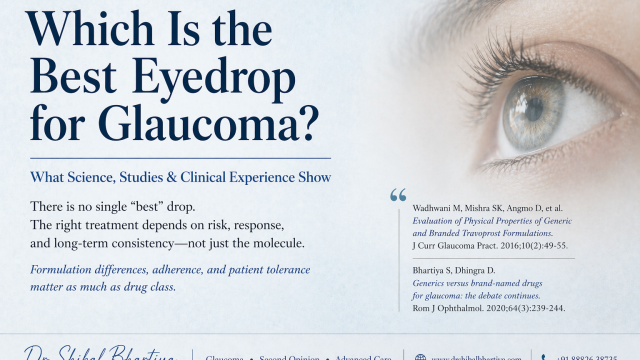
That said, prostaglandin analogs (like bimatoprost or travoprost) are usually the first-line and most effective starting choice, explains Dr Shibal Bhartiya. The best eyedrop for glaucoma depends on the patient, type of glaucoma, target pressure, and tolerance. This can often require combinations rather than one “best” option. Glaucoma treatment is individualised to achieve safe, long-term control rather than a one-size-fits-all solution.
Patients often ask: “Doctor, which is the best eyedrop for glaucoma?” The honest answer is: There is no single best drop. The best eyedrop for glaucoma is the one that safely achieves your target eye pressure with the least side effects, for your optic nerve.
Glaucoma treatment is personalised risk management, explains Dr Bhartiya.
Dr Shibal Bhartiya is a fellowship-trained glaucoma specialist and Mayo Clinic Research Collaborator with over 25 years of experience. Her approach focuses on identifying risk before damage is irreversible, simplifying treatment decisions, and protecting vision long-term. Emphasis on early detection, risk assessment, and continuity of care. She is rated 5 stars across 1,500+ patient reviews on Google.
The Goal of Treatment
We are not treating eye pressure alone. We are protecting the optic nerve.
Each patient has a target pressure, based on:
• Stage of damage
• Rate of progression
• Age
• Life expectancy
• Other health conditions
This is long-arc thinking, planning for vision preservation for the rest of your life.
Main Types of Glaucoma Eyedrops
1. Prostaglandin Analogues
Examples: Latanoprost, Travoprost, Bimatoprost
Advantages
• Strong pressure reduction
• Once daily dosage
• Good long-term control
Side Effects
• Redness
• Eyelash growth
• Darkening of iris/eyelid skin
Usually first-line therapy, because of once a day dosage, and also because these drops have NO systemic side effects.
2. Beta Blockers
Examples: Timolol, Betaxolol
Advantages
• Effective
• Affordable
Side Effects
• Asthma worsening, slow heart rate
• Loss of libido
• Fatigue, and depression
Not suitable in many older people, cardiac patients and those prone to depression. Less effective in those taking oral beta blockers for their blood pressure.
3. Carbonic Anhydrase Inhibitors
Examples: Dorzolamide, Brinzolamide
Advantages
• Useful as add-on
• Good in combination therapy
Side Effects
• Burning sensation
• Bitter taste
4. Alpha Agonists
Examples: Brimonidine
Advantages
• Moderate pressure reduction
Side Effects
• Allergy
• Sleepiness
• Dry mouth
Often not tolerated long term, as the allergy may develop over time.
5. Combination Drops
Two drugs in one bottle.
Examples include prostaglandin + beta blocker, or alpha agonist+ beta blocker, or carbonic anhydrase inhibitor + beta blocker, or carbonic anhydrase inhibitor + alpha agonist.
Useful when multiple medicines are needed. These improve compliance by decreasing the number of eyedrops, and are gentler on the eye because of decreased preservative load..
Which Is The Best Eyedrop for Glaucoma For YOU?
Depends on YOUR:
• Optic nerve risk
• Pressure level
• Other illnesses
• Cost considerations
• Lifestyle
• Side-effect tolerance
For many patients, affordability matters. But stopping drops due to irritation is also very common. So we balance efficacy and comfort. Each treatment protocol is designed for the individual patient, keeping all of these factors in mind. There is no one “best eyedrop for glaucoma”!
When Drops Are Not Enough
If pressure is still high, we consider:
• Laser treatment
• Minimally invasive glaucoma surgery
• Traditional surgery
Delaying escalation can cost vision. Early, calm decisions are better than emergency surgery.
Common Mistakes Patients Make
• Using drops irregularly, or not using them correctly
• Stopping when eye feels better
• Changing brands without advice
• Using expired drops
• Missing follow-up
Glaucoma drops work only with consistency. Think of them like insulin or blood pressure medicine. Please do NOT stop treatment because you are fine. You are fine BECAUSE you are taking your medication regularly. And the drops that keep your vision safe over time are the best eyedrops for glaucoma, for you.
Dry Eye and Glaucoma Drops
Many glaucoma drops worsen dry eye. Preservative-free options may help. This is especially important for those with pre-existing dry eye, multiple medications or digital strain.
We individualise treatment for better comfort, whenever required.
Generic vs Branded Eye Drops in Glaucoma
In glaucoma treatment, patients often ask whether branded or generic eye drops are better. The important point is that generic medicines contain the same active ingredient as branded drugs and are expected to work similarly.
However, glaucoma is a chronic disease where drops may be needed for life, so small differences can matter. Cost, comfort, side-effects, bottle design, and consistency of use all affect whether patients continue treatment regularly.
Generic drops are usually cheaper, which can improve long-term adherence. But some patients notice differences in bottle shape, drop size, preservatives, or irritation. These differences can affect comfort and sometimes the amount of medicine reaching the eye.
There is no single “best” eyedrop for glaucoma– only the best drop for a particular patient.
What matters most is:
• Achieving target eye pressure
• Using drops regularly and comfortably
• Monitoring the optic nerve over time
If a patient is stable on a medication, frequent switching between brands and generics is usually avoided unless medically necessary. In glaucoma care, consistency is more important than brand name.
For patients and clinicians alike, the question is not just “which drop works,” but “which formulation delivers consistent, reliable care over time.” Evidence from studies such as Evaluation of Physical Properties of Generic and Branded Travoprost Formulations which I worked on with my colleagues from AIIMS, New Delhi, highlights that even within the same molecule, differences in formulation can affect stability, bottle design, and drug delivery. In parallel, another of my articles in the Romanian Journal of Ophthalmology, Generics versus brand-named drugs for glaucoma: the debate continues, underscores that while generics improve affordability, variability in quality and patient experience remains a real-world consideration. Therefore, individual response, adherence, and consistency are just as important as the molecule itself.
Glaucoma Eye Drops During Pregnancy and Breastfeeding
Managing glaucoma during pregnancy requires balancing two important goals: protecting the mother’s optic nerve and protecting the baby.
There is no glaucoma eye drop proven completely safe in pregnancy, because strong human studies are limited. However, most drops used in normal doses result in only small systemic absorption, so treatment decisions are individualised.
General principles
• Avoid medications in the first trimester if possible
• Use the lowest effective dose
• Reduce absorption by closing the tear duct after drops
• Consider laser treatment when appropriate
Medication considerations
• Brimonidine is often considered relatively safer early in pregnancy, though avoided near delivery and during breastfeeding because of possible effects on newborns.
• Beta-blockers may be used cautiously later in pregnancy but can affect fetal heart rate or blood sugar.
• Prostaglandin analogues and carbonic anhydrase inhibitors are generally avoided early unless clearly necessary.
Because glaucoma is lifelong, sudden stopping of treatment without medical advice can risk permanent optic nerve damage.
What matters most
• Stable optic nerve
• Target eye pressure
• Safe pregnancy monitoring
Every case is individual. Decisions are best made jointly by the glaucoma specialist and obstetrician.
Our Treatment Philosophy
• Minimum number of drops that help achieve target pressure ( that is, effective drops)
• Long-term tolerability and comfort
• Monitoring optic nerve and visual fields, not just eye pressure
• Educating patients, and empowering them to share the decision making around their treatment protocols
Because glaucoma care is a partnership.
Clinical Reality (What’s not always obvious)
- There is no universal “best” drop for glaucoma—effectiveness varies by patient, optic nerve risk, and tolerance.
- A drop that lowers pressure well may still be insufficient if progression continues on OCT or visual fields.
- Side effects (redness, allergy, surface toxicity) often determine real-world success more than textbook efficacy.
- Many patients need combination therapy or laser (SLT) over time—starting with one drop doesn’t mean staying on one.
- Treatment choice is not about the strongest drug—it’s about the right balance of control, safety, and adherence over years,
What You Must Remember
| Option | What It Means for You |
|---|---|
| Prostaglandin analogs | First-line; strong pressure reduction, once daily |
| Beta blockers | Effective, but need caution with heart/lung conditions |
| Alpha agonists | Additional pressure lowering; may cause allergy/dryness |
| Carbonic anhydrase inhibitors | Often added when more control is needed |
| Combination drops | Fewer bottles, improved adherence, similar efficacy |
| Preservative-free options | Better for ocular surface comfort in long-term use |
| Laser (SLT) | Can reduce or replace drops in selected patients |
| When drops aren’t enough | Surgery may be needed for sustained control |
| What guides choice | Pressure target, optic nerve status, side effects, lifestyle |
| Big picture | “Best” drop = the one that keeps your optic nerve stable over time, not just lowers pressure once |
FAQs
1. Which is the best eye drop for glaucoma?
There is no single “best” eye drop. Prostaglandin analogs are usually first-line, but the right choice depends on individual response, target eye pressure, and tolerance.
2. Are all glaucoma eye drops equally effective?
No. Even within the same drug class, differences in formulation, preservatives, and delivery can affect effectiveness and patient comfort.
3. What is the safest glaucoma eye drop for long-term use?
Most modern glaucoma drops are safe long-term, but safety depends on ocular surface tolerance, systemic conditions, and adherence.
4. Can I switch between generic and branded glaucoma drops?
Yes, but consistency matters. Some patients experience variation in effect or comfort when switching, so monitoring is important.
5. How do glaucoma eye drops work?
They either reduce fluid production in the eye or improve its outflow, thereby lowering intraocular pressure.
6. How long do I need to use glaucoma drops?
Usually lifelong. Glaucoma is a chronic condition, and stopping drops can lead to silent progression.
7. What if one eye drop is not enough?
Combination therapy is common. Doctors often add or switch drops to achieve target pressure safely.
8. Do glaucoma drops have side effects?
Yes, ranging from mild irritation or redness to systemic effects depending on the drug class.
9. Are preservative-free drops better?
They may be better for patients with dry eye or long-term use, as they reduce ocular surface toxicity.
10. What matters more, the drug or how regularly I use it?
Consistency wins. Even the best drop won’t work if not used regularly and correctly.
Read the research articles
This article was written by Dr Shibal Bhartiya, fellowship-trained glaucoma specialist and Mayo Clinic Research Collaborator, Clinical Director at Marengo Asia Hospitals, Gurugram, known for ethical, patient-centred glaucoma care and independent glaucoma second opinions. She is also the Program Director for Community Outreach & Wellness; and for the Marengo Asia International Institute of Neuro and Spine.
She has published peer-reviewed research on glaucoma management, examining how treatment decisions should balance medical evidence, patient preferences, and long-term vision outcomes.
As Editor-in-Chief of Clinical and Experimental Vision and Eye Research and Executive Editor of the Journal of Current Glaucoma Practice (Pubmed Indexed, official journal of the International Society of Glaucoma Surgery), Dr Shibal Bhartiya brings editorial and research depth to every clinical decision. Her 200+ publications, including 90+ PubMed-indexed publications and 28 edited textbooks span glaucoma biology, surgical outcomes, health equity, and emerging diagnostics.
Access her work on Pubmed, Google Scholar, ResearchGate and ORCID.
Dr Shibal Bhartiya
Glaucoma • Second Opinion • Advanced Care
www.drshibalbhartiya.com
+91 88826 38735
1500+ Five Star Patient Reviews Google Business Profile
Upload your reports for a structured review.
If you are unable to come to Dr Bhartiya’s clinic: Read more about teleconsultation for glaucoma
Related Reading
Get an Online Glaucoma Consult
Visual Field and OCT: Structure & Function Correlation