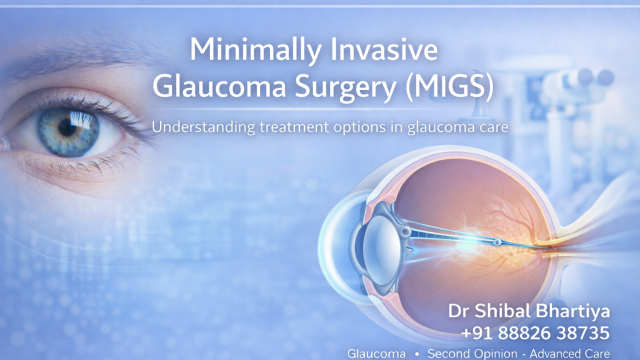
Minimally Invasive Glaucoma Surgery (MIGS) is a group of surgical procedures designed to lower intraocular pressure using small, precise techniques. Compared with traditional glaucoma surgery, MIGS typically offers faster recovery, fewer complications, and a lower surgical burden.
Glaucoma treatment often begins with eye drops or laser procedures. In some patients, surgery becomes necessary to control eye pressure and protect the optic nerve from further damage.
MIGS is not appropriate for every patient. It works best for carefully selected individuals, and the decision to proceed must always be based on disease severity, rate of progression, and the patient’s lifetime risk of vision loss.
Dr Shibal Bhartiya is a fellowship-trained glaucoma specialist and Mayo Clinic Research Collaborator with over 25 years of experience. Her approach focuses on identifying risk before damage is irreversible, simplifying treatment decisions, and protecting vision long-term. Emphasis on early detection, risk assessment, and continuity of care. She is rated 5 stars across 1,500+ patient reviews on Google.
What is MIGS?
Minimally Invasive Glaucoma Surgery (MIGS) refers to a group of surgical techniques that improve the natural drainage of fluid from the eye, helping to lower intraocular pressure.
These procedures typically involve:
• very small surgical openings
• minimal disruption of eye tissues
• shorter recovery times
• lower complication rates than traditional surgery
Many MIGS procedures are performed at the time of cataract surgery, although some can be done as standalone procedures.
Why eye pressure matters in glaucoma
Glaucoma damages the optic nerve, which carries visual information from the eye to the brain. The most important modifiable risk factor for glaucoma progression is intraocular or eye pressure.
When eye pressure remains elevated over time, it can gradually damage the optic nerve and lead to irreversible vision loss.
Lowering eye pressure is therefore the main goal of glaucoma treatment.
Treatment options may include:
• eye drops
• laser procedures
• minimally invasive glaucoma surgery (MIGS)
• traditional glaucoma surgery
The choice depends on the stage of glaucoma, the rate of progression,Why Glaucoma May Progress Despite Treatment and the patient’s individual risk factors.
Types of MIGS procedures
Types of MIGS procedures
Several MIGS techniques are currently used in clinical practice. They work by improving the eye’s natural fluid drainage pathways through different mechanisms.
Trabecular bypass procedures target the trabecular meshwork, the main drainage tissue of the eye. Devices such as the iStent and iStent inject create a small channel that bypasses this tissue, improving fluid outflow directly into Schlemm’s canal. These are among the most commonly used MIGS devices worldwide and are frequently combined with cataract surgery.
Schlemm’s canal procedures enlarge or dilate Schlemm’s canal itself to improve drainage. Ab interno canaloplasty (ABiC) and the Hydrus Microstent work through this mechanism. The Hydrus also scaffolds the canal open along a longer segment, which can give more sustained pressure reduction.
Angle-based cutting procedures remove or incise the trabecular meshwork directly. The Kahook Dual Blade (KDB) and gonioscopy-assisted transluminal trabeculotomy (GATT) fall into this category. These tend to offer greater pressure reduction than micro-stent procedures and are used when more aggressive IOP lowering is needed while still avoiding traditional surgery.
Subconjunctival and suprachoroidal procedures create alternative drainage pathways outside the conventional drainage system. The XEN gel stent, for example, creates a small channel from inside the eye to the subconjunctival space. These procedures sit at the boundary between MIGS and conventional filtering surgery in terms of both effect and risk.
Each technique reduces resistance to fluid outflow through a different route. The choice of procedure depends on the severity of glaucoma, the target pressure required, and whether the surgery is being combined with cataract removal.
Who may benefit from MIGS?
Now, the most important question: Is MIGS right for you?
MIGS procedures are most commonly recommended for patients who:
• have mild to moderate glaucoma
• require additional pressure reduction beyond eye drops
• are undergoing cataract surgery
• want to reduce the number of glaucoma medications
Because MIGS procedures are generally less aggressive than traditional glaucoma surgery, they are often used earlier in the disease course.
However, MIGS may not be appropriate for advanced or rapidly progressing glaucoma, where stronger pressure reduction may be required.
Advantages of MIGS
Minimally invasive glaucoma surgery offers several potential advantages:
• smaller surgical incisions
• faster visual recovery
• lower risk of serious complications
• the possibility of reducing glaucoma medications
• the ability to combine the procedure with cataract surgery
For carefully selected patients, MIGS can provide meaningful pressure reduction with relatively low surgical risk.
Limitations of MIGS
Although MIGS procedures can be helpful, they are not a cure for glaucoma.
Important limitations include:
• pressure reduction may be modest compared with traditional surgery
• some patients may still require eye drops after the procedure
• glaucoma monitoring remains necessary
• the procedure may not be sufficient for advanced disease
Glaucoma is a long-term condition, and surgical procedures must always be considered within the context of the patient’s lifetime risk of vision loss.
MIGS vs traditional glaucoma surgery
This is one of the most important questions a glaucoma patient can ask before agreeing to any procedure.
Trabeculectomy remains the gold standard for advanced glaucoma. It creates a new drainage opening in the eye wall, allowing fluid to drain under the conjunctiva. In experienced hands it can reduce eye pressure to very low levels — sometimes below 12 mmHg — making it the preferred option for patients with advanced disease or rapidly worsening visual fields. The trade-off is a longer recovery of four to six weeks, a higher complication rate, and the need for close post-operative monitoring.
Glaucoma drainage implants (such as the Ahmed valve or Baerveldt tube) are used when trabeculectomy has failed or is unlikely to succeed. They provide reliable long-term pressure control in complex cases but carry their own risks, including tube-related complications.
MIGS procedures offer more modest pressure reduction — typically in the range of 20 to 35 percent from baseline — but with significantly fewer complications, faster recovery of one to two weeks, and the ability to combine with cataract surgery in the same sitting. They are the right choice for patients with mild to moderate glaucoma who need pressure reduction beyond what drops can provide, but who do not yet need the aggressive lowering that trabeculectomy delivers.
The key principle is this: the treatment must match the disease. MIGS for a patient who needs a trabeculectomy is under-treatment. Trabeculectomy for a patient who would respond to MIGS is over-treatment. This is why an independent glaucoma assessment before surgery matters.
| MIGS | Trabeculectomy | Drainage Implant | |
|---|---|---|---|
| Typical IOP reduction | 20–35% | 40–60% | 30–50% |
| Recovery | 1–2 weeks | 4–6 weeks | 4–8 weeks |
| Best for | Mild–moderate glaucoma | Advanced glaucoma | Complex / refractory cases |
| Combined with cataract | Yes, commonly | Rarely | No |
| Complication profile | Low | Moderate–high | Moderate–high |
The importance of long-term follow-up
Even after MIGS, glaucoma does not disappear. Patients must continue regular monitoring to ensure that eye pressure remains controlled and the optic nerve remains stable.
Follow-up visits may include:
• eye pressure measurement
• optic nerve evaluation
• visual field testing
• retinal imaging
Long-term monitoring helps detect any changes early and adjust treatment when necessary.
When patients seek a second opinion
Because glaucoma surgery decisions can affect long-term vision, some patients choose to seek an independent second opinion before proceeding with surgery.
A second opinion may help clarify:
• whether MIGS is appropriate
• whether alternative treatments are available
• what level of pressure reduction is required to protect vision
Clear communication and careful decision-making are important parts of responsible glaucoma care.
Key takeaways
• MIGS refers to minimally invasive glaucoma surgeries designed to lower eye pressure
• these procedures use small surgical techniques with faster recovery
• MIGS is most often used in mild to moderate glaucoma
• the procedure may reduce medication burden in some patients
• glaucoma still requires lifelong monitoring after surgery
Frequently asked questions about MIGS
What does MIGS stand for?
MIGS stands for Minimally Invasive Glaucoma Surgery. It refers to a group of surgical procedures that lower eye pressure using small, precise techniques with lower risk and faster recovery than traditional glaucoma surgery.
Who is a good candidate for MIGS?
MIGS is most appropriate for patients with mild to moderate glaucoma who need additional pressure reduction beyond eye drops, or who are already having cataract surgery and want to address glaucoma at the same time. It is generally not sufficient for advanced or rapidly progressing glaucoma.
Can MIGS replace eye drops?
In some patients, MIGS can reduce the number of drops required or eliminate them entirely. This depends on the procedure chosen, the pressure achieved after surgery, and the individual patient’s target IOP. Many patients still require at least one medication after MIGS.
Is MIGS combined with cataract surgery?
Yes. Many MIGS procedures are performed at the time of cataract surgery. This is one of the practical advantages of MIGS, patients can address both conditions under one anaesthetic with one recovery period.
How does MIGS compare to trabeculectomy?
MIGS offers lower pressure reduction than trabeculectomy, but with fewer complications and faster recovery. Trabeculectomy remains the better choice for advanced glaucoma where very low pressures are required. MIGS is appropriate for earlier-stage disease.
Should I get a second opinion before MIGS surgery?
Yes, if you have any doubt about whether surgery is necessary, whether the right procedure has been chosen, or whether your glaucoma truly needs surgical intervention at this stage. A second opinion from an independent glaucoma specialist gives you a clearer picture before you commit to any procedure.
How long does MIGS last?
Results vary by procedure and by patient. Some patients maintain good pressure control for many years. Others see pressure creep back up over time and require additional treatment. Regular follow-up after MIGS is essential, glaucoma does not stop requiring monitoring after surgery.
About the author
This article was written by Dr Shibal Bhartiya, fellowship-trained glaucoma specialist and Mayo Clinic Research Collaborator, Clinical Director at Marengo Asia Hospitals, Gurugram, known for ethical, patient-centred glaucoma care and independent glaucoma second opinions. She is also the Program Director for Community Outreach & Wellness; and for the Marengo Asia International Institute of Neuro and Spine. This article was updated in April 2026.
She has published peer-reviewed research on glaucoma management, examining how treatment decisions should balance medical evidence, patient preferences, and long-term vision outcomes.
Her published work on MIGS includes:
Minimally Invasive Glaucoma Surgery: A Review of the Clinical Evidence — a systematic review of outcomes across MIGS device categories. Available on PubMed.
Patient Selection for MIGS: Balancing Evidence and Expectation — examines how to match procedure choice to disease severity and long-term risk. Available on PubMed.
Emerging MIGS Technologies: Where the Evidence Stands — evaluates newer devices and techniques entering clinical practice. Available on PubMed.
MIGS and the Ethics of Surgical Decision-Making in Glaucoma — addresses how surgeons should communicate risk, benefit, and uncertainty to patients facing a surgery decision. Available on PubMed.
As Editor-in-Chief of Clinical and Experimental Vision and Eye Research and Executive Editor of the Journal of Current Glaucoma Practice (Pubmed Indexed, official journal of the International Society of Glaucoma Surgery), Dr Shibal Bhartiya brings editorial and research depth to every clinical decision. Her 200+ publications, including 90+ PubMed-indexed publications and 28 edited textbooks span glaucoma biology, surgical outcomes, health equity, and emerging diagnostics.
Access her work on Pubmed, Google Scholar, ResearchGate and ORCID.
Dr Shibal Bhartiya
Glaucoma • Second Opinion • Advanced Care
www.drshibalbhartiya.com
+91 88826 38735
1500+ Five Star Patient Reviews Google Business Profile
Upload your reports for a structured review.
If you are unable to come to Dr Bhartiya’s clinic: Read more about teleconsultation for glaucoma