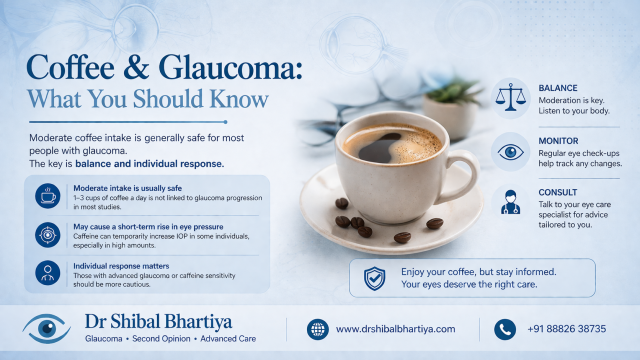
Quick Answer: Yes, one to two cups of coffee a day is unlikely to harm most people with glaucoma. Heavier intake, exfoliation glaucoma or a family history of glaucoma call for a talk with your specialist.
Coffee is the habit glaucoma patients ask me about most. Many fear their morning cup is quietly raising their eye pressure. The answer sits between “no problem” and “stop completely.” Here is what the research shows.
Last updated: 31 October 2026
Does Coffee Raise Eye Pressure?
Caffeine raises intraocular pressure (IOP) a little. The rise appears within an hour or two and settles within a few hours.
For someone with well-controlled pressure, that small bump is unlikely to matter. It matters more if your pressure already sits near the top of your target range. It also matters if you sip coffee all day, which keeps caffeine levels up.
Response varies from person to person. Research cannot yet predict who responds more. Your own pressure checks are the best guide.
Does Coffee Cause or Worsen Glaucoma?
Two large US cohorts, the Nurses’ Health Study and the Health Professionals Follow-up Study, followed about 120,000 adults for decades. They gave us most of what we know. The studies are observational, so they show associations, not proof.
Open-Angle Glaucoma
Overall caffeine intake showed no link with primary open-angle glaucoma. In the heaviest group, five or more cups of caffeinated coffee a day, risk looked about 60 percent higher. That result was borderline. The link was stronger in people with a family history of glaucoma.
The authors said chance could explain this finding. They called for more study.
Exfoliation Glaucoma
People who drank three or more cups of caffeinated coffee a day had a higher risk of exfoliation glaucoma or glaucoma suspect. The rate ratio was 1.66 against people who drank none. Women with a family history of glaucoma showed the strongest signal.
Researchers found no link with tea, caffeinated soda or decaf coffee. They do not know why.
How Much Coffee Is Too Much?
| Your situation | What studies suggest | What I suggest |
|---|---|---|
| Up to two cups, controlled glaucoma | No clear harm | Enjoy it, and keep to your routine |
| Three or four cups a day | Higher exfoliation glaucoma risk in one large study | Discuss with your specialist |
| Five or more cups a day | Borderline higher open-angle risk in one study | Cut down and review your pressure |
| Exfoliation glaucoma | Strongest signal in the research | Stay below three cups a day |
| Family history, pressure near target | Signal stronger in family-history groups | Keep to two cups or fewer and review |
Is Decaf, Tea or Cola Safer?
Decaf, tea and caffeinated soda showed no link with exfoliation glaucoma in the large study. Decaf is a low-risk step if you want less caffeine and still want the ritual.
Tea and cola contain caffeine, so they can also nudge pressure up briefly. A cup usually holds less caffeine than a cup of coffee. Energy drinks combine high caffeine with other stimulants. I advise patients to avoid them.
What Doctors Often Miss
- Timing before your pressure check matters. Coffee shortly before your visit may push your reading up slightly. Keep your usual routine and tell your doctor when you had your last cup.
- Gulping large volumes of any fluid raises IOP. The water drinking test uses this effect with a litre drunk within minutes. Sip your drinks.
- Exfoliation glaucoma is easy to miss. Flaky white material on the lens may show only on a dilated exam. Ask whether you have it.
- Family history changes the picture. The coffee signal was stronger in people with a family history of glaucoma. Tell your doctor if a parent or sibling has glaucoma.
- Cutting coffee never replaces your drops. Some patients cut caffeine, then stretch or skip their medicines. Never do that. Coffee’s effect on pressure is small next to the effect of treatment.
When to See a Doctor
See a Doctor Urgently
Coffee does not cause these, but they need same-day eye care:
- Severe eye pain, especially with headache, nausea or vomiting
- Sudden blurred vision or coloured haloes around lights with eye pain
- Sudden loss of vision
- A new shadow or missing patch in your vision
See a Doctor
Book a routine visit if:
- You drink three or more cups a day and have exfoliation glaucoma or a family history
- Your pressure sits near target or keeps creeping up
- You do not know which type of glaucoma you have
- You get repeated eye ache or headache after coffee
- You want to change your caffeine intake and need a plan
What This Means for You
If your glaucoma is controlled and you have no exfoliation or family history, one or two cups is fine. If you drink three or more, or either risk applies, ask your specialist. You do not need to give up coffee. You need numbers that fit your eyes.
Frequently Asked Questions
Does coffee cause glaucoma?
Large studies have not shown that moderate coffee causes glaucoma. Heavy intake showed a borderline link with open-angle glaucoma. Three or more cups a day showed a link with exfoliation glaucoma. These are associations, not proof of cause.
How much does coffee raise eye pressure?
Caffeine raises IOP slightly for a few hours. The rise is small in most people. Your baseline pressure and how often you drink coffee both shape the effect.
Should I give up coffee if I have glaucoma?
Not usually. One to two cups is unlikely to harm most patients with controlled disease. If you have exfoliation glaucoma, a family history or pressure near target, discuss your intake with me.
Are decaf coffee and tea safe with glaucoma?
Decaf showed no link with exfoliation glaucoma in the large study, and tea did not either. Both are reasonable choices. Tea still contains some caffeine, so it can raise pressure briefly.
Can I drink coffee before my eye pressure check?
Keep your usual routine so your reading reflects your normal pattern. Tell your doctor when you had your last cup. Your specialist may occasionally ask you to hold caffeine before a specific measurement.
Research Behind This Page
- Kang JH, Willett WC, Rosner BA, Hankinson SE, Pasquale LR. Caffeine consumption and the risk of primary open-angle glaucoma. Invest Ophthalmol Vis Sci 2008;49(5):1924-31. PMID 18263806
- Pasquale LR, Wiggs JL, Willett WC, Kang JH. Caffeine and coffee consumption and exfoliation glaucoma or glaucoma suspect. Invest Ophthalmol Vis Sci 2012;53(10):6427-33. PMID 22918628
- Dada T, Bhartiya S. Lifestyle Medicine for Glaucoma. J Curr Glaucoma Pract 2026;20(2):39-42. PMID 42582284
Speak to a Specialist
Wondering how your coffee habit fits your glaucoma? Discuss your intake and pressure records with SB. Lifestyle questions in glaucoma, coffee, sleep, exercise, supplements, deserve the same careful, evidence-based answer as medication questions. If you are managing glaucoma and want to understand how your daily habits interact with your treatment, that conversation is a legitimate and important part of your care.
Book an Appointment:
📍 Gurgaon 📞 +91 88826 38735 | 🌐 Contact Us | Second Opinion Form for teleconsults
Upload your latest IOP records and investigation reports through the website before your appointment.
Caption (35 words): Dr Shibal Bhartiya talks through coffee, caffeine and eye pressure with glaucoma patients at her clinic in Gurgaon, helping each person find a daily habit that fits their glaucoma type, family history and pressure targets.
Alt text: Dr Shibal Bhartiya, coffee and glaucoma advice, glaucoma specialist Gurgaonlaucoma, this is worth a specific discussion with your glaucoma specialist.
This page is a part of the Glaucoma Hub. You may want to read about Glaucoma Progression, and Risk Stratification in Glaucoma. You may want to read more about OCT and Visual Field, Glaucoma Tests Explained, Normal OCT but Vision Symptoms and How to Understand Your OCT Better. Also of help could be Why Do I Need a Visual Field Test? Glaucoma Diagnosis in Gurgaon, Get a Glaucoma Second Opinion in Gurgaon and Get an Online Glaucoma Consult.
Speak to a Specialist
Lifestyle questions in glaucoma, coffee, sleep, exercise, supplements, deserve the same careful, evidence-based answer as medication questions. If you are managing glaucoma and want to understand how your daily habits interact with your treatment, that conversation is a legitimate and important part of your care.
Book a consultation: +91 88826 38735 | www.drshibalbhartiya.com
Upload your latest IOP records and investigation reports through the website before your appointment.
About the Author
This article was written by Dr Shibal Bhartiya, fellowship-trained glaucoma specialist and Mayo Clinic Research Collaborator, Clinical Director at Marengo Asia Hospitals, Gurugram, known for ethical, patient-centred glaucoma care and independent glaucoma second opinions. She is also the Program Director for Community Outreach & Wellness; and for the Marengo Asia International Institute of Neuro and Spine.
Dr Bhartiya has published peer-reviewed research onglaucoma management, examining how treatment decisions should balance medical evidence, patient preferences, and long-term vision outcomes. She is also a committed patient advocate and mainstream medical columnist, translating complex ophthalmic evidence into actionable public health insights across leading national platforms including NDTV and OnlyMyHealth
As Editor-in-Chief of Clinical and Experimental Vision and Eye Research and Executive Editor of the Journal of Current Glaucoma Practice (Pubmed Indexed, official journal of the International Society of Glaucoma Surgery). Her 200+ publications, including 90+ PubMed-indexed publications and 28 edited textbooks span glaucoma biology, surgical outcomes, health equity, and emerging diagnostics.
1700+ Five Star Patient Reviews Google Business Profile
If you are unable to come to Dr Bhartiya’s clinic: Read more about teleconsultation
Read her research on PubMed | Google Scholar | ResearchGate | ORCID | Github | Wikidata
📋Upload your reports for a structured review.| 🌐 Contact Us| 📞 +91 88826 38735
⭐ Helped by this article? Leave a Google review — it helps other patients find reliable eye care.
Last Reviewed: October 31, 2026