Two patients. Same diagnosis. Similar eye pressure. Same drops. One is stable at ten years. The other has lost significant…
Tag: glaucoma risk assessment Gurgaon
Glaucoma Care in Gurgaon
Glaucoma is the leading cause of irreversible blindness worldwide. It is a progressive optic nerve disease that can silently damage vision much before symptoms become obvious. Early diagnosis, OCT imaging, visual field testing, and long-term monitoring are essential to reducing the risk of irreversible vision loss.
Superspecialty glaucoma care means catching that damage early, tracking it precisely, and making treatment decisions that are built around your individual risk, not a standard protocol.
Dr Shibal Bhartiya is a fellowship-trained glaucoma specialist and Mayo Clinic Research Collaborator with over 25 years of experience. Her approach focuses on identifying risk before damage is irreversible, simplifying treatment decisions, and protecting vision long-term. Emphasis on early detection, risk assessment, and continuity of care. She is rated 5 stars across 1,500+ patient reviews on Google
Glaucoma Care in Gurgaon: Diagnosis, Treatment, and Second Opinions
Most people who arrive at a glaucoma consultation did not expect to be there.
Perhaps a routine eye check flagged your optic nerve. Maybe a parent lost vision to glaucoma and you want to know your own risk. Perhaps you have been on drops for years and something still doesn’t feel right. Whatever brought you here, you are asking the right question at the right time, because in glaucoma, timing is everything.
The nerve fibres that glaucoma destroys do not regenerate. Vision lost to this disease does not return. But vision that has not yet been lost can almost always be protected, if the disease is identified accurately, monitored carefully, and managed by a specialist with the training to interpret what the tests are actually showing.
This is what superspecialty glaucoma care means in practice.
What Glaucoma Actually Is
Glaucoma is not a single disease. It is a family of conditions that share one defining feature: progressive damage to the optic nerve, the cable that carries visual information from your eye to your brain.
In most forms of glaucoma, elevated intraocular pressure — the fluid pressure inside the eye — is the primary driver of that damage. But pressure is not the whole story. Roughly a third of glaucoma patients have pressures that fall within the normal range. In these patients, the nerve is vulnerable for reasons that go beyond simple mechanics — vascular supply, structural anatomy, and systemic factors all play a role.
This is why glaucoma cannot be managed by pressure alone. It requires a trained eye on the nerve itself.
The most common forms of glaucoma
Primary open-angle glaucoma is the most prevalent form globally and in India. It develops slowly, painlessly, and without warning. By the time peripheral vision is affected, significant nerve damage has usually already occurred.
Normal tension glaucoma is systematically underdiagnosed in India. Patients with pressures in the normal range are often reassured and discharged — while damage continues. Identifying this condition requires looking beyond the pressure reading.
Angle-closure glaucoma is more common in Asian populations. It can present as a sudden, painful emergency — or develop slowly and silently in the chronic form. A detailed anterior segment assessment is essential to detect the anatomical risk before a crisis occurs.
Childhood and secondary glaucomas require specialist evaluation. Secondary glaucomas — arising from inflammation, steroid use, trauma, or systemic conditions — are frequently missed or mismanaged without subspecialty input.
Why Superspecialty Training Changes Outcomes
A general ophthalmologist is trained to detect glaucoma and initiate treatment. A fellowship-trained glaucoma subspecialist is trained to do something more precise: to distinguish true progression from test variability, to select the right intervention at the right disease stage, and to manage the full complexity of a condition that evolves over decades.
The difference becomes most visible in three situations.
When the diagnosis is uncertain. Glaucoma suspects — patients with suspicious optic nerves or borderline pressures who do not yet meet diagnostic criteria — require careful longitudinal monitoring. The decision of when to treat, and how aggressively, requires experienced clinical judgement.
When progression occurs despite treatment. Patients who worsen on drops are not simply non-compliant. They may have nocturnal pressure spikes, inadequate pressure targets, or structural vulnerability that requires a different therapeutic approach entirely.
When surgery is on the table. The glaucoma surgical landscape has changed significantly with the advent of MIGS — minimally invasive glaucoma surgery. Knowing when MIGS is appropriate, which device fits which patient, and when conventional filtration surgery remains the better option requires a surgeon who operates across the full spectrum.
What to Expect at This Practice
My approach to glaucoma care is built around four principles.
Catch it before it matters. Early detection requires looking beyond the standard pressure check — at the optic nerve structure, the retinal nerve fibre layer on OCT, and the visual field pattern over time. I look for the signal before the symptom.
Track it with precision. A single test is a photograph. Glaucoma management requires a series of photographs — read by someone who understands what change looks like, and what normal variation looks like. I review trends, not snapshots.
Treat it at the right stage. Not every glaucoma patient needs surgery. Not every glaucoma patient can be managed on drops alone. The treatment plan is built around your disease stage, your lifestyle, your pressure target, and your individual risk of progression.
Protect the ocular surface. Long-term glaucoma drops affect the surface of the eye in a significant proportion of patients. Ocular surface disease reduces comfort, affects adherence, and is frequently undertreated. I address it as part of glaucoma management — not as a separate problem.
Glaucoma Care Covered in This Practice
Diagnosis and Detection
- Early Glaucoma Symptoms: The Definitive Guide
- Can Routine Eye Tests Miss Glaucoma?
- Glaucoma Symptoms — A Silent Disease
- Glaucoma Test Results Explained: OCT, Visual Fields and Eye Pressure
- OCT and Visual Field
- Visual Field Explained
- Do I Really Need All These Eye Tests?
- First Glaucoma Review: What Do I Look For
- Glaucoma Diagnosis in Gurgaon
- Family History & Glaucoma Screening
- Glaucoma in India: Why the Risk Is Higher Than You Think
- Normal Tension Glaucoma
- Open Angle Glaucoma: Symptoms, Diagnosis and Treatment
- Understanding Glaucoma
- Glaucoma and Blindness: Risk and Prevention
- Can You Have Glaucoma With Normal Eye Pressure?
- Clinical Evaluation of Optic Nerve Head in Glaucoma
- Comprehensive Eye Exam
- Do Glaucoma Patients Go Blind?
- Early Detection of Glaucoma
- Family History? Screen Before Symptoms
- Glaucoma: Are You at Risk?
- Glaucoma: Risk Factors
- Gonioscopy
- How Is Optic Nerve Damage Diagnosed Early?
- Is Glaucoma Hereditary?
- Narrow Angle Glaucoma
- OCT Scan Explained
- Ocular Hypertension — High Eye Pressure
- Scanning Laser Polarimetry in Glaucoma
- Symptoms of Glaucoma
- What Are the Symptoms of Glaucoma?
- Why Do I Need a Visual Field Test?
- Your Visual Field Test Results Explained
- Glaucoma Patients Don’t Notice Vision Loss — coming soon
- Glaucoma Visual Symptoms in Real Life — coming soon
- Why Even Intelligent, Health-Conscious People Miss Early Glaucoma? — coming soon
- Common Myths About Glaucoma — coming soon
- Common Myths About Eye Pressure — coming soon
Medical Management
- Prostaglandin Eye Drops for Glaucoma
- Best Eyedrop for Glaucoma
- How to Reduce Glaucoma Eye Drops
- More Glaucoma Eye Drops is Not Better Glaucoma Care
- 5 Mistakes Patients Make in Glaucoma Care
- Do You Really Need Treatment for Glaucoma?
- Risk Stratification in Glaucoma
- Glaucoma and Sleep Apnoea
- Steroid Induced Glaucoma
- Can I Drive at Night with Glaucoma?
- Can Stress Increase Eye Pressure?
- Complementary and Alternate Management of Glaucoma
- Exercise, Yoga, Weightlifting, and Eye Pressure
- Eye Drops During Pregnancy and Lactation: Glaucoma
- Eye Pressure Test in Glaucoma
- Eye Pressure Variations
- Eye Pressure: Why and How
- Generic versus Branded Medications in Glaucoma
- Glaucoma and Blood Pressure
- Glaucoma and Depression
- Glaucoma and Diabetes
- Glaucoma and Diet
- Glaucoma and Ocular Blood Flow
- Glaucoma Eye Drops: The Complete Guide
- Laser or Eye Drops for Glaucoma
- Managing Glaucoma Eye Drop Side Effects
- Marijuana for Glaucoma Treatment
- Musical Instruments and Glaucoma
- New Bimatoprost Implant
- Rhopressa
- Should I Start Glaucoma Eyedrops?
- Side Effects of Glaucoma Eye Drops
- Target Eye Pressure in Glaucoma
- Using Eye Drops: Tips and Tricks
- What Eye Pressure Is Dangerous?
- What Is Target IOP?
- Which Is the Best Eyedrop for Glaucoma?
- Why Do I Need So Many Glaucoma Eye Drops?
- Yoga and Glaucoma
- Glaucoma and Dry Eye
- Glaucoma and Musical Instruments
- Coffee and Glaucoma — coming soon
- Flying with Glaucoma — coming soon
- My Glaucoma Eye Drop Is Darkening My Skin — coming soon
- My Glaucoma Eye Drops Are Not Working — coming soon
- Optic Nerve Cupping — coming soon
- Why Follow-Up Matters Even When Glaucoma Feels Stable — coming soon
Monitoring and Progression
- Are Your Eye Tests Being Interpreted Together? — coming soon
- When Glaucoma Keeps Progressing
- Why Glaucoma Gets Worse Faster in Some People Than Others
- What Happens If Glaucoma Is Left Untreated?
- Glaucoma and Blindness: Risk and Prevention
- Can Glaucoma Be Cured?
- Do Screens Worsen Glaucoma?
- Glaucoma: Why Early, Consistent Care Matters
- Is My Glaucoma Getting Worse?
- Understanding Glaucoma Progression: Stability vs Change
- Why Glaucoma May Progress Despite Treatment
- Will Glaucoma Make Me Blind?
- Visual Field Test: What to Expect — coming soon
- Glaucoma Patients Don’t Notice Vision Loss — coming soon
Surgery
- Glaucoma Surgery in Gurgaon
- Glaucoma Treatment in Gurgaon
- Cataract in Glaucoma Patients
- Cataract Surgery Does Not Protect You From Glaucoma
- Glaucoma Laser: Understanding LPI and SLT
- Indications for Glaucoma Surgery
- MIGS: Minimally Invasive Glaucoma Surgery
- When I Recommend Glaucoma Surgery & When I Don’t
Local and General
- Glaucoma Care in Gurgaon
- Glaucoma Specialist in Gurgaon
- Best Glaucoma Specialist in Gurgaon: How to choose?
- Advanced Glaucoma Care in Gurgaon
- Selected Work in Glaucoma
- Glaucoma FAQs
- Quality of Life Concerns
- Online Glaucoma Consultation
- Ethical Glaucoma Care
- Glaucoma Second Opinion — Gurgaon
- What Good Glaucoma Care Actually Optimises For
When to Come In
Book a superspecialty consultation if any of the following apply:
- You have been told your optic nerve looks “suspicious” or “cupped”
- You have a parent or sibling with glaucoma
- You are on glaucoma drops and have never had a formal progression assessment
- Your visual fields are worsening despite treatment
- You have been recommended surgery and want a second opinion
- You have high myopia — a significant independent risk factor for glaucoma
- You use steroid drops, inhalers, or nasal sprays regularly
Glaucoma does not announce itself. By the time you notice something is wrong, the window for easy intervention may already be narrowing. Early assessment costs very little. Late diagnosis costs vision.
Frequently Asked Questions
What is the difference between a glaucoma specialist and a general eye doctor?
A glaucoma specialist has completed a dedicated fellowship — one to two years of focused training in glaucoma diagnosis, medical management, laser, and surgery — beyond standard ophthalmology residency. This training matters most in uncertain diagnoses, complex progression, and surgical planning.
How often should I have my eyes checked if I have glaucoma?
Most patients with established glaucoma require review every three to six months, including IOP measurement, OCT, and periodic visual field testing. The exact frequency depends on your disease stage, stability, and treatment response. Suspects require annual or biannual monitoring.
Can glaucoma be cured?
Glaucoma cannot currently be cured — but in the vast majority of patients, it can be controlled well enough to preserve functional vision for life. The key is early detection, accurate monitoring, and treatment that is adjusted as the disease evolves.
Is glaucoma hereditary?
Yes. First-degree relatives of glaucoma patients have a four to nine times higher risk of developing the condition. Screening siblings and adult children of affected patients is one of the most cost-effective interventions in glaucoma prevention.
What is MIGS and am I a candidate?
MIGS — minimally invasive glaucoma surgery — is a family of procedures designed to lower eye pressure with a safer profile than traditional filtration surgery. It is most appropriate for mild to moderate glaucoma. Not every patient is a candidate; appropriate selection requires subspecialty assessment.
You may want to listen to Dr Bhartiya answer some frequently asked questions here.
About the Author
This article was written by Dr Shibal Bhartiya, fellowship-trained glaucoma specialist and Mayo Clinic Research Collaborator, Clinical Director at Marengo Asia Hospitals, Gurugram, known for ethical, patient-centred glaucoma care and independent glaucoma second opinions. She is also the Program Director for Community Outreach & Wellness; and for the Marengo Asia International Institute of Neuro and Spine.
She has published peer-reviewed research on glaucoma management, examining how treatment decisions should balance medical evidence, patient preferences, and long-term vision outcomes.
As Editor-in-Chief of Clinical and Experimental Vision and Eye Research and Executive Editor of the Journal of Current Glaucoma Practice (Pubmed Indexed, official journal of the International Society of Glaucoma Surgery), Dr Shibal Bhartiya brings editorial and research depth to every clinical decision. Her 200+ publications, including 90+ PubMed-indexed publications and 28 edited textbooks span glaucoma biology, surgical outcomes, health equity, and emerging diagnostics.
1500+ Five Star Patient Reviews Google Business Profile
If you are unable to come to Dr Bhartiya’s clinic: Read more about teleconsultation for glaucoma
Read her research on PubMed | Google Scholar | ResearchGate | ORCID
Upload your reports for a structured review.| www.drshibalbhartiya.com | +91 88826 38735
Leave a review on Google
Here are some patient stories
Glaucoma Care in Gurgaon
Dr Shibal Bhartiya provides glaucoma care in Gurgaon, focusing on early detection, risk stratification, and long-term management of glaucoma to prevent irreversible vision loss. Care typically includes detailed optic nerve evaluation, OCT and visual fields, and personalised treatment plans tailored to disease stage and progression risk.
Early detection. Risk-based care. Long-term vision protection. Glaucoma often develops silently, but the risk can be identified early with the right tests and careful interpretation, before vision loss becomes irreversible. Dr Shibal Bhartiya, fellowship-trained glaucoma specialist in Gurgaon, brings together evidence-based insights on screening, risk stratification, and long-term care to help protect vision over time.
Glaucoma is a silent, progressive disease. Vision loss often occurs gradually and cannot be reversed. The goal of care is not just lowering eye pressure, but protecting the optic nerve safely over time.
If you are looking for a glaucoma specialist in Gurgaon, treatment decisions should be based on risk, progression, and long-term safety, not just the number of medications.
Dr Shibal Bhartiya is a fellowship-trained glaucoma specialist and Mayo Clinic Research Collaborator with over 25 years of experience. Her approach focuses on identifying risk before damage is irreversible, simplifying treatment decisions, and protecting vision long-term. Emphasis on early detection, risk assessment, and continuity of care. She is rated 5 stars across 1,500+ patient reviews on Google.
🧠 A Different Approach to Glaucoma Care
Glaucoma is often managed reactively, pressure rises, more drops are added. But glaucoma is a long-arc disease.
Effective care focuses on:
- Early detection before irreversible damage
- Risk stratification, not one-size-fits-all treatment
- Judicious use of medications
- Minimising side effects and treatment burden
- Long-term stability, not short-term numbers
This is not about doing more. It is about doing what is right, at the right time.
🔎 Start Here: Understanding Your Glaucoma
If you are trying to understand your diagnosis or treatment, these guides will help:
- Learn why more glaucoma eye drops are not always better and when simplifying treatment may be safer
→ https://drshibalbhartiya.com/more-glaucoma-eye-drops-not-better-care/ - Understand when to seek a glaucoma second opinion if your treatment feels unclear or complex
→ https://drshibalbhartiya.com/glaucoma-second-opinion-gurgaon/ - Recognise the early symptoms of glaucoma people often miss
→ https://drshibalbhartiya.com/glaucoma-early-symptoms/ - See how family history increases glaucoma risk and why screening matters
→ https://drshibalbhartiya.com/family-history-glaucoma-screening/ - Understand how OCT and visual fields track glaucoma progression over time
→ https://drshibalbhartiya.com/oct-visual-field-interpretation/
⚠️ When Should You Be Concerned?
You should consider evaluation if you have:
- Family history of glaucoma
- Increasing number of eye drops
- Redness, irritation, or intolerance to medications
- “Normal” eye pressure but worsening reports
- Difficulty understanding your treatment plan
Glaucoma often progresses silently. Waiting for symptoms can delay care.
If this sounds familiar, it may be time to consider a glaucoma second opinion:
https://drshibalbhartiya.com/glaucoma-second-opinion-gurgaon/
🧪 How Glaucoma Is Evaluated
Accurate glaucoma care requires more than a pressure check.
Assessment includes:
- Optic nerve evaluation
- OCT (optic nerve imaging)
- Visual field testing
- Corneal thickness
- Risk profiling over time
Understanding glaucoma progression through OCT and visual field analysis is key to making safe treatment decisions.
💊 Treatment Is Not Just About Eye Drops
Treatment options may include:
Adding more medications is not always the safest approach.
In many cases, treatment strategy matters more than the number of drops used:
https://drshibalbhartiya.com/more-glaucoma-eye-drops-not-better-care/
Managing side effects of glaucoma drops
🔁 Long-Term Care Matters
Glaucoma requires:
- Regular follow-up
- Consistent monitoring
- Adjustment based on progression
The goal is:
- Stable vision
- Minimal side effects
- Sustainable treatment
👁️ Not Sure Where You Stand?
If:
- you are on multiple eye drops
- your reports are difficult to interpret
- or your condition seems to be progressing
A structured evaluation can help simplify your treatment.
👉 Request a glaucoma second opinion:
https://drshibalbhartiya.com/glaucoma-second-opinion-gurgaon/
Clinical Reality (What’s not always obvious)
- Good glaucoma care is not a one-time consultation—it’s longitudinal monitoring of glaucoma over years.
- A “normal” eye pressure does not guarantee safety—progression can occur despite seemingly controlled numbers.
- Technology (OCT, visual fields) supports care, but clinical judgement and pattern recognition over time are what prevent vision loss.
- Over-treatment (too many drops) and under-treatment (delayed escalation) are both risks—balance is key.
- The quality of follow-up and consistency of care often matter more than any single test or visit.
What you Must Remember
| Aspect | What It Means for You |
|---|---|
| Core goal | Preserve vision long-term by slowing disease progression |
| Key evaluations | Optic nerve exam, OCT, visual fields, eye pressure |
| Treatment options | Eye drops, laser (SLT), surgery if needed |
| Follow-up importance | Regular monitoring detects early progression |
| Personalisation | Care tailored to risk, lifestyle, and response |
| When to seek specialist care | Uncertain diagnosis, progression, second opinion |
| Role of technology | Supports early detection and tracking |
| Systemic factors | Sleep, blood pressure, health influence outcomes |
| Patient role | Adherence to treatment and follow-up is critical |
| Big picture | Glaucoma care is ongoing risk management, not a one-time fix |
FAQs About Glaucoma Care in Gurgaon
When should I see a glaucoma specialist in Gurgaon?
You should see a glaucoma specialist if you have a family history of glaucoma, are on an increasing number of eye drops, experience redness or irritation from your medications, have been told your eye pressure is normal but your reports are worsening, or find your current treatment plan difficult to understand. Glaucoma often progresses silently. Waiting for symptoms can delay care and lead to irreversible vision loss.
What tests are done in a glaucoma evaluation?
A comprehensive glaucoma evaluation includes optic nerve examination, OCT imaging of the optic nerve and retinal nerve fibre layer, visual field testing, corneal thickness measurement, and risk profiling over time. A pressure check alone is not sufficient to evaluate or manage glaucoma safely. Each of these tests contributes a different piece of information about disease risk and progression.
What is a glaucoma second opinion and when is it needed?
A glaucoma second opinion is a structured, independent review of your diagnosis and treatment plan. It is useful when you are on multiple eye drops, when your condition seems to be progressing despite treatment, when reports are difficult to interpret, or when your treatment plan feels unclear. Dr Shibal Bhartiya offers dedicated glaucoma second opinion consultations in Gurgaon, with a focus on simplifying decisions and protecting vision long-term.
Is adding more eye drops always the right treatment for glaucoma?
No. Adding more medications is not always the safest or most effective approach. Glaucoma treatment should be based on risk, rate of progression, side effect burden, and long-term safety. In many cases, treatment strategy matters more than the number of drops prescribed. Laser procedures or surgical options may be more appropriate than escalating medications, depending on the individual case.
About the Author
This article was written by Dr Shibal Bhartiya, fellowship-trained glaucoma specialist and Mayo Clinic Research Collaborator, Clinical Director at Marengo Asia Hospitals, Gurugram, known for ethical, patient-centred glaucoma care and independent glaucoma second opinions. She is also the Program Director for Community Outreach & Wellness; and for the Marengo Asia International Institute of Neuro and Spine. This article was updated in April 2026.
She has published peer-reviewed research on glaucoma management, examining how treatment decisions should balance medical evidence, patient preferences, and long-term vision outcomes.
As Editor-in-Chief of Clinical and Experimental Vision and Eye Research and Executive Editor of the Journal of Current Glaucoma Practice (Pubmed Indexed, official journal of the International Society of Glaucoma Surgery), Dr Shibal Bhartiya brings editorial and research depth to every clinical decision. Her 200+ publications, including 90+ PubMed-indexed publications and 28 edited textbooks span glaucoma biology, surgical outcomes, health equity, and emerging diagnostics.
Access her work on Pubmed, Google Scholar, ResearchGate and ORCID.
Dr Shibal Bhartiya
Glaucoma • Second Opinion • Advanced Care
www.drshibalbhartiya.com
+91 88826 38735
1500+ Five Star Patient Reviews Google Business Profile
Upload your reports for a structured review.
If you are unable to come to Dr Bhartiya’s clinic: Read more about teleconsultation for glaucoma
Related Reading
Get an Online Glaucoma Consult
Why Do I Need a Visual Field Test?
Understanding Your OCT Report in Glaucoma
Visual Field and OCT: Structure & Function Correlation
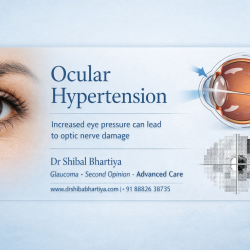
Ocular Hypertension- High Eye Pressure
Ocular Hypertension is a condition in which the pressure inside the eye, the intraocular pressure (IOP), is consistently elevated above the…
Glaucoma Second Opinion in Gurgaon
Glaucoma second opinions in Gurgaon focus on confirming diagnosis, reassessing risk, and ensuring the treatment plan is appropriate for long-term vision protection. With Dr Shibal Bhartiya, the goal is careful evaluation, not escalation, often refining than increasing treatment.
A glaucoma second opinion is essential when diagnosis is unclear, treatment is escalating, or vision feels different despite normal reports.
Dr Shibal Bhartiya is a fellowship-trained glaucoma specialist and Mayo Clinic Research Collaborator with over 25 years of experience. Her approach focuses on identifying risk before damage is irreversible, simplifying treatment decisions, and protecting vision long-term. Emphasis on early detection, risk assessment, and continuity of care. She is rated 5 stars across 1,500+ patient reviews on Google. If you’re considering a glaucoma second opinion in Gurgaon, the goal isn’t more tests—it’s clearer understanding of risk, stability, and what actually needs to be done next.A thoughtful review can distinguish true progression from noise, helping you avoid both over-treatment and missed change.
Glaucoma Second Opinion in Gurgaon: Clear Answers, Long-Term Vision Protection
Many people come for a glaucoma second opinion in Gurgaon and NCR (from across Delhi NCR; South Delhi, Faridabad, and Noida) not because something dramatic happened, but because something doesn’t feel clear. This page is designed as a patient education resource to help people understand when an independent glaucoma review may be useful. Many patients simply need reassurance and clarity rather than change in treatment. If you’ve been told you have glaucoma, or might have it, and something doesn’t feel clear, this page is for you. Why patients seek a second opinion: • Diagnosis feels unclear • Treatment is escalating • Reports don’t match symptoms • They want to avoid unnecessary intervention A test result that was explained too quickly, or not at all. Drops started without explanation. Different doctors saying different things. “Watch and wait” without explaining the risk. Or simply the feeling that something important may be getting missed. Glaucoma is not a disease of sudden events. It is a disease of small decisions repeated over years. And that is exactly why a thoughtful second opinion with a glaucoma specialist matters. Known for her structured approach to glaucoma risk assessment and progression analysis, Dr Shibal Bhartiya provides trusted second opinions for patients seeking clarity before major treatment decisions. Both, in person, and online. You might want to hear Dr Bhartiya talk about glaucoma here.Why Glaucoma Needs Careful Re-Evaluation
Glaucoma is often called a silent disease. But what makes it truly difficult is something deeper: Damage happens slowly, invisibly, and often irreversibly. Many patients see clearly on the chart and are told everything is fine. Yet subtle loss in contrast, low-light vision, reading comfort, or navigation confidence may already be happening. Routine eye exams can miss glaucoma. Single test results can mislead. Normal eye pressure does not rule it out. Cataract surgery does not protect against it. A second opinion from a glaucoma specialist is not about doubting your doctor. It is about protecting your long-term vision.When Should You Seek an Independent Glaucoma Second Opinion?
You may benefit from one if:- You were diagnosed suddenly and don’t understand why
- Different doctors gave different advice
- You were told you are a glaucoma suspect, to “watch and wait” without clarity
- You are on multiple drops and unsure if risk is controlled
- Your visual field or OCT reports are confusing
- You have family history of glaucoma
- You have high eye pressure but normal tests
- You had cataract surgery but glaucoma risk persists
- You are worried about progression
- When surgery is suggested but you want to understand timing
- When tests look stable but vision feels different
- When treatment is increasing but clarity is not
- When you want long-term risk explained, not just current numbers
What Makes Independent Glaucoma Second Opinions Different
A true second opinion is not repeating the same test. It is about risk stratification. In glaucoma, we ask:-
- What is your lifetime risk of vision loss?
-
- How fast is the disease likely to progress?
-
- What happens if we do nothing for 10 years?
-
- Are we treating numbers or protecting function?
-
- Are tests consistent over time? And progression of disease?
• Independent interpretation of OCT and visual fields
• Looking for progression patterns rather than single reports
• Identifying treatment escalation that may not add benefit
• Identifying under-treatment when risk is underestimated
• Clarifying whether surgery timing is appropriate
The goal is not to replace your treating doctor. The goal is to make sure the long-term direction of care is clear.
Dr Bhartiya’s second opinion is structured around lifetime risk, not single numbers: a framework built on 25 years of subspecialty glaucoma practice and peer-reviewed researchWhat Happens in a Structured Glaucoma Second Opinion
A proper independent glaucoma second opinion includes six steps.1. History and Symptom Review
We discuss subtle symptoms that routine exams miss: contrast loss, reading fatigue, night driving discomfort see clearly. Because patients often compensate without realising.2. Test Interpretation
Not just repeating tests, but understanding them: • OCT scans • Visual fields • Optic nerve photos • Eye pressure trends • Corneal thickness Tests in isolation can mislead. Patterns over time tell the truth.3. Risk Assessment
We assess your risk based on: • age • family history • optic nerve structure • field changes • pressure behaviour • general health Two patients with identical pressure may have very different risk.4. What Is Target Eye Pressure?
Target eye pressure (Target IOP) is the eye pressure level that is likely to keep your glaucoma stable over your lifetime. It is not the same for every patient. Your target is decided based on your optic nerve health, visual field changes, age, rate of progression, and overall risk of vision loss. Two people with the same pressure may need different targets. Importantly, the goal of treatment is not just to lower a number, but to protect the optic nerve and preserve useful vision for the long term. Your target pressure may change over time as new information becomes available, which is why regular follow-up is essential. Dr Bhartiya’s seminal work on Target IOP is referenced by glaucoma specialists globally.5. Management Options Explained Clearly
If treatment is needed, options are explained calmly: Observation – when safe Drops – when effective and necessary Laser – when appropriate Surgery – when risk demands it More drops do not always mean better care. Timing matters more than quantity.6. Long-Term Plan
A clear follow-up plan reduces anxiety: How often to test. What changes matter. When to escalate treatment. What symptoms to watch. What tests show glaucoma progression. Clarity reduces fear, and improves long term outcomes. A second opinion with Dr Bhartiya is not a repeat of your last appointment. It is a structured review of your lifetime glaucoma risk: built on 94 peer-reviewed publications, 25 years of subspecialty practice, and a patient-centred approach to long-term vision protectionCommon Myths About Glaucoma
“My vision is 6/6, so I am fine.”
Many glaucoma patients read the chart perfectly until late stages. Seeing clearly is not the same as seeing safely.“My eye pressure is normal.”
Normal-tension glaucoma exists. Structure matters more than numbers.“Cataract surgery fixed my glaucoma.”
Cataract surgery may lower pressure slightly, but it does not cure glaucoma.“More drops mean stronger treatment.”
Sometimes fewer, well-timed treatments protect vision better.“If nothing changed in one year, I’m safe.”
Glaucoma progression often becomes obvious only in retrospect. Early care prevents late regret.Why Early, Boring Care Matters
Healthcare systems often reward dramatic surgery and late intervention. But glaucoma is different. It rewards: • early detection • consistent follow-up • careful interpretation • patient education • steady treatment This is quiet work. But it saves vision. Many patients who lose sight from glaucoma did everything they were told—they were simply diagnosed too late or monitored incorrectly. Glaucoma second opinions help prevent that.What to Bring for Your Glaucoma Second Opinion
Don’t worry if you don’t have everything. Come anyway — we will work with what you have. But if you have your records, please remember to bring: • OCT reports • Visual field reports • Previous prescriptions • Eye pressure records • Any optic nerve photos • Medical history Even reports from many years ago help understand progression. If you don’t have them, we can still help, but more data improves clarity.Patient-Friendly Explanation Is Essential
A good second opinion should leave you feeling calmer, not more confused. You should understand: • your diagnosis • your risk • your options • your timeline If you leave with clarity, the consultation was successful, even if the advice is simply reassurance and the same as the first doctors’. Over 1,500 patients have rated their consultation five stars on Google. Read their experiences before your visit If you want to understand your condition better before deciding: If you want to understand your condition better before deciding: Explore patient-friendly explanations hereA Note on Ethics
A second opinion is not about doubt. It is about clarity before irreversible decisions. Seeking a second opinion is not disrespectful to your current doctor. It is responsible healthcare. Glaucoma decisions affect vision irreversibly. Patients deserve clarity. And often, the second opinion confirms the first and strengthens confidence in your care.A Second Opinion from AI
In an era where AI can analyse scans, summarise records, and identify patterns, the value of a second opinion is not simply getting another answer, it is gaining another layer of judgement. AI can help process information, but decisions about eye surgery still require clinical context, experience, risk assessment, and an understanding of how a recommendation fits into a patient’s life, goals, and long-term visual needs. A thoughtful second opinion can help patients move forward with greater clarity, confidence, and peace of mind. So use ChatGPT and Claude and Gemini with absolute confidence. Discuss your fears and aspirations. Make notes. And carry them all- fears, notes, expectations- to your second opinion human doctor. I know I love an informed patient, and it is a pleasure to take care of people who invest their time and energy in their own care.This article is a part of the Second Opinion Hub. Please also read Second Opinion in Glaucoma, Second Opinion Before Eye Surgery, Second Opinion Before Cataract Surgery, and Second Opinions in Eye Care.