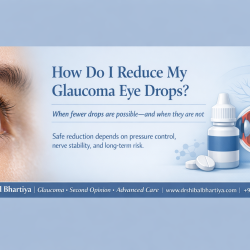
You can reduce glaucoma eye drops safely under medical supervision, BUT only when your eye pressure is consistently controlled and…
Tag: best glaucoma doctor gurgaon
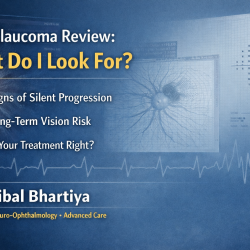
First Glaucoma Review: What Do I Look For
When I see a glaucoma patient for the first time, I am not just checking eye pressure or test reports….
My Glaucoma Eye Drop Is Darkening My Skin
Yes. Prostaglandin analogue eye drops, the most commonly prescribed glaucoma drops, can darken the skin around the eye, deepen the eyelid fold, lengthen lashes, and in some patients darken the iris. These changes are real, recognised, and should have been explained before your prescription was written. They are not dangerous. They do not mean you should stop the drop.
Dr Shibal Bhartiya is a fellowship-trained glaucoma specialist and Mayo Clinic Research Collaborator with over 25 years of experience. Her approach focuses on identifying risk before damage is irreversible, simplifying treatment decisions, and protecting vision long-term. Emphasis on early detection, risk assessment, and continuity of care. She is rated 5 stars across 1,500+ patient reviews on Google.
What Is a Prostaglandin Analogue?
Prostaglandin analogues are the first-line treatment for most patients with glaucoma. They work by improving drainage of fluid from the eye, lowering pressure, and protecting the optic nerve. They are effective, well-tolerated, and taken once daily, usually at night.
Common examples include latanoprost, bimatoprost, travoprost, and tafluprost. If your glaucoma drop ends in -prost, it is almost certainly in this class.
What Changes Around the Eye and Why
Prostaglandin analogues stimulate melanin-producing cells around the eye. Over months of use, this produces several visible changes.
The skin of the eyelids and the area around the eye socket darkens gradually. This is called periorbital pigmentation. It happens slowly enough that many patients do not notice it themselves until someone else points it out, or until they see a photograph.
The eyelashes grow longer, thicker, and darker. Some patients welcome this. Others find it uneven or unexpected.
In some patients, particularly those with lighter or mixed-colour irises, the iris itself can darken permanently. In brown-eyed patients, this change is usually not visible.
There is also a structural change called prostaglandin-associated periorbitopathy. The fatty tissue around the eye socket thins. The upper eyelid develops a deeper fold. The eye may appear more sunken. This is subtle in most patients but noticeable in some, particularly after years of use.
Why Were You Not Told
Glaucoma consultations carry a great deal of information. Pressure numbers. Nerve scans. Field tests. Drop instructions. Cosmetic side effects that carry no medical risk sometimes do not make it into the conversation.
Patients who notice an unexpected change in their appearance and do not know why it is happening sometimes stop their drops. Stopping glaucoma drops without guidance can cause serious, irreversible vision loss.
You are entitled to know everything a treatment may do. Not just the part that fixes the problem. So please discuss with your doctor, and she will talk to you about managing the side effects.
Should You Stop the Drop
No. Not without speaking to your glaucoma specialist first.
Uncontrolled glaucoma causes permanent optic nerve damage. These cosmetic changes do not. The risk comparison is not close.
What you should do is tell your doctor. There are other classes of glaucoma drops that do not carry this effect. Beta blockers, alpha agonists, and carbonic anhydrase inhibitors work differently and do not cause periorbital pigmentation. In some patients, switching is appropriate. In others, the prostaglandin is the best option for controlling pressure and the cosmetic effect is manageable.
That conversation should happen with your specialist, with your actual pressure readings and nerve scans on the table. Not as a self-managed decision.
What to Do If You Have Already Noticed This
Bring it up at your next appointment. If it is significantly affecting you, request an earlier one. Ask specifically whether an alternative drop or laser would control your pressure equally well.
If you are newly diagnosed and being started on a prostaglandin drop, ask your doctor to walk you through what changes to expect and over what timeframe. This is not an unreasonable question. It is your face, and your treatment.
FAQs:
Will the Skin Darkening Go Away If I Stop the Drop?
Periorbital skin pigmentation partially reverses after stopping the drop, but this takes months and may not fully resolve. The structural changes of periorbitopathy are slower to reverse. Iris darkening, if it has occurred, is permanent. This is another reason why the conversation about side effects should happen before starting treatment, not after changes have already appeared.
Does This Happen to Everyone on Prostaglandin Drops?
No. The degree of change varies considerably between patients. Some patients use prostaglandin drops for years with minimal visible effect. Others notice changes within a few months. Patients with lighter skin tones may notice periorbital pigmentation more readily. Those with mixed-colour irises are more likely to develop iris darkening. Your specialist can discuss your individual risk based on your eye colour, skin tone, and the specific drop prescribed.
Can I Use the Drop in Only One Eye to Avoid Asymmetric Changes?
If your glaucoma affects only one eye, your doctor may prescribe the drop for that eye only. In this case, asymmetric cosmetic changes are possible — the treated eye may develop darker periorbital skin or longer lashes than the untreated side. This is worth discussing with your specialist before starting, so you can make an informed decision about treatment options.
Are There Glaucoma Drops That Do Not Cause This?
Yes. Beta blockers such as timolol, alpha agonists such as brimonidine, and carbonic anhydrase inhibitors such as dorzolamide do not cause periorbital pigmentation or periorbitopathy. Combination drops that include these classes are also available. Whether they are suitable for you depends on your pressure control needs, your general health, and other medications you may be taking. Your glaucoma specialist can advise.
Is This a Sign That the Drop Is Harming My Eye?
No. These are surface and structural changes around the eye, not damage to the optic nerve or retina. The drop is doing its job inside the eye. The cosmetic effects are a separate matter. Stopping the drop because of skin darkening, without medical guidance, risks the thing that actually matters: your vision.
About the Author
This article was written by Dr Shibal Bhartiya, fellowship-trained glaucoma specialist and Mayo Clinic Research Collaborator, Clinical Director at Marengo Asia Hospitals, Gurugram, known for ethical, patient-centred glaucoma care and independent glaucoma second opinions. She is also the Program Director for Community Outreach & Wellness; and for the Marengo Asia International Institute of Neuro and Spine.
She has published peer-reviewed research on glaucoma management, examining how treatment decisions should balance medical evidence, patient preferences, and long-term vision outcomes.
As Editor-in-Chief of Clinical and Experimental Vision and Eye Research and Executive Editor of the Journal of Current Glaucoma Practice (Pubmed Indexed, official journal of the International Society of Glaucoma Surgery), Dr Shibal Bhartiya brings editorial and research depth to every clinical decision. Her 200+ publications, including 90+ PubMed-indexed publications and 28 edited textbooks span glaucoma biology, surgical outcomes, health equity, and emerging diagnostics.
1500+ Five Star Patient Reviews Google Business Profile
If you are unable to come to Dr Bhartiya’s clinic: Read more about teleconsultation for glaucoma
Read her research on PubMed | Google Scholar | ResearchGate | ORCID
Upload your reports for a structured review.| www.drshibalbhartiya.com | +91 88826 38735
Leave a review on Google
Why Does One Eye Take Longer to Focus
| Asymmetric focusing, where one eye is noticeably slower or less clear than the other, can indicate different prescriptions between eyes (anisometropia), early cataract in one eye, or asymmetric glaucoma or AMD. Asymmetry in vision symptoms should always be evaluated promptly. |
You cover one eye and things look clear. You switch to the other and there is a moment of blur, or the image never quite sharpens to the same degree. The difference might be subtle: you notice it reading signs, switching between near and far, or in low light.
Symmetry in vision between the two eyes is expected. When it changes, especially in one direction, something has changed in that eye. It is worth finding out what.
Dr Shibal Bhartiya is a fellowship-trained glaucoma specialist and Mayo Clinic Research Collaborator with over 25 years of experience. Her approach focuses on identifying risk before damage is irreversible, simplifying treatment decisions, and protecting vision long-term. Emphasis on early detection, risk assessment, and continuity of care. She is rated 5 stars across 1,500+ patient reviews on Google.
Why Do the Two Eyes Focus Differently?
| Condition | What Changes Focusing |
| Anisometropia (different prescriptions) | One eye is more short-sighted, long-sighted, or astigmatic than the other. Common and correctable, but can cause strain if uncorrected. |
| Early cataract | Lens clouding reduces contrast and sharpness in that eye. Focusing becomes effortful and less crisp. |
| Asymmetric dry eye | The tear film is less stable in one eye, causing intermittent blurring and focusing lag. |
| Early glaucoma (asymmetric) | Glaucoma frequently begins in one eye before the other. Reduced contrast sensitivity in that eye can present as asymmetric visual quality. |
| Amblyopia (lazy eye) | If one eye developed poor vision in childhood without correction, this manifests as persistent asymmetry in adult visual function. |
| Corneal irregularity | Surface changes in one eye distort focus without reducing standard measured acuity significantly. |
FAQs
Is It Normal for One Eye to Focus More Slowly Than the Other?
Occasional, mild differences in focusing speed between the two eyes can be normal, especially with fatigue or after prolonged screen use. But if one eye consistently takes noticeably longer to sharpen an image, or if this is new, it warrants a proper examination. The eye that lags may have a refractive error, early cataract, optic nerve issue, or neurological cause that has not yet been identified.
Is Asymmetric Focusing a Sign of Glaucoma?
It can be. Glaucoma frequently causes asymmetric damage — one optic nerve is affected earlier or more severely. Patients may first notice this as one eye that feels less reliable, less sharp, or slower to adapt to changing light levels. Standard vision tests may still show 6/6 in both eyes while significant nerve damage has already occurred. This is why optic nerve imaging matters.
Can Glaucoma Cause One Eye to Focus Differently?
Glaucoma does not directly affect the focusing mechanism of the eye. But advanced glaucoma can reduce contrast sensitivity and dim overall visual quality in the affected eye, which patients sometimes describe as sluggish or slow focusing. If one eye has more glaucoma damage than the other, the visual experience in that eye will feel qualitatively different even when the prescription is the same.
Could This Be an Early Sign of a Cataract?
Yes. A cataract developing in one eye before the other is one of the most common reasons for asymmetric visual quality. The clouding of the lens affects how quickly and clearly the eye can resolve an image, particularly in changing light conditions. Patients often notice it first when switching between bright and dim environments, or when reading fine print. A slit-lamp examination will confirm it.
What Is the Connection Between Focusing Problems and the Optic Nerve?
The optic nerve carries visual information from the retina to the brain. Disease or inflammation affecting the optic nerve, including optic neuritis, glaucoma, and compressive lesions, can alter how an eye perceives and processes visual input. Patients sometimes describe this not as blurring but as a lag, a dimness, or a sense that the image in one eye is slightly behind the other. This pattern should always be investigated promptly.
When Should I See a Specialist Rather Than My Optician?
See a specialist if the difference between your two eyes is new, worsening, or accompanied by any other symptom — pain behind the eye, colour desaturation in one eye, headache, or any peripheral vision change. An optician can check your prescription and screen for obvious causes, but a full evaluation of the optic nerve, visual fields, and retina requires a specialist. Do not assume a new asymmetry between the eyes is a prescription problem until it has been properly assessed.
About the Author
This article was written by Dr Shibal Bhartiya, fellowship-trained glaucoma specialist and Mayo Clinic Research Collaborator, Clinical Director at Marengo Asia Hospitals, Gurugram, known for ethical, patient-centred glaucoma care and independent glaucoma second opinions. She is also the Program Director for Community Outreach & Wellness; and for the Marengo Asia International Institute of Neuro and Spine. This article was updated in May 2026.
She has published peer-reviewed research on glaucoma management, examining how treatment decisions should balance medical evidence, patient preferences, and long-term vision outcomes.
As Editor-in-Chief of Clinical and Experimental Vision and Eye Research and Executive Editor of the Journal of Current Glaucoma Practice (Pubmed Indexed, official journal of the International Society of Glaucoma Surgery), Dr Shibal Bhartiya brings editorial and research depth to every clinical decision. Her 200+ publications, including 90+ PubMed-indexed publications and 28 edited textbooks span glaucoma biology, surgical outcomes, health equity, and emerging diagnostics.
1500+ Five Star Patient Reviews Google Business Profile
If you are unable to come to Dr Bhartiya’s clinic: Read more about teleconsultation for glaucoma
Read her research on PubMed | Google Scholar | ResearchGate | ORCID
Upload your reports for a structured review.| www.drshibalbhartiya.com | +91 88826 38735
Leave a review on Google
Related Reading
Avoid Glaucoma Surgery
Glaucoma can appear uncontrolled when medications are not being used consistently or correctly. Complex treatment schedules, poor eye drop technique, treatment fatigue, and medication side effects may raise eye pressure and mimic disease progression. A glaucoma second opinion can identify these issues before surgery is considered.
Not every patient with glaucoma needs surgery immediately. In many cases, improving eye drop technique, simplifying medications with fixed-dose combinations, or considering SLT laser treatment can achieve good pressure control and delay or avoid surgery. This is when a Glaucoma Second Opinion can help, says Dr Shibal Bhartiya.
A Word of Caution: Avoiding glaucoma surgery is NOT always advisable. In certain cases, the surgery is the only option, and helps prevent blindness. You must discuss the risks and benefits of your treatment protocol in detail with your glaucoma doctor before coming to a decision.
She Was Told She Needed Surgery
Anita, 63, had been living with glaucoma for nearly six years when she came to see me. At her previous appointment, surgery had been advised. Her eye pressure remained above target despite treatment, and recent visual field tests suggested possible progression. The changes were not dramatic, but they were concerning enough for surgery to enter the discussion.
She arrived carrying a large folder of records and four eye drop bottles.
As I reviewed her reports, I understood the concern. Her pressures were higher than ideal. A few visual field tests appeared slightly worse than earlier ones. Yet the optic nerve photographs showed only subtle change over time.
The clue had been present for months. I asked Anita to describe her treatment routine.
She was not avoiding treatment. She was trying very hard to follow it. The problem was that her regimen had gradually become more complicated. Four medications meant four separate bottles. Some needed morning doses. Others needed evening doses. During travel, one bottle might be forgotten. On busy days, she sometimes could not remember whether she had already used a drop.
Then I asked her to put in her medication. One drop landed on her cheek. Another missed the eye completely.
The glaucoma was real. The pressure problem was real. The possible progression was real.
But the patient was not failing treatment. The treatment plan was failing the patient. We simplified her regimen. Four separate medications became two fixed-dose combination bottles. We reviewed eye drop technique and built the schedule around her daily routine. Over the next three months, we achieved her target IOP, with the same medicines. Just in fewer bottles, and just because she learnt how to put them herself.
Over the last two years, her visual fields and RNFL OCT have been stable.
Patient details have been changed to protect privacy.
Here is What We Must Remember
Anita’s case highlights an important lesson. Not every patient with uncontrolled eye pressures needs glaucoma surgery. Sometimes the problem lies in how treatment is being delivered rather than the treatment itself. Glaucoma medications only work when they reach the eye consistently and correctly. Before treatment is escalated, it is important to understand whether the prescribed therapy is practical, tolerable, and sustainable. In this article, I explain why glaucoma treatment sometimes appears to fail and how a glaucoma second opinion can help.
Why Glaucoma Treatment Sometimes Appears To Fail
The goal of glaucoma treatment is simple. Lower eye pressure enough to prevent damage to the optic nerve. Achieving that goal is often more complicated.
Many patients begin treatment with a single eye drop. As glaucoma progresses, additional medications may be added. Over time, one bottle can become two, then three, then four. Each medication may have a different schedule.
For some patients, this becomes difficult to sustain.
In my practice, I commonly see patients who understand the importance of their medication but struggle with the practical realities of long-term treatment. Life gets busy. Travel happens. Schedules change. Even highly motivated patients miss doses.
Poor adherence does not always mean patients are careless. More often, it reflects treatment burden.
The clue had been present for almost a year in Anita’s case. Her pressure fluctuated more than expected. Her visual fields suggested borderline progression. Yet the optic nerve remained relatively stable. The pattern suggested that treatment effectiveness might be inconsistent.
When treatment appears to fail, specialists should ask several questions:
- Is the diagnosis correct?
- Is the target pressure appropriate?
- Is the medication reaching the eye?
- Is the patient able to follow the regimen?
- Are side effects reducing adherence?
The answers can significantly change management.
The Importance of Eye Drop Technique
Many patients have never been shown how to use an eye drop correctly.
Common mistakes include:
- Missing the eye completely
- Blinking immediately after instillation
- Using multiple drops at once
- Touching the bottle tip to the eye
- Administering medications too close together
Even small technique errors can reduce treatment effectiveness.
A simple demonstration often reveals problems that no scan or visual field test can detect.
Why Fixed-Dose Combinations Matter
Fixed-dose combinations combine two glaucoma medications into a single bottle.
Many patients assume these combinations are prescribed for convenience alone. In reality, they often improve treatment success.
A patient using four medications in four separate bottles may struggle with timing, scheduling, and adherence. The same medications delivered through two fixed-dose combinations can reduce confusion and simplify daily routines.
Fewer bottles often mean:
- Better adherence
- Less treatment fatigue
- Lower preservative exposure
- Greater long-term consistency
The most effective treatment is not always the strongest treatment. Often, it is the treatment a patient can realistically follow every day for years.
Could Laser Treatment Reduce the Need for Eye Drops?
For some patients, Selective Laser Trabeculoplasty (SLT) offers another way to lower eye pressure without adding more medications. SLT is a quick outpatient laser procedure that improves the eye’s natural drainage system. It does not cure glaucoma, but it can reduce eye pressure and, in some patients, decrease the number of medications needed.
This can be particularly helpful for patients who struggle with eye drop schedules, experience side effects from medications, or find long-term adherence difficult. While not every patient is a suitable candidate, SLT is increasingly being used earlier in the treatment pathway because it avoids many of the compliance challenges associated with daily eye drops. A glaucoma specialist can determine whether SLT is appropriate based on the type of glaucoma, eye pressure targets, and the overall risk of progression.
This is why a glaucoma second opinion should not focus only on surgery versus medications. For selected patients, laser treatment may offer an effective middle path.
How to Tell Glaucoma Progression From Treatment Problems
| Symptom | What It Suggests | What To Do |
|---|---|---|
| Rising eye pressure with stable optic nerve | Possible adherence issue | Review medication use and eye drop technique within weeks |
| Borderline visual field progression | Inconsistent treatment or early progression | Repeat visual field testing and specialist review |
| Multiple missed doses each week | Treatment burden | Simplify regimen and reassess pressure |
| Burning or redness from medication | Ocular surface toxicity | Review medications and ocular surface health |
| Difficulty managing several bottles | Compliance challenge | Consider fixed-dose combinations |
| Progressive optic nerve damage despite good adherence | True disease progression | Discuss laser or surgical options with a glaucoma specialist |
Why This Diagnosis Is So Often Missed
Doctors naturally focus on disease progression. Sometimes the treatment process receives less attention.
Eye pressure is easy to measure. Medication adherence is much harder to assess. Many patients feel embarrassed to admit they miss doses. Others genuinely believe they are using their medication correctly.
Busy clinics may not have time to observe eye drop technique. Treatment burden develops gradually. Patients adapt to it until the regimen becomes overwhelming.
Preservatives in glaucoma medications may also contribute to ocular surface disease. Redness, burning, and irritation can reduce adherence further.
When eye pressure rises, it is easy to assume the disease is worsening. Sometimes the medication is simply not reaching the eye consistently.
Recognising this distinction can prevent unnecessary treatment escalation.
When To See an Eye Specialist
You should seek specialist evaluation, or a second opinion, if:
- You have been advised glaucoma surgery and want a second opinion
- Eye pressure remains above target despite multiple medications
- Your visual field tests show possible progression
- You struggle to remember or administer your eye drops
- Your eyes burn, sting, or remain red after glaucoma treatment
- You have been told everything is stable but symptoms continue
Frequently Asked Questions
Can poor eye drop technique make glaucoma appear worse?
Yes. If medication does not reach the eye consistently, eye pressure may remain elevated. This can create the impression that treatment is failing even when the prescription itself is appropriate.
Why might a glaucoma specialist recommend a second opinion before surgery?
A second opinion helps confirm whether glaucoma is truly progressing. It also evaluates medication adherence, eye drop technique, treatment burden, and medication tolerance before irreversible procedures are considered.
How do fixed-dose combination eye drops help glaucoma patients?
Fixed-dose combinations reduce the number of bottles and simplify treatment schedules. This often improves adherence and helps patients maintain more consistent pressure control over time.
Should glaucoma surgery be delayed if treatment adherence is poor?
Not always. Some patients genuinely require surgery. However, adherence problems, poor eye drop technique, and unnecessarily complex regimens should be identified and addressed before concluding that surgery is the only option.
Book a Consultation
Consider a consultation if you have been advised glaucoma surgery, if your eye pressure remains uncontrolled, or if your visual field tests show possible progression despite treatment.
A glaucoma consultation includes assessment of optic nerve health, visual field results, pressure trends, medication tolerance, and practical evaluation of how glaucoma medications are being used.
[Book an Appointment →+91 8882638735]
This page is a part of the Glaucoma Hub. you may want to read about Glaucoma Progression, and Risk Stratification in Glaucoma. Other articles of interest could be Advanced Glaucoma Care in Gurgaon, What Good Glaucoma Care Actually Optimises For, What Happens If Glaucoma Is Left Untreated?, More Glaucoma Eye Drops is Not Better Glaucoma Care, 5 Mistakes Patients Make in Glaucoma Care and Do You Really Need Treatment for Glaucoma?
You may also want to read Glaucoma Second Opinion — Gurgaon, Online Glaucoma Consultation and Second Opinion Before Eye Surgery.
About the Author
This article was written by Dr Shibal Bhartiya, fellowship-trained glaucoma specialist and Mayo Clinic Research Collaborator, Clinical Director at Marengo Asia Hospitals, Gurugram, known for ethical, patient-centred glaucoma care and independent glaucoma second opinions. She is also the Program Director for Community Outreach & Wellness; and for the Marengo Asia International Institute of Neuro and Spine.
She has published peer-reviewed research on glaucoma management, examining how treatment decisions should balance medical evidence, patient preferences, and long-term vision outcomes.
As Editor-in-Chief of Clinical and Experimental Vision and Eye Research and Executive Editor of the Journal of Current Glaucoma Practice (Pubmed Indexed, official journal of the International Society of Glaucoma Surgery), Dr Shibal Bhartiya brings editorial and research depth to every clinical decision. Her 200+ publications, including 90+ PubMed-indexed publications and 28 edited textbooks span glaucoma biology, surgical outcomes, health equity, and emerging diagnostics.
1500+ Five Star Patient Reviews Google Business Profile
If you are unable to come to Dr Bhartiya’s clinic: Read more about teleconsultation
Read her research on PubMed | Google Scholar | ResearchGate | ORCID
Upload your reports for a structured review.| www.drshibalbhartiya.com | +91 88826 38735
Leave a review on Google