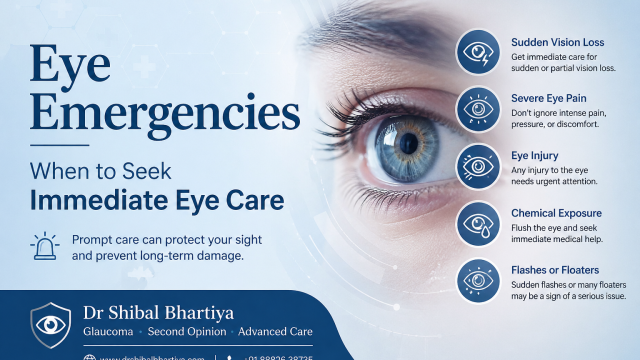
Sudden vision loss, a chemical in your eye, or a severe injury need emergency care right now. Many other eye symptoms, a red eye, mild irritation, a floater, can wait hours or days. Knowing the difference protects your sight and saves you unnecessary panic. Dr Shibal Bhartiya explains in this Eye Emergency Guide
📞 Call Dr Bhartiya: +91 88826 38735
Dr Shibal Bhartiya is a fellowship-trained glaucoma specialist and Mayo Clinic Research CoDr Shibal Bhartiya is a fellowship-trained glaucoma specialist and Mayo Clinic Research Collaborator with over 25 years of experience. Her approach focuses on identifying risk before damage is irreversible, simplifying treatment decisions, and protecting vision long-term. Emphasis on early detection, risk assessment, and continuity of care. She is rated 5 stars across 1,500+ patient reviews on Google.
She sees patients who have waited too long, and patients who rushed to emergency rooms for something minor. This guide helps you act at the right moment.
🔴 Call Now — These Are True Eye Emergencies
The following symptoms require immediate emergency care. Do not wait for morning. Do not drive yourself if your vision is severely affected.
⚠ Go to Emergency or Call Right Now
- Sudden loss of vision in one or both eyes — even if it lasts only a few minutes
- Chemical splash in the eye — acid, alkali, cleaning fluid, bleach, or any unknown substance
- Penetrating eye injury — a sharp object piercing the eye
- Sudden severe eye pain with nausea and vomiting (acute angle-closure glaucoma)
- A curtain, shadow, or dark veil across your vision — retinal detachment until proven otherwise
- Sudden appearance of many new floaters plus flashing lights
- Double vision that begins suddenly, especially with headache or facial numbness
- Eye injury with visible blood inside the eye (hyphema)
- Eyeball that looks misshapen or sunken after trauma
- Loss of vision following head trauma
Why sudden vision loss is never “wait and see”
Vision loss can signal a retinal artery occlusion, essentially a stroke in the eye. The treatment window is extremely narrow. Every minute of delay increases permanent damage. If your vision disappears and returns within minutes, that is called a transient ischaemic attack of the eye. It is a warning sign. Seek care the same day.
Chemical injuries: the first 20 minutes matter most
Flush your eye immediately with clean water: tap water, bottled water, saline. Hold your eye open under running water for at least 15 to 20 minutes. Do not stop to find eye drops first. Do not rub. Flush first, then go to emergency. Alkali burns (bleach, cement, oven cleaner) are more dangerous than acid burns because they penetrate deeper and faster.
🟡 See a Doctor Today — Urgent but Not Emergency-Room Urgent
These symptoms are serious. They can deteriorate quickly. Arrange to be seen within hours, not days.
⌛ Same-Day Appointment Needed
- Eye redness with significant pain and light sensitivity — could be uveitis or corneal ulcer
- A sudden large floater with or without flashing lights
- Blurred or hazy vision that developed today
- A foreign body you cannot remove — metal, glass, or wood fragment
- Contact lens stuck in your eye with pain or redness
- Eyelid swollen, red, and painful — possibly cellulitis or severe stye
- Eye discharge with severe redness in a newborn
- Eye pain in a child with redness and fever
- Painful red eye in a patient with glaucoma
The painful red eye with light sensitivity rule
A red eye that is painful and makes you squint in bright light is not conjunctivitis. Conjunctivitis does not usually hurt. A painful photosensitive red eye needs a slit-lamp examination to rule out corneal ulcer, uveitis, or acute glaucoma. Do not put over-the-counter drops in and hope it improves. Call your doctor.
🟢 Monitor at Home — These Can Usually Wait
These symptoms are common and rarely sight-threatening. They deserve attention but not panic. Book an appointment within a few days or at your next available slot.
📅 Schedule Within a Few Days
- Mild redness with watery or sticky discharge — likely viral or bacterial conjunctivitis
- A single small floater that has been stable for weeks
- Gritty, sandy, or dry feeling in the eye — dry eye disease
- Mild eyelid swelling or a painless lump — chalazion or stye
- Itchy eyes with watering — allergic conjunctivitis
- Gradual blurring of vision that has been worsening for weeks or months
- Mild redness after swimming
- Eye strain or headache after screen use
Quick Reference: Symptom, Likely Cause, Action Needed
| Symptom | Likely Cause | When to Worry | Action |
|---|---|---|---|
| Sudden vision loss | Retinal artery occlusion, detachment | Always | Emergency |
| Chemical in eye | Alkali or acid burn | Always | Flush + Emergency |
| Curtain across vision | Retinal detachment | Always | Emergency |
| Severe pain + nausea | Acute angle-closure glaucoma | Always | Emergency |
| Many new floaters + flashes | Posterior vitreous detachment / tear | Yes | Emergency |
| Sudden double vision | Cranial nerve palsy, TIA | Yes — especially with headache | Emergency |
| Painful red eye + photophobia | Uveitis, corneal ulcer | Yes | Same Day |
| One sudden large floater | PVD, possible tear | Yes | Same Day |
| Blurred vision today | Multiple — needs assessment | Yes | Same Day |
| Foreign body stuck | Metal, glass, wood | Yes | Same Day |
| Swollen painful eyelid | Cellulitis, severe stye | Yes if fever or eye cannot open | Same Day |
| Mild red watery eye | Conjunctivitis (viral/allergic) | Only if worsening | Wait + Monitor |
| Stable single floater | Age-related vitreous change | Only if new or multiplying | Routine Appointment |
| Dry, gritty eye | Dry eye disease | No, unless painful | Routine Appointment |
| Itchy eyes + watering | Allergic conjunctivitis | No | Routine Appointment |
| Gradual vision blur (weeks) | Glasses change, cataract | No | Routine Appointment |
Small Things That Are Actually Dangerous
Patients often dismiss these because they seem minor. They are not.
A Quiet Painless Red Spot
A bright red patch on the white of the eye after coughing or straining is usually a subconjunctival haemorrhage, harmless. But a red eye after a blow to the head or a red eye in someone taking blood thinners needs assessment that same day.
Brief Vision Loss (Seconds to Minutes)
Vision that goes dark or grey for a few seconds and returns feels trivial. It is not. This is called amaurosis fugax — a transient ischaemic attack of the eye. It is a stroke warning. Seek urgent medical care the same day.
Flashes of Light
Brief flashes, especially in a dark room, can signal retinal traction or a tear. A flash of light with a new shower of floaters is a retinal emergency. Do not wait to see if it settles.
Contact Lens Pain
Any pain while wearing a contact lens is the lens telling you to come out. Ignoring contact lens pain for hours risks Acanthamoeba keratitis, a serious corneal infection that can threaten vision permanently.
Headache Behind One Eye
A headache localised behind or around one eye, especially with a slightly droopy lid or a dilated pupil, can sometimes signal a posterior communicating artery aneurysm. This is a neurological emergency. Seek care immediately.
Eye Redness in a Glaucoma Patient
If you have glaucoma and your eye turns red with any pain or blurring, call your specialist the same day. A painful red eye in a glaucoma patient can mean acute angle closure, a vision-threatening emergency.
What We Often Miss — and Patients Dismiss
Missed Emergency #1
Vision loss in one eye dismissed as a migraine. Migraine aura affects both eyes. Sudden vision loss in only one eye is not a migraine. It is a vascular occlusion or detachment until proven otherwise.
Missed Emergency #2
Floaters in a young myopic patient ignored. Young patients with high myopia are at elevated risk for retinal tears. A new floater in this group needs dilated fundus examination, not reassurance.
Missed Emergency #3
Acute glaucoma treated as a migraine or food poisoning. Nausea, vomiting, and headache with a red eye and blurred vision is acute angle-closure glaucoma, not gastroenteritis. Many patients are given antiemetics at a general clinic and sent home. Vision can be permanently lost within hours.
Missed Emergency #4
Chemical injury undertreated because “it was just a splash.” Even a brief contact with a strong alkali can cause permanent corneal opacification. The volume matters less than the substance. Always irrigate and always seek care.
Missed Emergency #5
Eyelid infections assumed to be cosmetic. A painful, red, warm swelling of the eyelid that causes fever or restricts eye movement is orbital cellulitis, a medical emergency. It is not a stye that will go away on its own.
Eye Emergencies in Children: A Special Note
Children cannot always describe what they feel. Trust behaviour over words. A child rubbing one eye constantly, avoiding light, keeping an eye closed, or losing interest in activities because of what appears to be a sore eye needs to be seen promptly.
⚠ In Children: Seek Care That Day
- Any eye injury — even if the child says it doesn’t hurt
- Red eye in a newborn or infant with discharge
- A child who suddenly develops a squint or whose eye turns inward or outward
- A white or yellowish reflection in the pupil in a photograph (leukocoria)
- Drooping of one eyelid in a child — especially new onset
Frequently Asked Questions
My eye is red but it doesn’t hurt. Should I be worried?
A painless red eye is usually conjunctivitis: viral, bacterial, or allergic. It is not an emergency. Monitor it for 24 to 48 hours. If it worsens, develops pain, affects vision, or is accompanied by photophobia, see a doctor the same day. A red eye that follows trauma is different, that needs assessment regardless of pain.
I see a new floater. Is this an emergency?
A single new floater, especially in someone over 50, is often a posterior vitreous detachment, a common ageing change. It is not dangerous on its own. But if it is accompanied by flashing lights, a shower of new floaters, or a shadow in your peripheral vision, treat it as an emergency. Get a dilated examination that day. Retinal tears caught early are treatable with laser. Missed tears become detachments.
Can I use over-the-counter eye drops for a red eye?
rLubricating drops are safe for dry or irritated eyes. Avoid redness-reducing drops (those containing vasoconstrictors) as a habit: they mask symptoms without treating the cause and can worsen redness with prolonged use. Never put steroid-containing drops in your eye without a prescription. If the redness has not improved in 48 hours or is getting worse, see a doctor.
What should I do if something goes into my eye?
Blink repeatedly and let tears wash it out. Flush with clean water if needed. Do not rub. If you can see the foreign body on the white of the eye and it does not come out after gentle irrigation, see a doctor that day. Never attempt to remove a foreign body that appears to be embedded in the cornea or inside the eye. If there is any chance of a penetrating injury, cover the eye loosely and go to emergency immediately.
Please also read Should I Wash My Eyes?
How do I know if my headache is related to my eyes?
Eye strain headaches are typically around the eyes and temples after long periods of screen work or reading. They improve with rest. A headache that is severe, comes on suddenly, is located behind one eye, or accompanies vision changes or a droopy eyelid needs medical assessment. It can indicate raised intracranial pressure or an aneurysm. Any sudden worst-ever headache is a neurological emergency regardless of eye involvement.
Not Sure? Call and Ask.
If you are reading this and still uncertain whether your symptom is urgent, call the clinic. A two-minute call is always better than a missed emergency, or an unnecessary night in the waiting room.
📍 Gurgaon 📞 +91 88826 38735 | 🌐 Contact Us | Second Opinion Form for teleconsults
About the Author
This article was written by Dr Shibal Bhartiya, fellowship-trained glaucoma specialist and Mayo Clinic Research Collaborator, Clinical Director at Marengo Asia Hospitals, Gurugram, known for ethical, patient-centred glaucoma care and independent glaucoma second opinions. She is also the Program Director for Community Outreach & Wellness; and for the Marengo Asia International Institute of Neuro and Spine.
She has published peer-reviewed research onglaucoma management, examining how treatment decisions should balance medical evidence, patient preferences, and long-term vision outcomes.
As Editor-in-Chief of Clinical and Experimental Vision and Eye Research and Executive Editor of the Journal of Current Glaucoma Practice (Pubmed Indexed, official journal of the International Society of Glaucoma Surgery), Dr Shibal Bhartiya brings editorial and research depth to every clinical decision. Her 200+ publications, including 90+ PubMed-indexed publications and 28 edited textbooks span glaucoma biology, surgical outcomes, health equity, and emerging diagnostics.
1600+ Five Star Patient Reviews Google Business Profile
If you are unable to come to Dr Bhartiya’s clinic: Read more about teleconsultation
Read her research on PubMed | Google Scholar | ResearchGate | ORCID | Github | Wikidata
📋Upload your reports for a structured review.| 🌐 Contact Us| 📞 +91 88826 38735
⭐ Helped by this article? Leave a Google review — it helps other patients find reliable eye care.