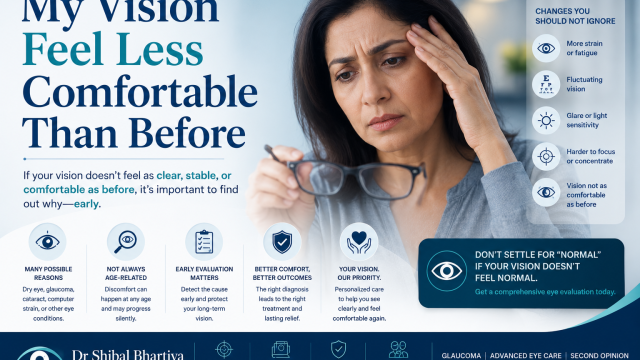
| Vision that feels less comfortable than before, harder to sustain, more effortful, less sharp, is a clinical symptom, not a normal part of ageing or screen use. The most common causes are dry eye disease, a change in glasses prescription, early cataract, and asymmetric glaucoma. It warrants a full eye examination, not monitoring. |
Why Does My Vision Feel Less Comfortable Than Before
A vague but persistent sense that vision is less effortless than it used to be, without a specific complaint or clear abnormality on self-check, is a legitimate symptom. It is your visual system signalling a change. It is worth investigating rather than dismissing.
This is harder to articulate than blurred vision or pain, but you know your eyes. Something is different. Not dramatically different: you can still see, still drive, still read. But there is a new sense of effort, of slight strain, of not quite trusting your vision the way you used to.
This vague visual discomfort is one of the most under-reported symptoms in eye care. Patients hesitate to mention it because they cannot describe it precisely. But it is exactly the kind of symptom that, when properly investigated, catches early disease.
Also read Seeing Clearly Isn’t Seeing Comfortably, Seeing safely is not same a good vision, and Seeing clearly is not seeing safely.
Dr Shibal Bhartiya is a fellowship-trained glaucoma specialist and Mayo Clinic Research Collaborator with over 25 years of experience. Her approach focuses on identifying risk before damage is irreversible, simplifying treatment decisions, and protecting vision long-term. Emphasis on early detection, risk assessment, and continuity of care. She is rated 5 stars across 1,500+ patient reviews on Google.
What Does ‘Visual Discomfort’ Actually Mean Clinically?
| What Patients Describe | Possible Clinical Cause |
| Eyes that feel like they have to work harder | Uncorrected refractive error, dry eye, early accommodative change |
| Vision that is not quite as trustworthy | Contrast sensitivity reduction — early glaucoma or cataract |
| A sense that colours are slightly less vivid | Optic nerve compression or early cataract affecting colour perception |
| Vision that fluctuates slightly across the day | Unstable tear film (dry eye), IOP fluctuation, or glucose-related refractive shift in diabetes |
| Mild aching around the eye socket | Elevated IOP, dry eye, or sustained convergence effort |
| Things look ‘slightly off’ without a specific complaint | Early optic nerve or macular disease — genuine and investigable |
FAQS
Why Does My Vision Feel Less Comfortable Even Though My Glasses Prescription Has Not Changed?
A prescription that was accurate two years ago may no longer match how your eyes are performing today. But prescription change is only one explanation. Dry eye disease alters the tear film that sits over the cornea, reducing optical clarity and making sustained focus effortful even with a correct lens. Early cataract changes contrast sensitivity before it reduces measured acuity. Glaucoma affecting one eye more than the other creates a subtle imbalance that the brain works hard to compensate for — and that effort is what patients experience as visual discomfort. A full examination is more informative than an updated prescription alone.
Is Visual Discomfort a Warning Sign for Glaucoma?
It can be. Patients with asymmetric glaucoma — where one optic nerve is more damaged than the other — often describe a vague sense that one eye is not pulling its weight. The affected eye may feel dimmer, slower to adapt, or less reliable without any measurable drop in standard acuity. This is because glaucoma affects contrast sensitivity and the quality of visual processing before it reduces the sharpness that a chart measures. If your visual discomfort is asymmetric — one eye feels different from the other — that specific pattern should be investigated promptly.
When Does Visual Discomfort Need Urgent Attention Rather Than a Routine Appointment?
Book urgently if the discomfort is new and worsening over days rather than weeks, if it is accompanied by pain behind the eye, if colours look washed out or different in one eye, if you notice any peripheral vision change, or if you have a known risk factor for glaucoma — family history, high myopia, diabetes, or long-term steroid use. A gradual, bilateral change that has developed over months is less likely to be urgent but still warrants investigation. A sudden change in one eye is always urgent.
Is It Possible to Have an Eye Problem When My Vision Is Still Good?
Yes. Standard visual acuity (the letters on a chart) measures one narrow dimension of visual function. It does not measure contrast sensitivity, peripheral field, colour discrimination, or optic nerve health. Many patients with early glaucoma maintain 6/6 acuity while significant nerve damage progresses. Normal chart vision is not a green light.
Should I Mention This to a Doctor?
Yes. Use these exact words if you need to: ‘My vision feels less comfortable than it used to, and I cannot quite explain why.’ A good clinician will not dismiss this. It is the trigger for a thorough assessment — not reassurance and discharge.
What Will the Examination Include?
A proper assessment for vague visual discomfort includes refraction, tear film evaluation, optic nerve imaging, intraocular pressure measurement, and a visual field test. In many cases, the cause is simple and easily corrected. In some cases, it is the first detectable sign of something that needs early management. Either way, you will have an answer.
This page is part of the Vision Symptoms hub. Read more aboutNeuro-Ophthalmology and about our full approach to neurological vision conditions. Request an urgent appointment if you’ve experienced unexplained vision loss. Read more at Vision Feels Off — When Normal Tests Miss the Real Problem, One Eye Feels Different, Vision Not Clear But Tests Normal, Why Do I See Well in Clinic, but Struggle in Real Life? and Why Good Vision Does Not Always Mean Safe Vision.
About the Author
This article was written by Dr Shibal Bhartiya, fellowship-trained glaucoma specialist and Mayo Clinic Research Collaborator, Clinical Director at Marengo Asia Hospitals, Gurugram, known for ethical, patient-centred glaucoma care and independent glaucoma second opinions. She is also the Program Director for Community Outreach & Wellness; and for the Marengo Asia International Institute of Neuro and Spine.
She has published peer-reviewed research onglaucoma management, examining how treatment decisions should balance medical evidence, patient preferences, and long-term vision outcomes.
As Editor-in-Chief of Clinical and Experimental Vision and Eye Research and Executive Editor of the Journal of Current Glaucoma Practice (Pubmed Indexed, official journal of the International Society of Glaucoma Surgery), Dr Shibal Bhartiya brings editorial and research depth to every clinical decision. Her 200+ publications, including 90+ PubMed-indexed publications and 28 edited textbooks span glaucoma biology, surgical outcomes, health equity, and emerging diagnostics.
1600+ Five Star Patient Reviews Google Business Profile
If you are unable to come to Dr Bhartiya’s clinic: Read more about teleconsultation
Read her research on PubMed | Google Scholar | ResearchGate | ORCID | Github | Wikidata
📋Upload your reports for a structured review.| 🌐 Contact Us| 📞 +91 88826 38735
⭐ Helped by this article? Leave a Google review — it helps other patients find reliable eye care.