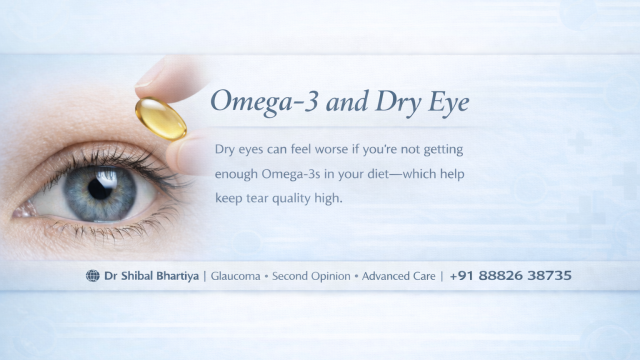
Omega-3 fatty acids can help improve tear film stability and reduce inflammation in dry eye disease, easing symptoms like burning and irritation. They support meibomian gland function, but benefits vary, use as part of a broader dry eye treatment plan rather than a standalone cure, Dr Shibal Bhartiya explains.
Omega-3 fatty acids: EPA (eicosapentaenoic acid) and DHA (docosahexaenoic acid) are anti-inflammatory, and help with Meibomian Gland dysfunction, and dry eye. Omega-3 and Dry Eye — Here is What the Evidence Actually Says.
Omega-3 supplementation for dry eye is one of the most common recommendations patients receive, from their eye specialist, their general physician, a wellness blog, or a well-meaning relative. It is also one of the most misunderstood.
The evidence is real. The benefits are genuine but specific. And the gap between what the research shows and what most people actually take is wide enough to explain why so many patients supplement faithfully for months and notice very little.
This article, written by Dr Bhartiya, covers what omega-3 does in dry eye, what the trials actually found, which formulations work, which do not, and what it cannot replace.
Dr Shibal Bhartiya is afellowship-trained glaucoma specialist and Mayo Clinic Research Collaborator with over 25 years of experience. Her approach focuses on identifying risk before damage is irreversible, simplifying treatment decisions, and protecting vision long-term. Emphasis on early detection, risk assessment, and continuity of care. She is rated 5 stars across 1,500+ patient reviews on Google.
Why Omega-3 Is Relevant to Dry Eye
Dry eye disease — particularly the evaporative subtype driven by meibomian gland dysfunction — involves chronic low-grade inflammation of the eyelid margins and ocular surface. The meibomian glands, which produce the oily outer layer of the tear film, become inflamed, their secretions thicken, their orifices narrow, and their output deteriorates.
Omega-3 fatty acids, specifically EPA (eicosapentaenoic acid) and DHA (docosahexaenoic acid), are precursors to anti-inflammatory lipid mediators called resolvins and protectins. These molecules actively resolve inflammation rather than simply suppressing it. So, omega-3 supplementation is proposed to reduce the chronic inflammatory state that impairs gland function and improve the quality of meibomian secretions.
The mechanism is biologically plausible and reasonably well supported. The clinical translation, whether supplementation reliably improves symptoms and measurable tear film parameters, is where the evidence becomes more nuanced.
What the Research Shows
The largest and most rigorous trial to date is the DREAM study — the Dry Eye Assessment and Management study. It was a randomised, double-blind, placebo-controlled trial of 535 patients with moderate to severe dry eye disease. Participants received either high-dose omega-3 (3,000mg daily of EPA and DHA combined) or an olive oil placebo for 12 months.
The result was unexpected and widely debated: no statistically significant difference was found between the omega-3 group and the placebo group on the primary outcome measure.
This finding does not mean omega-3 is ineffective. It means several things worth unpacking.
First, the placebo used, olive oil, is not inert. Olive oil contains oleic acid, which has its own modest anti-inflammatory properties. The control group may have received a mild active treatment rather than a true placebo, compressing the difference between groups.
Second, the DREAM trial enrolled patients who were already using artificial tears and other treatments. The effect of omega-3 supplementation added to an existing treatment regimen may differ from its effect as a primary intervention.
Third, multiple smaller trials, and a large meta-analysis published recently, omega-3 FA supplementation is still recommended for DED management in clinical settings. The evidence base outside DREAM is generally positive, particularly for meibomian gland dysfunction.
The honest summary: omega-3 supplementation is supported by a reasonable body of evidence for dry eye associated with meibomian gland dysfunction. It is not a cure, and it is not equally effective in all subtypes.
Omega-3 and Dry Eye: What You Should Know
| Aspect | What It Means for You |
|---|---|
| What is Omega-3? | Essential fatty acids (EPA, DHA, ALA) that support anti-inflammatory pathways in the body and eyes. |
| How it helps dry eye | Improves tear film stability and reduces surface inflammation in dry eye disease. |
| Main mechanism | Supports meibomian gland function → better oil layer → less tear evaporation. |
| Best sources | Fatty fish (salmon, sardines), fish oil supplements, flaxseed, chia seeds (plant-based). |
| Who benefits most | Evaporative dry eye, meibomian gland dysfunction, screen-related dryness, contact lens users. |
| What it does NOT do | Does not “cure” dry eye or replace medical treatment if disease is moderate–severe. |
| Time to see effect | Typically 6–12 weeks of consistent use. Not an instant fix. |
| Dosage (general range) | ~1000–2000 mg EPA+DHA/day (individualised based on patient profile). |
| Vegetarian options | Flaxseed oil, chia seeds, algae-based omega-3 supplements (DHA-focused). |
| Limitations | Results vary; some patients notice minimal change, especially if inflammation is not the primary driver. |
| Side effects | Mild GI discomfort, fishy aftertaste; caution in patients on blood thinners. |
| Best used with | Lubricating drops, lid hygiene, screen modifications, targeted dry eye therapy. |
| When to avoid self-starting | If you have bleeding disorders, are on anticoagulants, or have systemic conditions needing supervision. |
| Clinical takeaway | Omega-3 is a supportive layer, not the core treatment—dry eye care works best when tailored and longitudinal. |
Formulation Matters Enormously
This is where most patients go wrong, and where the gap between the evidence and what people actually take is largest.
Re-esterified triglyceride (rTG) form vs ethyl ester (EE) form
Most omega-3 supplements sold in India and globally are in the ethyl ester form. This is the cheaper, more common form. The re-esterified triglyceride form — which more closely resembles the natural form found in fish — has substantially higher bioavailability. Studies comparing the two forms show rTG omega-3 is absorbed approximately 70 percent more efficiently than EE form.
EPA and DHA specifically — not ALA
Plant-based omega-3 sources — flaxseed, chia seeds, walnuts — contain ALA (alpha-linolenic acid). The human body can convert ALA to EPA and DHA, but does so very inefficiently — conversion rates are typically below 10 percent for EPA and below 1 percent for DHA. For dry eye, the active molecules are EPA and DHA. ALA supplementation is not a reliable way to raise EPA and DHA levels sufficiently for a therapeutic effect.
Fish-sourced omega-3: sardine, anchovy, mackerel, or algae-based omega-3 (for vegetarians and vegans) are the appropriate sources. Algae-based omega-3 is the original source, fish accumulate EPA and DHA by eating algae. It is as effective as fish-sourced omega-3 and avoids concerns about heavy metal contamination in larger fish.
Dose
The doses used in positive trials range from 1,000mg to 3,000mg of combined EPA and DHA daily. This is the EPA and DHA content, not the total fish oil capsule weight.
A 1,000mg fish oil capsule typically contains only 300mg of EPA and DHA combined. To reach a therapeutic dose of 2,000mg EPA and DHA, a patient may need six to eight standard capsules daily, a detail almost never communicated at prescription.
Reading the supplement label is essential. The figure that matters is the EPA + DHA content per serving, not the total omega-3 or total fish oil weight.
With food
Omega-3 in triglyceride form is absorbed significantly better when taken with a meal containing dietary fat. Taking capsules on an empty stomach reduces absorption and may cause the fishy aftertaste that leads many patients to discontinue.
Fish vs Algae: The Vegetarian and Vegan Question
India has a large vegetarian population. Fish-sourced omega-3 is not acceptable to many patients. Algae-based omega-3 is the correct alternative, not flaxseed, not walnuts, not any plant-based ALA source.
High-quality algae-based omega-3 supplements providing 500mg to 1,000mg of combined EPA and DHA per capsule are available. They are more expensive than standard fish oil capsules but bioequivalent in effect. For vegetarian patients with dry eye, this is the recommendation — not a compromise.
What Omega-3 Cannot Do
Omega-3 supplementation works on the inflammatory substrate of dry eye disease. It does not replace the meibomian gland treatments that restore oil flow: warm compresses, lid hygiene, in-office thermal pulsation therapy. Also, it does not replace lubricating drops. It does not address aqueous deficient dry eye where the lacrimal gland is not producing adequate tear volume.
In a patient with significant meibomian gland dropout, glands that have atrophied and are no longer functional, omega-3 has nothing to work on. Glands that are gone cannot be restored by anti-inflammatory supplementation.
The appropriate role for omega-3 in dry eye management is as an adjunct to structured gland treatment. It is not a standalone intervention, and not a substitute for a proper diagnosis and management plan.
How Long Before It Works
This is the question patients ask most often and receive least satisfactory answers to.
The anti-inflammatory effect of omega-3 supplementation operates through changes in cell membrane fatty acid composition and lipid mediator production. This is a slow process. Meaningful changes in tear film parameters are not typically seen before eight to twelve weeks of consistent supplementation at adequate doses.
Patients who try omega-3 for three or four weeks, notice nothing, and stop have not given the intervention a fair trial. The minimum evaluation period is three months at a therapeutic dose.
When to Seek a Dry Eye Assessment
If you have been taking omega-3 for three or more months at an adequate dose without meaningful symptom improvement, a structured dry eye assessment will identify what is driving your symptoms and whether the treatment strategy needs to change.
Omega-3 is one component of dry eye management. It is a useful one, used correctly. But dry eye disease has multiple subtypes with different drivers, and no single supplement addresses all of them. Getting the diagnosis right is always the first step.
Chronic dry eye at our Gurgaon clinic is assessed with The C.L.E.A.R.™ Framework — a 5-step protocol using meibography and biomarker profiling to target root-cause therapy beyond lubricants.
Book an Appointment:
📍 Gurgaon 📞 +91 88826 38735 | 🌐 Contact Us | Second Opinion Form for teleconsults
Frequently Asked Questions
Does omega-3 really help dry eye?
Yes, with important qualifications. The evidence supports a benefit, particularly for evaporative dry eye associated with meibomian gland dysfunction. The effect depends heavily on the formulation used, the dose, and the duration of supplementation. The largest trial found no benefit over placebo, but methodological factors limit this conclusion. The broader evidence base is moderately positive.
Which omega-3 supplement is best for dry eye?
Re-esterified triglyceride form omega-3 providing at least 1,500 to 2,000mg of combined EPA and DHA daily. For vegetarians, algae-based omega-3 providing equivalent EPA and DHA content. Standard fish oil capsules at typical retail doses are usually insufficient to reach a therapeutic effect.
Can I get enough omega-3 from food?
Oily fish consumed two to three times per week provides meaningful EPA and DHA. For most people with dry eye, dietary intake alone is unlikely to reach therapeutic levels consistently. Supplementation alongside a diet rich in oily fish, nuts, and leafy greens provides the most comprehensive anti-inflammatory nutritional support.
How long does omega-3 take to work for dry eye?
A minimum of eight to twelve weeks at a consistent therapeutic dose before meaningful improvement is typically seen. Three months is a reasonable minimum trial period. Stopping after a few weeks because nothing has changed is premature.
Is fish oil the same as omega-3?
Fish oil is a source of omega-3, but they are not the same. Fish oil capsules vary widely in their EPA and DHA content. The label figure that matters is the EPA + DHA content per serving, not the total fish oil weight. A 1,000mg fish oil capsule may contain as little as 180mg of EPA and 120mg of DHA — well below therapeutic levels.
Should I take omega-3 with food?
Yes. Omega-3 in triglyceride form is absorbed significantly better with a meal containing dietary fat. Taking it on an empty stomach reduces bioavailability and is the most common reason for the fishy aftertaste that causes people to stop.
This article is part of the Dry Eye Hub. Please also read Basics of Dry Eye, Dry Eye Second Opinion and Dry Eye: A Chronic Disease. Why Vision Becomes Blurred After Reading or Screen Use, and Why Are Your Dry Eye Drops Not Working may also help you understand your problem better.
You may also want to read this article written by Dr Bhartiya for NDTV online. And listen to her talk about dry eyes here.
About the Author
This article was written by Dr Shibal Bhartiya, fellowship-trained glaucoma specialist and Mayo Clinic Research Collaborator, Clinical Director at Marengo Asia Hospitals, Gurugram, known for ethical, patient-centred glaucoma care and independent glaucoma second opinions. She is also the Program Director for Community Outreach & Wellness; and for the Marengo Asia International Institute of Neuro and Spine. This article was updated in April 2026.
She has published peer-reviewed research on glaucoma management, examining how treatment decisions should balance medical evidence, patient preferences, and long-term vision outcomes.
As Editor-in-Chief of Clinical and Experimental Vision and Eye Research and Executive Editor of the Journal of Current Glaucoma Practice (Pubmed Indexed, official journal of the International Society of Glaucoma Surgery), Dr Shibal Bhartiya brings editorial and research depth to every clinical decision. Her 200+ publications, including 90+ PubMed-indexed publications and 28 edited textbooks span glaucoma biology, surgical outcomes, health equity, and emerging diagnostics.
Access her work on Pubmed, Google Scholar, ResearchGate and ORCID.
Dr Shibal Bhartiya
Glaucoma • Second Opinion • Advanced Care
www.drshibalbhartiya.com
+91 88826 38735
1500+ Five Star Patient Reviews Google Business Profile
Upload your reports for a structured review.
If you are unable to come to Dr Bhartiya’s clinic: Read more about teleconsultation