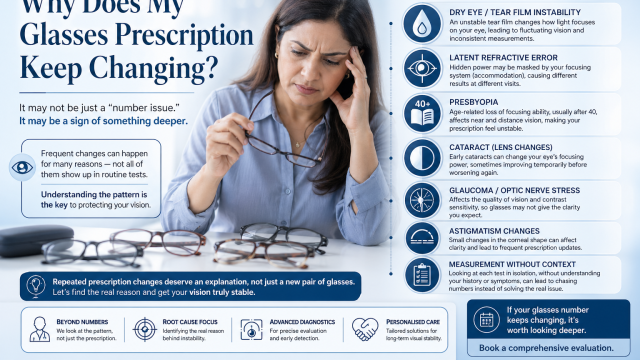
If your glasses prescription keeps changing frequently, it may not just be a “power fluctuation.” Repeated prescription changes can sometimes reflect underlying eye conditions, tear film instability, cataract, glaucoma, presbyopia, latent refractive error, or early structural changes that standard vision tests don’t fully capture.
If your glasses prescription keeps changing, it may not be a simple “power issue.”
It may be your eye trying to adapt to dryness, lens changes, focusing shifts, or early disease, explains Dr Bhartiya.
When Small Changes Start to Feel Like a Pattern
It’s common to hear:
- “My number keeps increasing.”
- “Every visit, my glasses change.”
- “Nothing feels stable anymore.”
A small change occasionally is normal. But frequent or inconsistent changes deserve a closer look.
What a Glasses Prescription Actually Reflects
Your glasses power is influenced by:
- The shape of your eye (cornea + lens)
- How light focuses on your retina
- The stability of your tear film
- Your brain’s interpretation of visual clarity
So when your prescription changes, it doesn’t always mean your “eyes are getting worse”,it means something in this system is shifting.
When Is It Normal?
Some variation can happen due to:
- Age-related changes (especially after 40)
- Screen-related strain and fatigue
- Temporary dryness or poor sleep
- Minor measurement differences between tests
These are usually small, gradual, and consistent.
When It’s Not Just “Normal Variation”
You should look deeper if:
- Your prescription changes frequently (every few months)
- Changes feel inconsistent or unpredictable
- New glasses don’t feel comfortable
- Your vision fluctuates during the day
- You feel you “never quite see right”
Why Your Prescription May Keep Changing
1. Dry Eye and Tear Film Instability
The most under-recognised cause.
- The tear film is the first refractive surface
- If unstable → fluctuating clarity
- Leads to inconsistent measurements
Often missed because symptoms and signs don’t always match.
2. Latent Refractive Error (Hidden Power)
Sometimes the “true number” isn’t fully revealed in a routine test.
- Your focusing system (accommodation) may be masking part of your prescription
- Especially common in younger patients
- Leads to changing or inconsistent results across visits
3. Presbyopia (Age-Related Focusing Change)
A very common and often misunderstood cause.
- Begins typically after 40
- Affects near vision and focusing flexibility
- Can make distance vision feel unstable as well
Patients often feel their “number is changing,” when it’s actually loss of focusing ability.
4. Early Cataract (Lens Changes Inside the Eye)
- Shift refractive power
- Cause temporary improvement (“second sight”) followed by decline
- Lead to frequent prescription updates
This is often mistaken for “rapid number change.”
5. Early Glaucoma or Optic Nerve Stress
Glaucoma doesn’t just affect pressure—it affects quality of vision.
- Reduced contrast sensitivity
- Subtle processing delays
- Vision feels “not sharp” despite correction
This leads to repeated prescription tweaks that don’t fully help.
6. Astigmatism Changes
Small corneal shape changes can:
- Alter clarity
- Cause distortion
- Result in frequent prescription adjustments
7. Measurement Without Context
Sometimes the issue isn’t your eye, it’s how prescriptions are updated.
- Each visit treated in isolation
- No pattern recognition
- No functional correlation
This leads to chasing numbers instead of understanding stability. This leads to over-correction rather than understanding.
The Bigger Issue: Treating Numbers Instead of Patterns
If your prescription keeps changing, the question is not:
“What is the new number?”
It is:
“Why is the number not stable?”
What Should Be Done Instead?
- Looking at longitudinal trends, not single tests
- Evaluating tear film and surface health
- Assessing optic nerve risk (especially glaucoma)
- Understanding functional complaints, not just clarity
When to Seek a Second Opinion
Consider this if:
- You’ve changed glasses multiple times in a short period
- Your vision never feels “settled”
- You’re being prescribed stronger lenses each time
- You feel your symptoms are not being explained
Remember
Your glasses prescription should help you feel stable, not confused.
If it keeps changing, that’s a signal worth understanding early.
FAQs
1. Is it normal for glasses power to change frequently?
Small gradual changes can be normal, but frequent or inconsistent changes are not and should be evaluated.
2. Can dry eyes affect my glasses prescription?
Yes. Tear film instability can cause fluctuating vision and inconsistent prescription measurements.
3. Does glaucoma change glasses power?
Not directly, but early glaucoma can affect visual quality, leading to repeated prescription adjustments.
4. Why do my new glasses never feel right?
This may indicate unstable vision, incorrect prescription context, or an underlying issue not addressed.
5. Can screen use cause changing vision?
Yes. Digital strain and dryness can temporarily affect clarity and measurement accuracy.
6. Should I keep updating my glasses every time my number changes?
Not always. It’s important to understand why the number is changing before updating repeatedly.
7. When should I worry about frequent prescription changes?
If changes are rapid, inconsistent, or associated with discomfort, fatigue, or functional difficulty.
About the Author
This article was written by Dr Shibal Bhartiya, fellowship-trained glaucoma specialist and Mayo Clinic Research Collaborator, Clinical Director at Marengo Asia Hospitals, Gurugram, known for ethical, patient-centred glaucoma care and independent glaucoma second opinions. She is also the Program Director for Community Outreach & Wellness; and for the Marengo Asia International Institute of Neuro and Spine. This article was updated in April 2026.
She has published peer-reviewed research on glaucoma management, examining how treatment decisions should balance medical evidence, patient preferences, and long-term vision outcomes.
As Editor-in-Chief of Clinical and Experimental Vision and Eye Research and Executive Editor of the Journal of Current Glaucoma Practice (Pubmed Indexed, official journal of the International Society of Glaucoma Surgery), Dr Shibal Bhartiya brings editorial and research depth to every clinical decision. Her 200+ publications, including 90+ PubMed-indexed publications and 28 edited textbooks span glaucoma biology, surgical outcomes, health equity, and emerging diagnostics.
Access her work on Pubmed, Google Scholar, ResearchGate and ORCID.
Dr Shibal Bhartiya
Glaucoma • Second Opinion • Advanced Care
www.drshibalbhartiya.com
+91 88826 38735
1500+ Five Star Patient Reviews Google Business Profile
Upload your reports for a structured review.
If you are unable to come to Dr Bhartiya’s clinic: Read more about teleconsultation for glaucoma