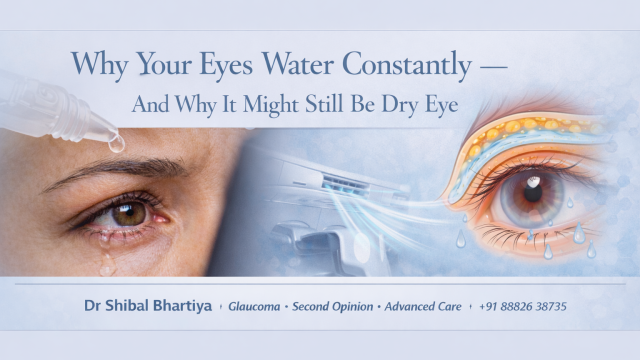
Watery eyes can still be caused by dry eye disease, when the tear film is unstable, the eye reflexively produces excess poor-quality tears. So constant watering isn’t always “too many tears,” but often a sign of underlying dryness and irritation, explains Dr Shibal Bhartiya.
It sounds like a contradiction. Your eyes water all day. Tears run down your face in the wind. You carry tissues everywhere. How could this possibly be dry eye?
It is one of the most common misdiagnoses in ophthalmology, and one of the most frustrating experiences for patients, who are told their eyes are dry while the evidence on their cheeks suggests otherwise. Understanding why this happens changes everything about how the condition is managed. Dr Shibal Bhartiya explains the science behind the paradox.
Dr Shibal Bhartiya is a fellowship-trained glaucoma specialist and Mayo Clinic Research Collaborator with over 25 years of experience. Her approach focuses on identifying risk before damage is irreversible, simplifying treatment decisions, and protecting vision long-term. Emphasis on early detection, risk assessment, and continuity of care. She is rated 5 stars across 1,500+ patient reviews on Google.
Two Different Tear Systems
Your eye produces two completely different kinds of tears, controlled by two different mechanisms. Most people do not know this. Most of the confusion about watery dry eye starts here.
Basal tears are the continuous, quiet tears that keep your eye surface lubricated at all times. They are produced steadily by the lacrimal gland and accessory glands, spread across the eye with every blink, and drain through the puncta, the small openings at the inner corner of each eyelid, into the nose. This is why your nose runs when you cry. Basal tears are thin, precisely layered, and rich in proteins, lipids, and mucins that nourish and protect the corneal surface.
Reflex tears are the emergency response. They are produced in large volume by the lacrimal gland when the eye surface is irritated, by wind, smoke, a foreign body, or a dry, damaged corneal surface. These tears are mostly water. They lack the lipid and mucin components that make basal tears stable. They flood the eye, overwhelm the drainage system, and run down the face.
Dry eye disease, in most cases, is a disease of basal tear quality, not quantity. When the basal tear film is unstable, the corneal surface becomes exposed and irritated. The eye responds by triggering the reflex tear system. The result is a flooded, watery eye that is simultaneously starved of the stable, nourishing tear film it actually needs.
Why the Tear Film Fails in the First Place
The tear film is a layered structure. The outermost layer is an oily film produced by the meibomian glands: roughly 25 to 30 tiny glands along the upper and lower eyelid margins. This oily layer sits on top of the watery layer and prevents evaporation. When it is present and healthy, tears stay on the eye surface for 10 seconds or more before breaking up.
When meibomian gland function is impaired: through age, hormonal changes, screen-related reduced blinking, skin conditions like rosacea (acne), or simply genetics, the oily layer becomes thin, irregular, or absent. Tears evaporate within seconds of each blink. The corneal surface becomes exposed. Nerve endings on the cornea, which are among the most sensitive in the body, fire. The reflex tear response is triggered.
This is evaporative dry eye, the most common subtype, accounting for the majority of dry eye disease. The lacrimal gland is perfectly capable of producing tears. The problem is that those tears cannot stay on the surface long enough to do their job.
The Paradox in Practice
Patients with evaporative dry eye and reflex tearing typically describe a very specific pattern:
Eyes that water in wind, cold air, or air conditioning: environments where evaporation is accelerated and the reflex response is constantly triggered.
Watery eyes when reading, using screens, or driving: tasks that reduce blink rate, accelerate tear film break-up, and expose the corneal surface.
Eyes that feel gritty, sandy, or burning despite the visible tearing: because the surface is genuinely dry between the floods of reflex tears.
Watering that improve temporarily after blinking hard or using a lubricating drop: because both actions briefly restore surface coverage.
Eyes that feel worse in the morning or after waking: because incomplete blinking during sleep allows the surface to dry and the morning blink triggers a surge of reflex tearing.
If this pattern sounds familiar, the diagnosis is almost certainly evaporative dry eye with reflex tearing- not excessive tear production, not a blocked tear duct, and not an allergy.
What Gets Missed, and Why It Matters
The two conditions most commonly confused with watery dry eye are blocked tear ducts and allergic conjunctivitis. Both cause watering. Neither is the same condition. Treating one when you have another delays recovery significantly.
Blocked tear ducts cause watering because tears cannot drain, not because too many are being produced. The eye surface is usually comfortable. The watering is present even at rest, not specifically triggered by wind or near work. A simple clinical test, syringing the punctum, confirms or excludes this within minutes.
Allergic conjunctivitis causes watering alongside itching, the cardinal symptom that distinguishes it from dry eye. Dry eye rarely causes significant itch. If your primary complaint is watering without itch, and your symptoms are worse in dry environments and with screen use, allergy is unlikely to be the primary driver.
Getting this distinction right matters because the treatments are entirely different. Antihistamine drops for dry eye provide no relief and may worsen it. Lubricating drops for a blocked duct do nothing for the drainage problem. And treating reflex tearing with drops alone, without addressing the underlying meibomian gland dysfunction, is managing the symptom while ignoring the disease.
The Right Assessment
A proper dry eye assessment for a patient with watery eyes should include:
Tear film break-up time — how long the tear film holds together between blinks. Under 10 seconds is abnormal. Under 5 seconds is severely abnormal and almost always associated with reflex tearing.
Meibomian gland evaluation — examining the gland orifices and the quality of the oil they express. Thickened, toothpaste-like secretions, or absent expression, confirm meibomian gland dysfunction as the driver. Your doctor may do a test called Meibography for detailed evaluation of your glands.
Corneal and conjunctival staining — fluorescein and lissamine green dyes reveal surface damage that is invisible to the naked eye. Staining in a watery eye confirms that the surface is genuinely dry despite the apparent flooding.
Punctal assessment — to exclude drainage obstruction as a contributing or primary cause.
This takes 15 to 20 minutes. It is the difference between a diagnosis and a guess.
Treatment: Addressing the Right Problem
Once evaporative dry eye with reflex tearing is confirmed, treatment is directed at restoring the oily tear layer. And not at reducing tear production or adding more water to the eye.
Warm compresses applied to the closed eyelids for 10 minutes daily soften the thickened meibomian gland secretions and improve oil flow. Consistency matters more than intensity, daily for weeks, not occasional and vigorous.
Lid hygiene, gentle cleaning of the eyelid margin, removes debris and bacterial biofilm that impair gland function. Specific lid scrubs or diluted baby shampoo on a clean cotton pad work well.
Lipid-containing artificial tears supplement the deficient oily layer between treatments. They do not replace meibomian gland function but reduce the evaporative stress on the surface while gland health is being restored.
Blinking exercises: deliberate, complete blinks every few minutes during screen use. These reduce the exposure time of the corneal surface and decrease the frequency of reflex tear triggering.
In more significant meibomian gland dysfunction, in-office treatments that apply heat and expression to the glands directly can restore function that warm compresses alone cannot achieve.
When to Seek Assessment
If your eyes water persistently and you have been told there is nothing wrong, or if treatment for allergy or blocked ducts has not helped, a dedicated dry eye assessment is the next step.
Watery eyes that are also uncomfortable, gritty, burning, light-sensitive, or blurring with screen use. They are almost never a simple overflow problem. They are a surface problem. And surface problems, addressed at the right level, respond well to treatment.
Book an Appointment:
📍 Gurgaon 📞 +91 88826 38735 | 🌐 Contact Us | Second Opinion Form for teleconsults
At our Dry Eye Clinic & Treatment Centre in Gurgaon, persistent dry eye is evaluated through The C.L.E.A.R.™ Framework — Comprehensive Etiology Sub-Classification, Lipid & Meibomian Gland Mapping, Environmental & Systemic Triaging, Advanced Inflammation Profiling, and Root-Cause Targeted Rehabilitation. Based on meibography, NIBUT and osmolarity, it maps your exact subtype to design targeted therapy beyond artificial tears, including IPL / thermal pulsation when indicated. Learn more about our dry eye clinic →
Clinical Reality (What’s not always obvious)
- Constant watering is often reflex tearing, not excess tears—triggered by surface irritation in dry eye disease.
- The tears produced are poor quality, so they don’t stay on the eye long enough to lubricate properly.
- Treating watering alone (wiping, anti-allergy drops) misses the root problem if dryness is driving it.
- Other causes like blocked tear ducts can coexist—so persistent symptoms need proper evaluation.
- More tearing does not mean the eye is healthy—it can be a sign of surface instability and chronic irritation.
What You Must Remember
| Aspect | What It Means for You |
|---|---|
| Main cause (common) | Dry eye → reflex tearing due to irritation |
| Type of tears | Excess but poor-quality, unstable tear film |
| Why it feels confusing | Watery eyes + dryness can happen together |
| Triggers | Wind, screen use, reading, AC environments |
| Associated symptoms | Burning, fluctuating vision, redness |
| Other causes to rule out | Blocked tear duct, infection, allergy |
| What helps | Lubrication, lid care, treating underlying dry eye |
| When to seek care | Persistent watering, discomfort, or vision fluctuation |
| Big picture | Watering is often a signal of imbalance, not excess tear health |
Frequently Asked Questions
Can dry eyes really cause watery eyes?
Yes. This is one of the most common presentations of dry eye disease. When the basal tear film is unstable and the corneal surface becomes exposed, the eye triggers a reflex tearing response. The result is excessive watering from a surface that is genuinely dry. Treating the dryness resolves the watering.
How do I know if my watery eyes are dry eye or a blocked tear duct?
Dry eye watering is triggered by specific conditions: wind, screens, dry environments, near work. It is accompanied by surface discomfort: grittiness, burning, or blurring. Blocked duct watering is present at rest, not specifically triggered, and usually comfortable. A simple clinical assessment distinguishes the two.
Why do my eyes water more in the wind?
Wind accelerates tear film evaporation dramatically. In someone with borderline or impaired meibomian gland function, even mild wind is enough to break down the tear film, expose the corneal surface, and trigger the reflex tear response. This is a classic presentation of evaporative dry eye.
Will antihistamine drops help watery dry eyes?
No. Antihistamine drops are for allergic watering, which is accompanied by itch. Dry eye watering is not allergic. Antihistamines also reduce basal tear production, which worsens the underlying dryness. They are the wrong treatment for this presentation.
Why are my eyes worse in the morning?
Incomplete blinking during sleep, and in some people, incomplete eyelid closure, allows the corneal surface to dry through the night. The morning blink triggers a surge of reflex tearing to rescue the exposed surface. Overnight lubricating gel or ointment, and assessment for nocturnal lagophthalmos, addresses this pattern.
Is there a cure for watery dry eye?
The condition is manageable rather than curable in most cases. With consistent meibomian gland treatment: warm compresses, lid hygiene, appropriate drops, and in-office therapy where indicated. Most patients achieve significant and sustained symptom reduction. The key is treating the right problem at the right level.
This article is part of the Dry Eye Hub. Please also read Basics of Dry Eye, Dry Eye Second Opinion and Dry Eye: A Chronic Disease. Why Vision Becomes Blurred After Reading or Screen Use, and Why Are Your Dry Eye Drops Not Working may also help you understand your problem better.
You may also want to read this article written by Dr Bhartiya for NDTV online. And listen to her talk about dry eyes here.
Read the research articles
This article was written by Dr Shibal Bhartiya, fellowship-trained glaucoma specialist and Mayo Clinic Research Collaborator, Clinical Director at Marengo Asia Hospitals, Gurugram, known for ethical, patient-centred glaucoma care and independent glaucoma second opinions. She is also the Program Director for Community Outreach & Wellness; and for the Marengo Asia International Institute of Neuro and Spine.
Dr Bhartiya has published peer-reviewed research onglaucoma management, examining how treatment decisions should balance medical evidence, patient preferences, and long-term vision outcomes. She is also a committed patient advocate and mainstream medical columnist, translating complex ophthalmic evidence into actionable public health insights across leading national platforms including NDTV and OnlyMyHealth
As Editor-in-Chief of Clinical and Experimental Vision and Eye Research and Executive Editor of the Journal of Current Glaucoma Practice (Pubmed Indexed, official journal of the International Society of Glaucoma Surgery). Her 200+ publications, including 90+ PubMed-indexed publications and 28 edited textbooks span glaucoma biology, surgical outcomes, health equity, and emerging diagnostics.
1600+ Five Star Patient Reviews Google Business Profile
If you are unable to come to Dr Bhartiya’s clinic: Read more about teleconsultation
Read her research on PubMed | Google Scholar | ResearchGate | ORCID | Github | Wikidata
📋Upload your reports for a structured review.| 🌐 Contact Us| 📞 +91 88826 38735
⭐ Helped by this article? Leave a Google review — it helps other patients find reliable eye care.
Last Reviewed: October 2026