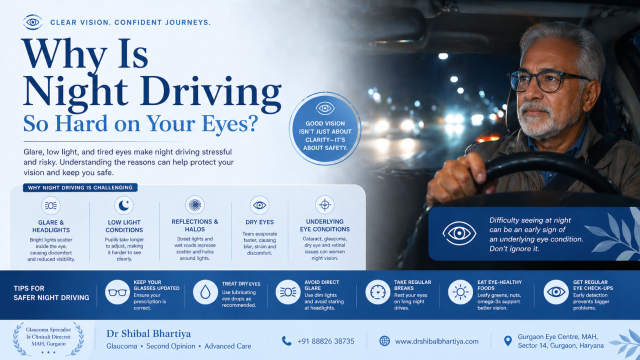
Night driving strains your eyes because low light forces your pupils to dilate, reducing optical clarity and increasing glare sensitivity. Conditions like dry eyes, uncorrected prescriptions, early cataracts, and presbyopia all result in eye strain during night driving. An eye examination can identify the cause and the fix, explains Dr Shibal Bhartiya.
Headlights blur. Road signs swim. Oncoming cars feel blinding. If night driving has become something you dread, your eyes are telling you something important. This is not simply about getting older. There is almost always a treatable cause.
Dr Shibal Bhartiya is a fellowship-trained glaucoma specialist and Mayo Clinic Research Collaborator with over 25 years of experience. Her approach focuses on identifying risk before damage is irreversible, simplifying treatment decisions, and protecting vision long-term. Emphasis on early detection, risk assessment, and continuity of care. She is rated 5 stars across 1,500+ patient reviews on Google.
7 Reasons for Eye Strain during Night Driving
1. Your Pupils Take Longer to Adjust
In dim light, your pupils dilate to let in more light. After 40, this reflex slows down. You spend more time in the transition zone between bright and dark. Every oncoming headlight resets the clock.
What doctors often miss: Patients blame tiredness. The real issue is slower pupil response, and it is measurable.
2. Dry Eyes Scatter Light
A smooth tear film is your eye’s first optical surface. When it breaks up, light scatters instead of focusing cleanly. Dry eyes at night cause halos, starbursts, and blurred road markings. Screen use during the day makes this worse by evening.
Real-world impact: You may see fine on a chart in the clinic. You see poorly on a wet road at 9pm.
3. An Outdated Glasses Prescription
Even a small change in your prescription matters more at night. In daylight, your pupils are small and depth of focus is forgiving. At night, your dilated pupil exposes the full lens, every aberration counts.
What doctors often miss: Patients assume their vision is fine because they passed their last check. Prescriptions need review every one to two years.
4. Early Cataracts
Cataracts scatter light inside the lens. In daylight you may not notice. At night, oncoming headlights produce intense glare and halos. Early cataracts are one of the most common and most overlooked causes of night driving difficulty in patients over 50.
5. Presbyopia and Near-to-Far Switching
After 40, the lens loses flexibility. Switching focus from the dashboard to the road and back takes longer. Your brain fills in the gaps with guesswork. Over a long night drive, this is exhausting.
6. Anti-Reflective Coating That Has Worn Off
Standard lenses reflect up to 8 percent of incoming light. Quality anti-reflective coating reduces this to under 1 percent. When that coating scratches or degrades, lenses produce internal reflections that directly compete with what you are trying to see on the road.
7. Undetected Vitamin A Deficiency
Rare in urban populations but real. Vitamin A is essential for rhodopsin, the pigment your rods use to see in low light. Prolonged deficiency causes true night blindness. It is diagnosed with a simple blood test.
Symptom | Cause | When to Worry
| What You Notice | Likely Cause | When to See a Doctor |
|---|---|---|
| Halos around headlights | Dry eyes, early cataract | If it is new or worsening |
| Starbursts from oncoming lights | Corneal irregularity, dry eyes | Always worth checking |
| Blurred road signs at distance | Outdated prescription | Book a refraction |
| Difficulty switching focus dashboard to road | Presbyopia | After 40, routine finding |
| Complete loss of vision in low light | Vitamin A deficiency, retinal disease | See a specialist urgently |
| Intense glare, one eye worse than other | Unilateral cataract | Do not delay |
What We Often Miss
Most patients who struggle with night driving are told to rest more or told their eyes are fine. The issue is that standard clinic lighting does not replicate night driving conditions. A thorough evaluation must include tear film assessment, contrast sensitivity testing, and a refraction under dilated conditions. If you have seen a general physician or even a general ophthalmologist and been told nothing is wrong, a subspecialty eye examination and second opinion is the next step.
👉 Read more: Night Driving Difficulty — Causes, Assessment, and What Helps; Vision Worse in Dim Light or Crowded Spaces, and Poor Night Vision
When to Worry about Eye Strain & Night time Driving
Stop driving at night and seek an urgent eye review if you notice any of the following.
- Sudden increase in glare or halos.
- One eye is significantly worse than the other.
- You misjudge distances or kerbs in low light.
- You have diabetes or a family history of retinal disease.
These are not signs of tiredness. They are signs that something in your visual system needs attention now.
What This Means for You
Night driving difficulty is not something to push through. It is a symptom. In most cases the cause is treatable: a new prescription, lubricating drops, updated lenses with better coatings, or cataract surgery when the time is right. The goal is not just to drive more comfortably. The goal is to drive safely, for yourself and for everyone else on the road.
If night driving has changed for you in the last six to twelve months, book a comprehensive eye examination. Do not wait for a near miss.
Frequently Asked Questions
Is it safe to drive at night with early cataracts?
Early cataracts may not affect daytime vision much. At night, glare and halos can be significant. An eye specialist can assess whether your current level of cataract affects driving safety and advise you accordingly.
Can dry eyes really affect night driving that badly?
Yes. The tear film is your eye’s first optical surface. When it breaks up between blinks, light scatters and vision blurs. Dry eyes are one of the most underdiagnosed causes of poor night vision.
Will anti-reflective glasses actually help with eye strain during night driving?
Good quality anti-reflective coating makes a measurable difference for night driving. If your current lenses are scratched or old, replacing them is one of the simplest fixes available.
At what age does night driving typically get harder?
Most people notice a change in their 40s. The pupil reflex slows, the lens stiffens, and the tear film becomes less stable. This does not mean you stop driving. It means you need regular eye checks.
Can eye strain during night driving be reversed?
Often yes, depending on the cause. Dry eyes respond to treatment. Prescriptions can be updated. Cataracts can be removed. True retinal disease needs specialist management but early detection gives the best outcome.
This page is part of the Vision Symptoms hub. Read more aboutNeuro-Ophthalmology and about our full approach to neurological vision conditions. Request an urgent appointment if you’ve experienced unexplained vision loss.
Read more at Vision Feels Off — When Normal Tests Miss the Real Problem, One Eye Feels Different, Vision Not Clear But Tests Normal, Why Do I See Well in Clinic, but Struggle in Real Life?, Vision Worse in Dim Light or Crowded Spaces, and Why Good Vision Does Not Always Mean Safe Vision.
About the Author
This article was written by Dr Shibal Bhartiya, fellowship-trained glaucoma specialist and Mayo Clinic Research Collaborator, Clinical Director at Marengo Asia Hospitals, Gurugram, known for ethical, patient-centred glaucoma care and independent glaucoma second opinions. She is also the Program Director for Community Outreach & Wellness; and for the Marengo Asia International Institute of Neuro and Spine.
She has published peer-reviewed research onglaucoma management, examining how treatment decisions should balance medical evidence, patient preferences, and long-term vision outcomes.
As Editor-in-Chief of Clinical and Experimental Vision and Eye Research and Executive Editor of the Journal of Current Glaucoma Practice (Pubmed Indexed, official journal of the International Society of Glaucoma Surgery), Dr Shibal Bhartiya brings editorial and research depth to every clinical decision. Her 200+ publications, including 90+ PubMed-indexed publications and 28 edited textbooks span glaucoma biology, surgical outcomes, health equity, and emerging diagnostics.
1600+ Five Star Patient Reviews Google Business Profile
If you are unable to come to Dr Bhartiya’s clinic: Read more about teleconsultation
Read her research on PubMed | Google Scholar | ResearchGate | ORCID | Github | Wikidata
📋Upload your reports for a structured review.| 🌐 Contact Us| 📞 +91 88826 38735
⭐ Helped by this article? Leave a Google review — it helps other patients find reliable eye care.