| Intelligent, health-conscious people miss early glaucoma because the disease has no symptoms, and the tests most people consider routine do not screen for it. A normal vision test, a general health check-up, and the absence of eye pain all provide false reassurance. Early glaucoma is only detected by three specific tests: optic nerve imaging, intraocular pressure measurement, and a visual field test. |
Glaucoma disproportionately affects people who consider themselves health-aware. Not because they are careless — but because glaucoma is uniquely designed to evade exactly the self-monitoring strategies that health-conscious people rely on. This article explains the nine specific cognitive and clinical traps that allow glaucoma to progress undetected in informed, proactive patients.
You track your steps. You have your blood pressure checked. Of course, you read the research. You are, by any reasonable measure, the kind of person who manages their health well.
And yet glaucoma does not care.
In my clinic, some of the patients with the most advanced glaucoma at first presentation are also among the most engaged, informed, and health-attentive individuals I meet. Professors. Physicians. Executives. People who have diligently managed their health for decades. This is not coincidence. It is the nature of the disease.
Dr Shibal Bhartiya is a fellowship-trained glaucoma specialist and Mayo Clinic Research Collaborator with over 25 years of experience. Her approach focuses on identifying risk before damage is irreversible, simplifying treatment decisions, and protecting vision long-term. Emphasis on early detection, risk assessment, and continuity of care. She is rated 5 stars across 1,500+ patient reviews on Google.
Glaucoma’s Nine Invisible Traps
Trap 1: It Does Not Hurt
Most chronic diseases that progress silently eventually produce a symptom that triggers action. Elevated blood pressure causes headaches. Diabetes causes fatigue and thirst. Glaucoma produces nothing. No pain, no redness, no visual change you can detect on self-examination for most of its disease course. Health-conscious people are trained to respond to symptoms. Glaucoma provides none to respond to.
Trap 2: Standard Vision Tests Pass You
The letters on the chart represent one narrow slice of visual function: central high-contrast acuity. Glaucoma attacks peripheral vision first and reduces contrast sensitivity — neither of which is captured by a routine vision test. People who test 6/6 reasonably conclude their eyes are fine. For glaucoma, this conclusion can be catastrophically wrong.
Trap 3: The Brain Fills In What Is Missing
When peripheral visual field is lost in one eye, the other eye and the brain’s visual cortex actively fill in the gap. The patient sees a complete world. There is no obvious hole, no dark patch, no warning signal. This neural completion is so effective that patients can lose 40% or more of their optic nerve fibres before noticing anything during daily life. Self-monitoring simply cannot detect this.
Trap 4: Normal Eye Pressure Gives False Reassurance
A significant proportion of glaucoma patients — perhaps 30 to 40% in South Asian populations — have normal intraocular pressure throughout their disease course. This is called normal tension glaucoma. Patients who have had their pressure checked by a pharmacist or at a health camp and been told it is normal reasonably believe they have been screened. They have not. IOP measurement without optic nerve evaluation is not a glaucoma screen.
Trap 5: Optician Visits Are Not Glaucoma Screens
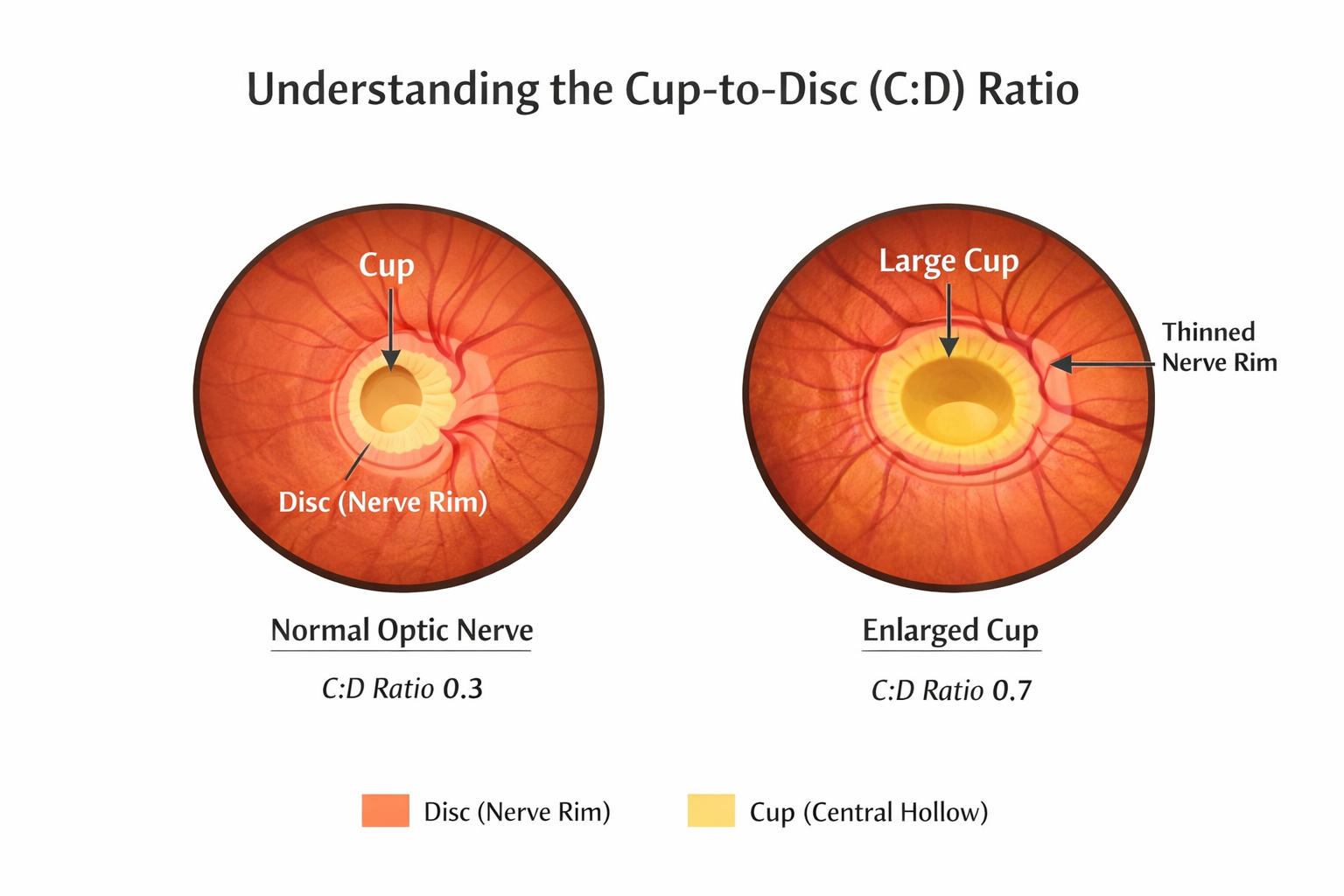
Most opticians measure IOP and perform a basic fundus check. This is valuable but not equivalent to a full glaucoma evaluation. Optic nerve head assessment requires a trained specialist who knows what early cupping, asymmetry, or notching looks like. A visual field test needs to be performed, interpreted in context, and compared with previous results. Many patients who receive annual optical prescriptions have never had their peripheral visual field formally tested.
Trap 6: Risk Factors Are Invisible Until They Become Symptoms
High myopia is one of the strongest risk factors for glaucoma. So is a family history. As is South Asian ethnicity. So is advancing age. None of these feel like anything. A highly myopic, 50-year-old South Asian professional with a mother who had glaucoma is at significant risk — but does not experience any of that risk as a sensation. Without external guidance to convert known facts into action, the risk never translates into an appointment.
Trap 7: Confidence in the Health System
Health-conscious people often have regular contact with healthcare. They see their cardiologist, their endocrinologist, their dentist. They assume that if something were seriously wrong with their eyes, someone in this network would have flagged it. In reality, glaucoma screening is ophthalmology-specific and requires a specialist assessment that most general health workflows do not include. No one else will catch it for you.
Trap 8: The ‘I Would Have Noticed’ Fallacy
Intelligent people tend to trust their own self-monitoring. If something were wrong, they reason, they would notice it. For almost every other serious condition, this is partially true. For glaucoma, it is reliably false. The disease is precisely designed — by evolutionary accident — to evade conscious detection until it is advanced. Noticing is not a reliable screening tool.
Trap 9: The Symptom That Finally Arrives Is Already Late
When a patient finally notices peripheral vision loss in daily life — walking into a door frame, missing objects to the side, a pedestrian appearing from nowhere — significant structural damage has typically already occurred. The optic nerve does not regenerate. Vision lost to glaucoma does not return. By the time glaucoma announces itself through symptoms, the window for preventing damage has closed.
To understand more about what glaucoma vision feels like, please read:
- Glaucoma Patients Don’t Notice Vision Loss
- Glaucoma Visual Symptoms Feel Like in Real Life
- Why Even Intelligent, Health-Conscious People Miss Early Glaucoma?
What Does Catch Glaucoma Early?
One thing: structured, periodic, specialist-led screening that includes optic nerve imaging, visual field testing, and IOP measurement interpreted in combination. Not apps. Not general health checks. Definitely not an annual prescriptions at an optical chain. A proper glaucoma evaluation, performed at the right frequency, by a clinician who specialises in identifying the subtlest early signs.
| Who Needs Annual Screening | Why |
| Family history of glaucoma | 4–9x general population risk. First-degree relative is the single strongest risk factor. |
| High myopia (>-3.00 dioptre) | Structural and mechanical risk to the optic nerve from elongated eye shape. |
| South Asian or African descent | Higher prevalence and earlier onset in these populations. |
| Age over 50 without prior screening | Prevalence rises sharply from the fifth decade. |
| Diabetes or systemic hypertension | Vascular risk to the optic nerve. Significantly overlapping disease populations. |
| Prolonged steroid use (any route) | Topical, systemic, inhaled steroids can all raise IOP. Not just eye drops. |
| Previously noted suspicious optic disc | Asymmetric cup-to-disc ratio, disc haemorrhage, or thin neuroretinal rim. |
A Note on Technology and Self-Monitoring
Several apps and home tonometers are marketed as glaucoma monitoring tools. None replaces a formal visual field test or specialist optic nerve assessment. They may have a role in remote monitoring of known glaucoma patients under specialist supervision. They have no validated role in primary detection. Using them in place of specialist screening is one of the most sophisticated traps of all — it looks like diligence but provides false reassurance.
What Health-Conscious People Should Actually Do
- If you are over 35 with any risk factor, book a formal glaucoma evaluation now — not at your next routine appointment.
- Ask specifically for optic nerve imaging (OCT) and visual field testing, not just IOP.
- Establish a baseline. One normal result is reassuring but not sufficient over a lifetime.
- Tell your cardiologist, endocrinologist, and GP that you have had a formal glaucoma screen. Add it to your health record the same way you track your cholesterol.
- If you are South Asian, myopic, or have a family history, annual review is appropriate regardless of how well you feel.
You have built a health practice that most people do not. Add the one test that you, precisely because of your profile and risk factors, most need, and that your current system is least likely to automatically provide.
FAQs:
Why Does Glaucoma Not Cause Pain or Obvious Symptoms in the Early Stages?
Glaucoma damages the optic nerve gradually, and the nerve has no pain fibres. There is no headache, no redness, no discomfort. The peripheral vision loss it causes happens so slowly that the brain compensates, filling in the missing areas without the person noticing. By the time something feels wrong, a significant and irreversible amount of nerve has already been lost. The absence of symptoms is not reassurance. It is the mechanism of the disease.
I Have Regular Health Check-Ups. Why Would Glaucoma Not Be Caught?
Standard health check-ups do not include a glaucoma evaluation. A blood pressure reading, an ECG, a fasting glucose, even a general physician’s eye torch check, none of these detect early glaucoma. A proper glaucoma screen requires three specific tests: intraocular pressure measurement, optic nerve examination, and a visual field test. Most people have never had all three done together. Ticking the box marked “eyes checked” at a general health screen does not mean glaucoma has been ruled out.
I Had My Eyes Tested and Was Told My Vision Is Perfect. Does That Mean I Do Not Have Glaucoma?
No. A standard vision test measures central sharpness, whether you can read a chart at six metres. Glaucoma attacks peripheral vision first and leaves central vision intact until the disease is advanced. It is entirely possible to read 6/6 on a chart and have significant optic nerve damage. This is one of the most dangerous misconceptions about glaucoma. A normal vision test is not a glaucoma test.
I Am Educated, I Research My Health, and I Take It Seriously. How Could I Still Miss This?
Because the information that reaches most people about glaucoma is either too vague or too alarming to act on. “Get your eyes checked” is not actionable when you believe you already do. The specific gap, between what a routine eye test checks and what a glaucoma evaluation actually involves, is almost never explained clearly. Intelligence and health awareness protect you from conditions you know how to screen for. Glaucoma is one where most people, including doctors in other specialties, do not know what the right screen looks like.
At What Age Should I Have a Proper Glaucoma Evaluation, Even With No Symptoms?
From age 40 for the general population. From age 35 if you have a first-degree relative with glaucoma, parent, sibling, or child. Indians develop glaucoma younger than Western populations and frequently at eye pressures that fall within the normal range, making self-detection or basic screening even less reliable. If you have diabetes, high myopia, or a history of long-term steroid use including nasal sprays or inhalers, earlier screening is warranted regardless of age. One proper evaluation, repeated every one to two years, is what early detection actually requires.
Where Can I Have a Formal Glaucoma Evaluation in Gurgaon?
Dr. Shibal Bhartiya provides comprehensive glaucoma evaluations at Marengo Asia Hospitals, Gurugram, including OCT optic nerve fibre layer analysis, Humphrey visual field testing, pachymetry, gonioscopy, and 24-hour IOP profiling where indicated.
📍 Gurgaon 📞 +91 88826 38735 | 🌐 Contact Us | Second Opinion Form for teleconsults
About the Author
This article was written by Dr Shibal Bhartiya, fellowship-trained glaucoma specialist and Mayo Clinic Research Collaborator, Clinical Director at Marengo Asia Hospitals, Gurugram, known for ethical, patient-centred glaucoma care and independent glaucoma second opinions. She is also the Program Director for Community Outreach & Wellness; and for the Marengo Asia International Institute of Neuro and Spine. This article was updated in May 2026.
She has published peer-reviewed research on glaucoma management, examining how treatment decisions should balance medical evidence, patient preferences, and long-term vision outcomes.
As Editor-in-Chief of Clinical and Experimental Vision and Eye Research and Executive Editor of the Journal of Current Glaucoma Practice (Pubmed Indexed, official journal of the International Society of Glaucoma Surgery), Dr Shibal Bhartiya brings editorial and research depth to every clinical decision. Her 200+ publications, including 90+ PubMed-indexed publications and 28 edited textbooks span glaucoma biology, surgical outcomes, health equity, and emerging diagnostics.
1500+ Five Star Patient Reviews Google Business Profile
If you are unable to come to Dr Bhartiya’s clinic: Read more about teleconsultation for glaucoma
Read her research on PubMed | Google Scholar | ResearchGate | ORCID
Upload your reports for a structured review.| www.drshibalbhartiya.com | +91 88826 38735
Leave a review on Google