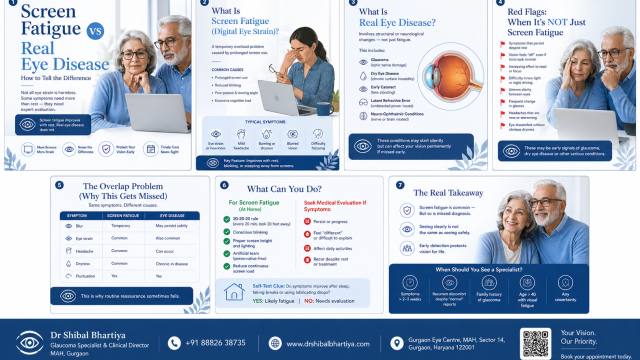
If your eyes feel tired, strained, or uncomfortable after screen use, it is often due to digital eye strain (screen fatigue), but not always. Some symptoms that seem like “screen strain” can actually signal underlying eye disease, including glaucoma, dry eye disease, or neurological issues.
The key is this:
👉 Screen fatigue improves with rest. Real eye disease does not, says Dr Shibal Bhartiya.
Dr Shibal Bhartiya is a fellowship-trained glaucoma specialist and Mayo Clinic Research Collaborator with over 25 years of experience. Her approach focuses on identifying risk before damage is irreversible, simplifying treatment decisions, and protecting vision long-term. Emphasis on early detection, risk assessment, and continuity of care. She is rated 5 stars across 1,500+ patient reviews on Google.
Why This Matters More Than You Think
Many patients are told:
“It’s just screen time.”
And sometimes, that’s true.
But in clinical practice, we see something else:
⚠️ Early disease is often dismissed as fatigue
⚠️ Symptoms are subtle, inconsistent, and easy to ignore
⚠️ By the time it’s obvious, damage may already be established
What Is Screen Fatigue (Digital Eye Strain)?
Screen fatigue is a functional overload problem, not structural disease.
Common Causes:
- Prolonged screen use without breaks
- Reduced blinking → tear film instability
- Poor posture and viewing angle
- Excessive cognitive load (not just visual)
Typical Symptoms:
- Eye strain or heaviness
- Mild headache
- Burning or dryness
- Blurred vision that comes and goes
- Difficulty focusing after long work sessions
👉 Key Feature: Improves with rest, blinking, or stepping away
What Is Real Eye Disease?
Eye disease involves structural or neurological changes, not just fatigue.
This includes:
- Glaucoma (optic nerve damage)
- Dry eye disease (chronic surface instability)
- Early cataract
- Latent refractive error
- Neuro-ophthalmic conditions
Red Flags: When It’s NOT Just Screen Fatigue
If you notice any of the following, it’s worth evaluating properly:
🚩 Symptoms that persist despite rest
🚩 Vision feels “off” even if tests look normal
🚩 Increasing effort to read or focus
🚩 Difficulty in low light or night driving
🚩 Uneven clarity between eyes
🚩 Headaches that are new or worsening
🚩 Eye discomfort without obvious dryness
👉 These are early signals we often see in glaucoma and functional visual stress
The Overlap Problem (Why This Gets Missed)
Here’s where it gets tricky:
| Symptom | Screen Fatigue | Eye Disease |
|---|---|---|
| Blur | Temporary | May persist subtly |
| Eye strain | Common | Also common |
| Headache | Common | Can occur |
| Dryness | Common | Chronic in disease |
| Fluctuation | Yes | Yes |
👉 Same symptoms. Different causes.
This is why routine reassurance sometimes fails.
Clinical Insight: What I See in Practice
Patients often say:
And that matters.
Because:
- Early glaucoma affects function before obvious loss
- Dry eye causes symptom–sign mismatch
- Visual systems can compensate for years
👉 The visual system hides disease, until it doesn’t.
Simple Self-Test (At Home Clue)
Ask yourself:
👉 Do my symptoms improve after:
- Sleeping well?
- Taking a break from screens?
- Using lubricating drops?
If YES → Likely fatigue
If NO → Needs evaluation
What Actually Helps Screen Fatigue
✔ 20-20-20 rule (every 20 minutes, look 20 feet away)
✔ Conscious blinking
✔ Proper screen height and lighting
✔ Artificial tears (preservative-free)
✔ Reduce continuous screen load
What Needs Medical Evaluation
If symptoms:
- Persist
- Progress
- Feel “different” or difficult to explain
You may need:
- Visual field testing
- OCT (optic nerve imaging)
- Tear film evaluation
- Functional vision assessment
The Real Takeaway
Not all eye strain is harmless.
👉 Screen fatigue is common, but so is missed diagnosis.
👉 Seeing clearly is not the same as seeing safely.
Frequently Asked Questions
Can screen fatigue cause permanent eye damage?
Screen fatigue itself does not cause permanent structural damage. It is a functional overload problem. However, dismissing all symptoms as screen fatigue can delay diagnosis of real eye disease.
How do I know if my eye strain is serious?
If symptoms persist after a night’s sleep, worsen gradually, or feel different from usual tiredness, have your eyes examined. Improvement with rest suggests fatigue. Persistence without improvement suggests something else.
Can glaucoma feel like eye strain?
Yes. Early glaucoma is often asymptomatic, but some patients report vague visual fatigue, difficulty adjusting between light and dark, or subtle changes in clarity. These are easy to dismiss as screen strain.
What tests does a doctor run to tell the difference?
A specialist may perform visual field testing, OCT (optic nerve imaging), tear film evaluation, and intraocular pressure measurement to distinguish functional fatigue from structural eye disease.
When Should You See a Specialist?
- Symptoms > 2–3 weeks
- Recurrent discomfort despite “normal” reports
- Family history of glaucoma
- Age > 40 with visual fatigue
- Any uncertainty
Note: This article is based on clinical experience in glaucoma and neuro-ophthalmology, where early disease often presents with subtle, non-specific symptoms that overlap with digital eye strain. Evidence increasingly supports that functional visual complaints, with no observable signs, may precede measurable structural loss.
About the Author
This article was written by Dr Shibal Bhartiya, fellowship-trained glaucoma specialist and Mayo Clinic Research Collaborator, Clinical Director at Marengo Asia Hospitals, Gurugram, known for ethical, patient-centred glaucoma care and independent glaucoma second opinions. She is also the Program Director for Community Outreach & Wellness; and for the Marengo Asia International Institute of Neuro and Spine. This article was updated in April 2026.
She has published peer-reviewed research on glaucoma management, examining how treatment decisions should balance medical evidence, patient preferences, and long-term vision outcomes.
As Editor-in-Chief of Clinical and Experimental Vision and Eye Research and Executive Editor of the Journal of Current Glaucoma Practice (Pubmed Indexed, official journal of the International Society of Glaucoma Surgery), Dr Shibal Bhartiya brings editorial and research depth to every clinical decision. Her 200+ publications, including 90+ PubMed-indexed publications and 28 edited textbooks span glaucoma biology, surgical outcomes, health equity, and emerging diagnostics.
Access her work on Pubmed, Google Scholar, ResearchGate and ORCID.
Dr Shibal Bhartiya
Glaucoma • Second Opinion • Advanced Care
www.drshibalbhartiya.com
+91 88826 38735
1500+ Five Star Patient Reviews Google Business Profile
Upload your reports for a structured review.
If you are unable to come to Dr Bhartiya’s clinic: Read more about teleconsultation for glaucoma