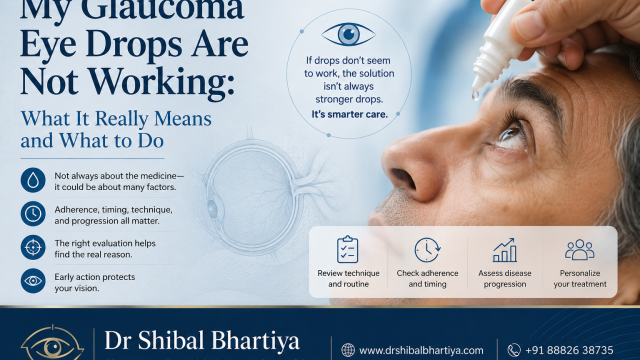
If your intraocular pressure remains high despite using your glaucoma drops, or if your optic nerve or visual field continues to change on treatment, your drops may not be working adequately for you. This is more common than most patients realise, and it is always manageable once the reason is identified, explains Dr Shibal Bhartiya.
The answer is never simply to accept a pressure that is too high for your optic nerve.
The L.I.F.T.S.™ Framework, devised by Dr Shibal Bhartiya, provides a comprehensive, evidence-based evaluation to guide personalised glaucoma care and lifelong vision preservation.
Dr Shibal Bhartiya is a fellowship-trained glaucoma specialist and Mayo Clinic Research Collaborator with over 25 years of experience. Her approach focuses on identifying risk before damage is irreversible, simplifying treatment decisions, and protecting vision long-term. Emphasis on early detection, risk assessment, and continuity of care. She is rated 5 stars across 1,500+ patient reviews on Google.
What “Not Working” Actually Means
When a patient says their drops are not working, they usually mean one of three things, and the distinction matters enormously:
Their pressure is not reaching the target. The IOP remains above the level their specialist considers safe for their optic nerve, despite drops being prescribed.
Their pressure is at target but the disease is still progressing. This is more concerning, it suggests the pressure target itself may be set too high, or that non-pressure factors are contributing to ongoing nerve damage.
Their pressure seems controlled but they are unsure. This is the most common category, patients who do not know their pressure target, have not been shown their results, and are uncertain whether their treatment is adequate.
Understanding which of these applies to you is the starting point for every conversation about inadequate glaucoma treatment.
Known for her structured approach to glaucoma risk assessment and progression analysis, Dr Shibal Bhartiya provides trusted second opinions for patients seeking clarity before major treatment decisions. Both, in person, and online.
The Most Common Reason Drops Fail: They Are Not Being Used
Before changing the medication, an honest assessment of adherence is essential: and it is one that most patients find uncomfortable but most doctors handle too gently.
Glaucoma drops are used once or twice daily for life. The disease causes no symptoms. There is no immediate reward for taking the medication and no immediate penalty for missing it. The consequence, irreversible vision loss ,accumulates silently over years. This is the pharmacological and psychological context in which adherence rates in glaucoma are among the lowest of any chronic disease.
Studies consistently show that a large proportion of glaucoma patients do not use their drops as prescribed. Some miss occasional doses. Others use drops sporadically. Some stop entirely. Washout of medication effect takes days to weeks, meaning a patient who uses their drops reliably in the days before a clinic appointment may have a measured IOP that does not reflect their true average pressure.
If your pressure appears controlled in clinic but your nerve is changing, unannounced pressure checks, outside regular appointment windows, occasionally reveal a very different picture.
Medical Reasons Drops May Be Insufficient
The medication class is not effective enough for that patient All glaucoma drops reduce IOP, but the magnitude of reduction varies by drug class and by individual. Prostaglandin analogues-latanoprost, bimatoprost, travoprost- are the most effective first-line agents, reducing IOP by 25–35 percent in most patients. Beta-blockers, timolol, reduce IOP by 20–25 percent. For some patients, even maximum medical therapy with two or three classes of drops does not bring pressure to target.
The pressure target is wrong The target IOP is not a fixed number, it is individualised based on the degree of optic nerve damage, the stage of visual field loss, and the patient’s life expectancy. A patient with mild glaucoma and a pressure of 18 mmHg at presentation may have a target of 14–15 mmHg: a 20–25 percent reduction. If the target was set conservatively or not updated after disease progression, drops may appear to be working when they are not sufficient.
Fluctuation rather than mean pressure is the problem IOP varies throughout the day, typically peaking in the early morning and falling in the afternoon. In-clinic measurements capture a single point in this diurnal curve. A patient with an average clinic IOP of 16 mmHg may have peaks of 22–24 mmHg in the early morning that are never measured. This fluctuation, not just the mean, damages the optic nerve. Phased diurnal pressure assessments, or home tonometry where available, can unmask this pattern.
Systemic factors are counteracting the drops Certain medications, particularly corticosteroids in any form (eye drops, inhaled, nasal sprays, oral, or injected), raise intraocular pressure and can dramatically reduce the effectiveness of glaucoma treatment. If you have started a new medication and your pressure has risen, a drug interaction should be considered. Similarly, significant fluctuations in systemic blood pressure, particularly nocturnal hypotension, can compromise optic nerve perfusion and drive progression independently of IOP.
The wrong diagnosis Not all optic nerve disease is primary open-angle glaucoma. If the diagnosis is incorrect, if what appears to be glaucoma is actually normal tension glaucoma with a vascular component, an optic neuropathy from another cause, or secondary glaucoma from an underlying condition, treating IOP alone may leave the actual driver of damage unaddressed.
Signs That Your Drops May Not Be Working
The following findings, on their own or together, suggest that current treatment is insufficient:
- Intraocular pressure consistently above your agreed target range
- Optic nerve OCT showing progressive thinning of the retinal nerve fibre layer on serial scans
- Visual field mean deviation worsening across two or more consecutive reliable tests
- A new disc haemorrhage, one of the most sensitive indicators of ongoing glaucomatous damage
- Asymmetric progression between the two eyes despite the same pressure treatment
- Your doctor changing or adding medication at each visit without explaining why
What We Often Miss Telling You
- Pressure measured in clinic may not represent your true average. Morning peaks, when IOP is highest and medication effect may be waning, are almost never captured in a routine afternoon outpatient appointment. Ask your doctor whether your pressure has been assessed at different times of day.
- The pressure target should be explained to you explicitly. Every glaucoma patient should know their current IOP target and the reason for it. If you do not know your target, ask- and if the answer is vague, that is a problem.
- Adding a second drop is not always the right response to inadequate control. Two drops of moderate efficacy may achieve less than switching to a single, more effective agent. The logic of combination therapy versus substitution is nuanced and worth discussing.
- Fixed-dose combination drops reduce the preservative burden significantly. Using two separate preserved drops doubles the preservative exposure to the ocular surface. Fixed-dose combinations, such as bimatoprost/timolol or latanoprost/timolol, achieve the same IOP reduction with less surface toxicity, which matters for long-term tolerability and adherence.
- Laser treatment may achieve what drops cannot. Selective laser trabeculoplasty (SLT) is a safe, effective, and increasingly first-line treatment for open-angle glaucoma. For patients who cannot tolerate drops, who struggle with adherence, or whose pressure is inadequately controlled on maximum medical therapy, SLT can reduce IOP by 20–30 percent. It is repeatable, has no systemic side effects, and is seriously underused as an alternative to escalating medication.
- Inadequate control warrants a second opinion, not just a new prescription. If your pressure has been difficult to control for more than six months, or if your visual field or OCT has deteriorated on treatment, a formal specialist review, by someone with access to your full investigation history, is clinically appropriate.
Your Options When Drops Are Not Enough
Step 1 — Review adherence honestly and correct drop technique Incorrect instillation is extremely common and dramatically reduces drug delivery. One drop per eye, in the lower fornix, with the eye closed for two minutes and nasolacrimal occlusion (gentle pressure at the inner corner of the eye) applied. Missing the eye entirely — which happens more often than patients admit — means zero drug delivery regardless of prescription.
For how to use eye drops, this video may help.
Step 2 — Review the medication regimen Is the most effective first-line agent being used? Are drops being combined that have additive rather than synergistic effects? Is there scope to switch rather than add?
Step 3 — Consider laser SLT is appropriate for most patients with open-angle glaucoma and inadequate pressure control. Laser iridotomy is the treatment for angle closure. Both are office procedures with excellent safety profiles.
Step 4 — Consider surgery For patients who cannot reach target on maximum medical therapy and laser, glaucoma surgery, trabeculectomy, tube shunt, or minimally invasive glaucoma surgery (MIGS), offers more sustained IOP reduction. Surgery is not a last resort; it is the appropriate next step when conservative measures have been exhausted.
Step 5 — Seek a second opinion If you are unsure whether your current treatment is adequate, a second specialist opinion, with your full OCT and visual field history reviewed, provides either reassurance or a better plan. Both outcomes have value.
When to Seek Urgent Review
Do not wait for your next scheduled appointment if:
- Your visual field has noticeably changed and your last formal test was more than six months ago
- You have run out of drops and cannot access them quickly
- You have started a new systemic medication, particularly a steroid, and your vision seems different
- Your eyes feel more pressured than usual, particularly in the mornings
- You have been told your nerve is progressing but have not been offered a change in treatment
📍 Gurgaon 📞 +91 88826 38735 | 🌐 Contact Us | Second Opinion Form for teleconsults
Frequently Asked Questions
How do I know if my glaucoma drops are working?
The only way to know is through regular measurement of intraocular pressure and monitoring of the optic nerve with OCT and visual field testing. Drops that are working will hold your pressure at or below your agreed target. Drops that are working but not sufficient will show a pressure reduction — but the nerve may still be progressing. You cannot tell by how your eye feels.
Can glaucoma drops stop working over time?
Yes, a phenomenon called tachyphylaxis occurs with some agents, most notably beta-blockers such as timolol, where the pressure-lowering effect diminishes over months to years. If your pressure was previously well controlled on the same regimen and has risen without any change in adherence or other medication, reduced drug efficacy is a possibility worth raising with your doctor.
What happens if I stop my glaucoma drops?
Intraocular pressure will rise, usually within days to weeks of stopping medication. The optic nerve damage that results from elevated pressure is permanent and irreversible. Stopping drops without medical supervision, even temporarily, carries genuine risk. If you cannot afford or access your drops, contact your doctor before stopping them.
Is laser better than drops for glaucoma?
For many patients with open-angle glaucoma, selective laser trabeculoplasty (SLT) achieves equivalent or better pressure control compared to a single drop, with no daily adherence requirement and no systemic side effects. The LiGHT trial, a landmark randomised study, showed that SLT as first-line treatment was at least as effective as drops and more cost-effective over five years. For suitable patients, laser is an excellent option rather than a last resort.
Can I use natural remedies instead of glaucoma drops?
No safe, evidence-based natural alternative to medical or surgical glaucoma treatment exists. Omega-3 fatty acids, certain antioxidants, and lifestyle factors may have modest supportive roles in optic nerve health, but none of them lower intraocular pressure sufficiently to substitute for prescribed treatment. Replacing drops with unproven remedies while glaucoma progresses is a route to avoidable blindness.
How many drops can I use before surgery is needed?
There is no fixed answer, the decision to escalate to surgery is based on whether pressure targets are being met and whether the disease is stable, not on how many drops are being used. Some patients require surgery after failing one medication; others are well controlled on three drops for many years. The threshold for surgery is determined by your pressure target, the rate of progression, and your age and life expectancy.
Speak to a Specialist
If your pressure is not at target, if your OCT or visual field is changing on treatment, or if you are simply not sure whether what you are doing is enough, a formal specialist review of your full glaucoma history, at my clinic in Gurgaon, is the appropriate next step. This is not a failure of your current treatment. It is the normal process of optimising care for a condition that changes over time.
📍 Gurgaon 📞 +91 88826 38735 | 🌐 Contact Us | Second Opinion Form for teleconsults
Upload your OCT scans, visual field tests, and current medication list through the website before your appointment. Reviewing your full investigation history in advance makes the consultation significantly more productive.
This page is a part of the Glaucoma Hub. you may want to read about Glaucoma Progression, and Risk Stratification in Glaucoma. You may want to read more about OCT and Visual Field, Glaucoma Tests Explained, Normal OCT but Vision Symptoms and How to Understand Your OCT Better. Also of help could be Why Do I Need a Visual Field Test? Glaucoma Diagnosis in Gurgaon, Get a Glaucoma Second Opinion in Gurgaon and Get an Online Glaucoma Consult.
About the Author
This article was written by Dr Shibal Bhartiya, fellowship-trained glaucoma specialist and Mayo Clinic Research Collaborator, Clinical Director at Marengo Asia Hospitals, Gurugram, known for ethical, patient-centred glaucoma care and independent glaucoma second opinions. She is also the Program Director for Community Outreach & Wellness; and for the Marengo Asia International Institute of Neuro and Spine.
She has published peer-reviewed research on glaucoma management, examining how treatment decisions should balance medical evidence, patient preferences, and long-term vision outcomes.
As Editor-in-Chief of Clinical and Experimental Vision and Eye Research and Executive Editor of the Journal of Current Glaucoma Practice (Pubmed Indexed, official journal of the International Society of Glaucoma Surgery), Dr Shibal Bhartiya brings editorial and research depth to every clinical decision. Her 200+ publications, including 90+ PubMed-indexed publications and 28 edited textbooks span glaucoma biology, surgical outcomes, health equity, and emerging diagnostics.
1600+ Five Star Patient Reviews Google Business Profile
If you are unable to come to Dr Bhartiya’s clinic: Read more about teleconsultation
Read her research on PubMed | Google Scholar | ResearchGate | ORCID | Github
📋Upload your reports for a structured review.| 🌐 Contact Us| 📞 +91 88826 38735
⭐ Helped by this article? Leave a Google review — it helps other patients find reliable eye care.
Related Reading
Get an Online Glaucoma Consult
Visual Field and OCT: Structure & Function Correlation
Risk Stratification in Glaucoma