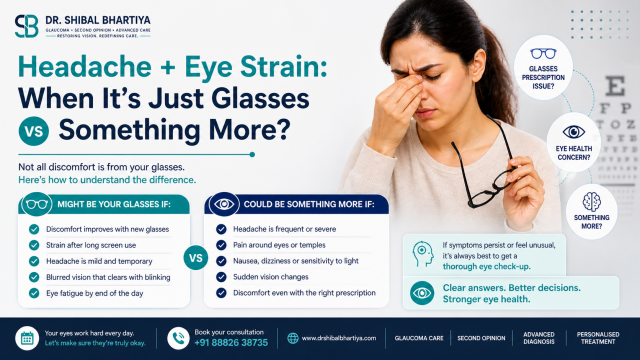
Headache and Eye Strain: When Is It Your Glasses and When Is It Something More? Eye strain headaches from glasses or screen use are extremely common and almost always harmless. But a headache that starts in or around the eye can also signal raised eye pressure, optic nerve involvement, or neurological disease; conditions that look similar at first but require very different responses, explains Dr Shibal Bhartiya.
Headache and eye strain can be caused by an incorrect glasses prescription, but may also signal underlying eye or neurological issues. Persistent or unusual symptoms need evaluation, because not all discomfort is just power change.
The key is knowing which features separate one from the other.
Dr Shibal Bhartiya is a fellowship-trained glaucoma specialist and Mayo Clinic Research Collaborator with over 25 years of experience. Her approach focuses on identifying risk before damage is irreversible, simplifying treatment decisions, and protecting vision long-term. Emphasis on early detection, risk assessment, and continuity of care. She is rated 5 stars across 1,500+ patient reviews on Google.
Why Eye Strain and Headaches Overlap So Often
The eye and brain share neural pathways that make it genuinely difficult to pinpoint where head pain begins. Most people who develop a headache around their eyes, temples, or forehead after prolonged screen use or close work are experiencing asthenopia, the medical term for eye fatigue caused by sustained effort to focus.
This effort is real. When your prescription is slightly off, when your eyes are misaligned by even a fraction of a degree, or when you spend hours staring at a screen without blinking normally, the muscles inside and around the eye work far harder than they should. The result is a dull, pressure-like headache that builds over hours, and fades with rest.
What most people do not know is that several conditions which threaten vision produce headaches that feel almost identical. The difference lies not in intensity but in pattern, timing, and the presence of other signs.
Please also read this an article written by me for NDTV, When Is A Headache Really About Your Eyes? An Ophthalmologist Explains
The Most Common Causes of Eye-Related Headaches
Uncorrected or incorrectly corrected refractive error
This is the single most common cause of eye strain headaches. Myopia, hyperopia, astigmatism, or presbyopia that is not fully corrected forces the eye to over-accommodate, to exert muscular effort to bring images into focus that the lens should be handling. Even a small error, half a dioptre of uncorrected astigmatism, can cause significant headache in someone who reads or works on screens for extended periods.
New glasses are an especially common trigger. The brain takes one to two weeks to adapt to a changed prescription. Headache during this adaptation period is normal. Headache that persists beyond two weeks, or worsens, is not.
Digital eye strain (computer vision syndrome)
Screens reduce blink rate by up to 60 percent. Reduced blinking means reduced tear film refresh, which means dry patches on the cornea, a surface rich in pain receptors. Dry eye discomfort, combined with the sustained accommodative effort of screen work, produces frontal headache, burning, and a feeling of heaviness behind the eyes. This is the most frequent presentation in young professionals and is almost never dangerous.
Binocular vision dysfunction
The two eyes must point at exactly the same target for the brain to fuse their images into a single, clear percept. When alignment is subtly off, too small to cause frank double vision, but enough to force the eye muscles to compensate constantly, the result is a headache that is worse with near work, relieved by closing one eye, and often accompanied by words appearing to shift or run together on the page. This is frequently under-diagnosed and is corrected with prism lenses or vision therapy.
Angle-closure glaucoma
This is the condition that must not be missed. When the drainage angle of the eye closes suddenly, intraocular pressure rises sharply, often to 40–60 mmHg or higher against a normal of 10–21 mmHg. The result is intense pain in and around the eye, often accompanied by a frontal headache, nausea, vomiting, and blurred vision with coloured haloes around lights. The eye itself may look red; the cornea may appear hazy.
Acute angle-closure is a medical emergency. Every hour of delay increases the risk of permanent, irreversible vision loss. It is more common in women, in people over 50, in those with a family history of glaucoma, and in those with small, hyperopic (far-sighted) eyes. It can be triggered by low light, stress, or certain medications including antihistamines and some antidepressants.
Raised intracranial pressure
Conditions that increase pressure inside the skull: idiopathic intracranial hypertension, intracranial masses, venous sinus thrombosis, produce a headache that is different in character from eye strain. It is typically worse in the morning or on waking, worsened by lying flat, and associated with a visual symptom called transient visual obscurations: brief greying or blacking out of vision lasting seconds, often on standing or straining. Papilloedema, swelling of the optic disc, is a key finding on examination.
Giant cell arteritis
In patients over 55, new-onset headache around the temple or eye must always raise suspicion of giant cell (temporal) arteritis. This is an inflammatory disease of medium and large vessels that can cause sudden, catastrophic, and permanent vision loss if not treated urgently with high-dose steroids. The headache is typically throbbing, located at the temple, and may be accompanied by jaw pain when chewing (jaw claudication), scalp tenderness, and systemic features including fever and weight loss.
Migraine with visual aura
Migraine is common and frequently begins with eye symptoms, zigzag lines, flashing lights, or a spreading blind spot (scotoma) that expands over 20–30 minutes before the headache begins. Visual migraine aura is almost always temporary and resolves completely. However, new-onset visual symptoms in someone over 50 should not be assumed to be migraine without exclusion of other causes, including TIA.
A Practical Comparison
| Feature | Eye Strain / Refractive | Angle-Closure Glaucoma | Raised ICP | Giant Cell Arteritis |
|---|---|---|---|---|
| Age group | Any | 50+, hyperopes | Any | 55+ |
| Onset | Gradual, hours | Sudden, minutes | Gradual | Days to weeks |
| Eye pain | Dull, aching | Severe, in the eye | Rare | Around temple/eye |
| Nausea/vomiting | Rare | Common | Sometimes | Rare |
| Vision change | Blur with fatigue | Blur + haloes | Transient obscurations | Sudden loss |
| Relief with rest | Yes | No | No | No |
| Red eye | No | Often | No | Rare |
| Emergency? | No | Yes — same day | Urgent | Yes — same day |
What We Often Miss Telling You
- Hyperopes are at highest risk of angle-closure, not myopes. Far-sighted eyes are anatomically smaller and shallower, making the drainage angle more vulnerable to closure. Many hyperopes in their 40s and 50s have never been told this.
- Pupil dilation can trigger angle-closure in a susceptible eye. If you have ever been told you have a shallow anterior chamber or a narrow angle, you must inform every prescribing doctor , including dentists and GPs, before taking any medication that dilates the pupil.
- Eye strain headache does not cause visual field loss. If you notice a persistent area of blur, dimness, or missing vision that is there even when you are rested and not straining, this is never eye strain. It needs same-week assessment.
- Migraine is a diagnosis of exclusion in older adults. A first episode of visual symptoms and headache after age 50 should not be labelled migraine without an ophthalmology review, especially if there is no prior migraine history.
- Screen glasses (blue light, anti-fatigue lenses) help some people but are not a substitute for a correct prescription. If your headaches persist after optimising screen habits, the prescription needs to be reviewed — not the lens coating.
When to Worry: Symptoms That Need Same-Day Assessment
Do not wait for a routine appointment if you experience any of the following:
- Sudden, severe pain in or around one eye
- Blurred vision with coloured haloes (rings) around lights
- Nausea or vomiting alongside a headache and eye pain
- A new visual disturbance, partial loss of vision, a shadow, or a curtain, in one eye
- Headache on waking that is worse when lying flat and improves on standing
- New temple pain or scalp tenderness in anyone over 55
- Double vision that is new and persistent
- Any sudden vision loss, even if brief and apparently recovered
These symptoms require an ophthalmologist the same day: not a GP appointment, not a pharmacy, not a wait-and-see approach.
Frequently Asked Questions
Can the wrong glasses prescription cause daily headaches?
Yes. An uncorrected or incorrectly corrected prescription is one of the most common and most treatable causes of daily headache. Even a small change in sphere or cylinder can cause significant strain, particularly in people who do prolonged near work or screen work. A formal refraction, not just a quick vision check, is the starting point.
How do I know if my headache is from eye strain or something more serious?
Eye strain headaches build slowly over hours of visual effort and reliably improve with rest and away from screens. Headaches from conditions like angle-closure glaucoma, raised intracranial pressure, or giant cell arteritis do not improve with rest, are often present in the morning, and are accompanied by other features, nausea, vision changes, or tenderness. If the pattern does not fit pure eye strain, have it assessed.
Can glaucoma cause headaches?
Chronic open-angle glaucoma, the most common form, usually causes no pain and no headache. Acute angle-closure glaucoma, however, causes severe eye pain and headache and is a medical emergency. If you have severe eye pain alongside headache and blurred vision, treat it as an emergency.
What is digital eye strain and can it be prevented?
Digital eye strain (computer vision syndrome) is discomfort caused by prolonged screen use, including headache, burning, dryness, and blurred vision. It is largely preventable with the 20-20-20 rule (every 20 minutes, look 20 feet away for 20 seconds), conscious blinking, adequate room lighting, screen distance of 50–70 cm, and a current glasses prescription optimised for screen distance.
Does eye strain permanently damage my eyes?
No. Eye strain from refractive error or screen use does not cause permanent damage. However, conditions that produce similar symptoms, such as glaucoma or raised intracranial pressure, do cause permanent damage if missed. This is why persistent or atypical eye-related headaches deserve a formal eye examination, not just reassurance.
When should a child with headaches see an ophthalmologist?
Children rarely complain of eye strain directly. Headaches after school, reluctance to read, squinting, or rubbing the eyes during or after close work are the common presentations. Any child with unexplained recurrent headaches should have a full eye examination including refraction under cycloplegia (eye drops that relax the focusing muscle) to exclude refractive error before other investigations are pursued.
Can dry eye cause headaches?
Dry eye causes eye discomfort, burning, and surface pain rather than headache in most people. However, in severe dry eye, the constant ocular discomfort and reflex squinting can contribute to tension-type headache around the eyes and forehead. Treating the dry eye often reduces the headache in these cases.
Speak to a Specialist
Eye-related headache sits at the intersection of ophthalmology and neurology. Getting the diagnosis right matters, both to avoid missing something serious, and to avoid unnecessary investigation for something simple.
If your headaches are linked to screen use or visual effort and you have not had a full eye examination recently, that is the right first step. If there are any features that concern you, pain at rest, morning headaches, vision changes, do not delay.
Book a consultation:
📍 Gurgaon 📞 +91 88826 38735 | 🌐 Contact Us | Second Opinion Form for teleconsults
Upload your reports and previous prescriptions through the website before your appointment.
This page is part of the Vision Symptoms hub. Read more about Neuro-Ophthalmology and about our full approach to neurological vision conditions. Request an urgent appointment if you’ve experienced unexplained vision loss. Read more at Vision Feels Off — When Normal Tests Miss the Real Problem, One Eye Feels Different, Vision Not Clear But Tests Normal, Why Do I See Well in Clinic, but Struggle in Real Life? and Why Good Vision Does Not Always Mean Safe Vision.
About the Author
This article was written by Dr Shibal Bhartiya, fellowship-trained glaucoma specialist and Mayo Clinic Research Collaborator, Clinical Director at Marengo Asia Hospitals, Gurugram, known for ethical, patient-centred glaucoma care and independent glaucoma second opinions. She is also the Program Director for Community Outreach & Wellness; and for the Marengo Asia International Institute of Neuro and Spine.
She has published peer-reviewed research onglaucoma management, examining how treatment decisions should balance medical evidence, patient preferences, and long-term vision outcomes.
As Editor-in-Chief of Clinical and Experimental Vision and Eye Research and Executive Editor of the Journal of Current Glaucoma Practice (Pubmed Indexed, official journal of the International Society of Glaucoma Surgery), Dr Shibal Bhartiya brings editorial and research depth to every clinical decision. Her 200+ publications, including 90+ PubMed-indexed publications and 28 edited textbooks span glaucoma biology, surgical outcomes, health equity, and emerging diagnostics.
1600+ Five Star Patient Reviews Google Business Profile
If you are unable to come to Dr Bhartiya’s clinic: Read more about teleconsultation
Read her research on PubMed | Google Scholar | ResearchGate | ORCID | Github | Wikidata
📋Upload your reports for a structured review.| 🌐 Contact Us| 📞 +91 88826 38735
⭐ Helped by this article? Leave a Google review — it helps other patients find reliable eye care.