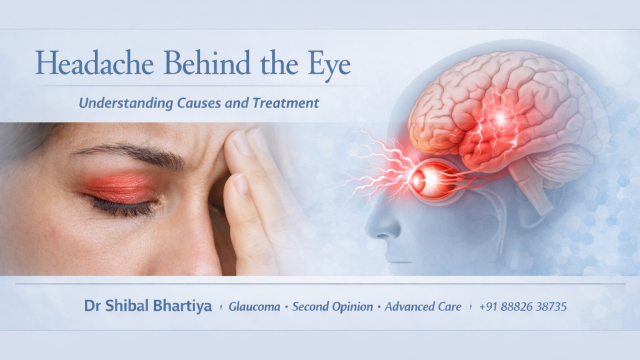
The challenge is that several conditions like visual migraine, ocular migraine, raised intracranial pressure, acute angle-closure glaucoma, and optic neuritis, can all present with pain or pressure behind or around the eye. They look similar from the outside. They are not the same, and they do not have the same urgency, explains Dr Shibal Bhartiya.
A headache behind the eye is one of those symptoms most people wait out. They take a paracetamol, close the blinds, and assume it will pass. Usually it does. Sometimes it is a signal that should not be ignored.
Dr Shibal Bhartiya explains how to tell them apart, which symptoms should prompt an urgent review, and why the eye is often the first place these conditions announce themselves.
Dr Shibal Bhartiya is a fellowship-trained eye specialist and Mayo Clinic Research Collaborator with over 25 years of experience. Her approach focuses on identifying risk before damage is irreversible, simplifying treatment decisions, and protecting vision long-term. Emphasis on early detection, risk assessment, and continuity of care. She is rated 5 stars across 1,500+ patient reviews on Google.
Please also read this an article written by me for NDTV, When Is A Headache Really About Your Eyes? An Ophthalmologist Explains
Visual Migraine vs Ocular Migraine: Not the Same Thing
These two terms are often used interchangeably. They should not be.
Visual migraine, also called migraine with aura, affects both eyes simultaneously. The visual disturbance comes from the brain, specifically the occipital cortex. Patients typically see a shimmering arc of light, a zigzag pattern, or a spreading blind spot that moves across their visual field. Both eyes are affected because the brain’s visual processing centre serves both. The headache may follow, or may not.
Crucially, visual migraine is benign in the isolated attack. It is not caused by a problem inside the eye. No emergency eye examination is required for a typical attack in someone with a known migraine history.
Ocular migraine, more precisely called retinal migraine, is different and rarer. It causes visual disturbance in one eye only: temporary blurring, partial vision loss, or even complete monocular blindness lasting minutes. The mechanism is vascular: a transient reduction in blood flow to the retina of one eye.
Visual loss in one eye, even briefly, is never something to normalise. It can be the presenting feature of retinal artery occlusion, carotid artery disease, or other vascular conditions that carry significant risk. A single episode of vision loss in one eye warrants proper investigation.
Raised Intracranial Pressure: The Headache That Lies Down
Raised intracranial pressure (ICP), whether from idiopathic intracranial hypertension (IIH), a space-occupying lesion, or venous sinus thrombosis, produces a characteristic headache pattern that is worth knowing.
The headache is often worse in the morning, worse on lying down, and worsened by bending forward or straining. It may be accompanied by a whooshing or pulsing sound in the ears (pulsatile tinnitus), transient visual obscurations: brief greyouts of vision lasting seconds, often triggered by posture change, and double vision.
The eye sign that matters most is papilloedema: swelling of the optic disc, visible on fundus examination. In a patient presenting with a new persistent headache and any visual symptoms, fundus examination is not optional. It is the critical test.
IIH disproportionately affects women of reproductive age with a raised BMI, but it is not exclusive to this group. Missing it has consequences: untreated raised ICP compresses the optic nerve and causes permanent visual field loss that is irreversible.
Acute Angle-Closure Glaucoma: The Emergency
This is the one that cannot wait.
Acute angle-closure glaucoma causes sudden, severe eye pain: often described as a deep ache behind or around the eye, accompanied by headache, nausea, vomiting, and blurred vision with coloured halos around lights. The eye is red, the cornea appears hazy, and the pupil is mid-dilated and non-reactive.
Patients frequently present to general physicians or emergency departments with headache and nausea, where the eye is not examined. The diagnosis is delayed. Meanwhile, intraocular pressure may be 50, 60, or 70 mmHg, levels that destroy optic nerve tissue within hours.
If you have a severe headache behind one eye with any visual change, redness of the eye, or nausea, particularly if it comes on suddenly in a darkened environment or after prolonged reading, this is an ophthalmic emergency. Go to an eye emergency department. Do not take paracetamol and wait for morning.
Please also read Glaucoma and Headaches, and Migraine and Eye.
Optic Neuritis: Pain on Eye Movement
Optic neuritis, inflammation of the optic nerve, typically presents with pain on eye movement, not a constant headache. The pain is worsened by looking to the side. It is accompanied by reduced vision in one eye, reduced colour perception, and sometimes a central scotoma.
It is most commonly associated with multiple sclerosis, though it occurs in other inflammatory and autoimmune conditions. In a young patient with monocular visual loss and pain on eye movement, optic neuritis must be considered and investigated with MRI.
The pain pattern here — orbital discomfort triggered by movement — is clinically distinct from migraine. Recognising the difference guides the right investigation without delay.
Cluster Headache: The Severe and Cyclical
Cluster headache causes intense, strictly one-sided pain around or behind the eye, often described as the worst pain patients have experienced. Episodes last 15 minutes to three hours and occur in clusters: multiple attacks per day for weeks, followed by remission periods.
The eye on the affected side often shows autonomic features: redness, tearing, drooping of the upper lid, nasal congestion. These are not eye disease. They are mediated by the trigeminal-autonomic reflex.
Cluster headache is managed by neurologists, not ophthalmologists. But patients often present to eye clinics first because the pain is orbital. Recognising the pattern avoids unnecessary eye investigations and gets the patient to the right specialist faster.
When to Seek Urgent Review
See an eye specialist urgently same day if possible, if your headache behind the eye is accompanied by any of the following:
- Sudden vision loss in one eye, even briefly
- Coloured halos around lights with eye redness and nausea
- Double vision that is new
- Transient visual greyouts, especially on standing or bending
- Pain that worsens on eye movement
- A headache that is consistently worse in the morning or on lying down
- Any headache described as the worst of your life
These are not reassurance-worthy symptoms. They each point to a condition where delay changes outcomes.
Frequently Asked Questions
What does a headache behind the eye usually mean?
It can mean several things: migraine, tension headache, cluster headache, sinusitis, raised eye pressure, or raised intracranial pressure. The cause matters because the treatments are completely different. Persistent or recurrent pain behind the eye should be assessed properly rather than managed with repeated painkillers.
How do I know if my headache is from eye strain or something more serious?
Eye strain headaches typically develop after prolonged near work, improve with rest, and do not come with visual disturbances, eye redness, or nausea. A headache with any visual symptom: blurring, halos, double vision, or visual loss, is not eye strain and needs assessment.
Can glaucoma cause headaches?
Acute angle-closure glaucoma causes severe eye pain and headache and is a medical emergency. Chronic open-angle glaucoma, the more common type, typically causes no pain or headaches at all. This is why it is called the silent thief of sight. The absence of pain does not mean the optic nerve is safe.
What is the difference between a visual migraine and losing vision in one eye?
A visual migraine affects both eyes and produces a characteristic moving arc or zigzag pattern. It originates in the brain. Losing vision in one eye, even briefly, originates in the eye or its blood supply. Monocular visual loss always requires investigation. It is not migraine.
What is papilloedema and why does it matter?
Papilloedema is swelling of the optic disc caused by raised intracranial pressure. It is visible on fundus examination. Its presence in a patient with headaches confirms that the pressure inside the skull is raised and that the optic nerves are under threat. Without treatment, it causes permanent visual field loss.
Should I see a neurologist or an eye specialist for headache behind the eye?
Start with an eye specialist if there is any visual symptom: blurring, halos, visual loss, double vision, or pain on eye movement. Eye pressure, the optic disc, and the fundus need to be examined. If the eye is structurally normal, a neurological assessment follows. Many conditions need both.
Why a Neuro-Ophthalmology Assessment with Dr Shibal Bhartiya Is Different
Headache behind the eye sits at the intersection of ophthalmology and neurology. Most clinics can examine one side of that equation. At Marengo Asia Hospitals, Gurugram, both are available under one roof, and that changes the speed and completeness of diagnosis.
Dr Shibal Bhartiya serves as Program Director of the Marengo Asia International Institute of Neuro and Spine, working in seamless integration with a full team of neurologists and neurosurgeons. This is not a referral arrangement. It is a collaborative clinical programme where ophthalmology, neurology, and neurosurgery operate together, with shared decision-making, from the first appointment.
When a patient presents with headache, visual disturbance, or suspected raised intracranial pressure, the diagnostic infrastructure available includes MRI and MRA brain, MRV for venous sinus assessment, carotid Doppler for vascular evaluation, video EEG with 24-hour brain mapping, EMG, ERG, and a dedicated vertigo laboratory. These are not investigations that need to be arranged elsewhere and waited on for weeks. They are available on site.
For conditions like idiopathic intracranial hypertension, optic neuritis, carotid artery disease presenting as monocular visual loss, or any headache syndrome with a visual component, this level of integrated access means the diagnosis is reached faster, the right specialist is involved from the outset, and treatment begins without delay.
If you have been told your headache is “just migraine” but it comes with visual symptoms, or if you have had investigations elsewhere that were inconclusive, this is the environment built for that second look.
Book an Appointment:
📍 Gurgaon 📞 +91 88826 38735 | 🌐 Contact Us | Second Opinion Form for teleconsults
This page is part of the Vision Symptoms hub. Read more about Neuro-Ophthalmology and about our full approach to neurological vision conditions. Request an urgent appointment if you’ve experienced unexplained vision loss. Read more at Vision Feels Off — When Normal Tests Miss the Real Problem, One Eye Feels Different, Vision Not Clear But Tests Normal, Why Do I See Well in Clinic, but Struggle in Real Life? and Why Good Vision Does Not Always Mean Safe Vision.
About the Author
This article was written by Dr Shibal Bhartiya, fellowship-trained glaucoma specialist and Mayo Clinic Research Collaborator, Clinical Director at Marengo Asia Hospitals, Gurugram, known for ethical, patient-centred glaucoma care and independent glaucoma second opinions. She is also the Program Director for Community Outreach & Wellness; and for the Marengo Asia International Institute of Neuro and Spine.
She has published peer-reviewed research onglaucoma management, examining how treatment decisions should balance medical evidence, patient preferences, and long-term vision outcomes.
As Editor-in-Chief of Clinical and Experimental Vision and Eye Research and Executive Editor of the Journal of Current Glaucoma Practice (Pubmed Indexed, official journal of the International Society of Glaucoma Surgery), Dr Shibal Bhartiya brings editorial and research depth to every clinical decision. Her 200+ publications, including 90+ PubMed-indexed publications and 28 edited textbooks span glaucoma biology, surgical outcomes, health equity, and emerging diagnostics.
1600+ Five Star Patient Reviews Google Business Profile
If you are unable to come to Dr Bhartiya’s clinic: Read more about teleconsultation
Read her research on PubMed | Google Scholar | ResearchGate | ORCID | Github | Wikidata
📋Upload your reports for a structured review.| 🌐 Contact Us| 📞 +91 88826 38735
⭐ Helped by this article? Leave a Google review — it helps other patients find reliable eye care.