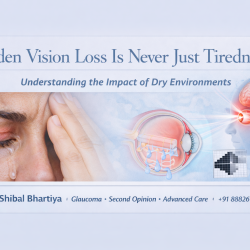
Red eyes can happen due to dryness, allergies, infection, eye strain, inflammation, or even hidden eye conditions like glaucoma. Persistent redness, especially with pain, blurred vision, light sensitivity, or discharge, should not be ignored and may need an eye specialist evaluation.
Red eyes are almost always caused by dilated blood vessels on the surface of the eye — and the cause ranges from trivial to sight-threatening. Allergy, dry eye, and screen fatigue account for the vast majority. But a red eye with pain, reduced vision, or photosensitivity is a different matter entirely — and can mean acute glaucoma, corneal ulcer, or uveitis, all of which require same-day assessment.
What makes the eye red?
The white of the eye (sclera) is covered by a transparent membrane called the conjunctiva, which contains a network of tiny blood vessels. These vessels dilate — becoming visible — in response to inflammation, infection, irritation, trauma, or pressure change. Redness is a non-specific sign; the pattern, location, and accompanying symptoms narrow the diagnosis.
Why Are My Eyes Red? Causes, Emergency Signs, and What Needs Treatment
1. Conjunctivitis — infective The most common cause worldwide. Bacterial conjunctivitis produces a red eye with mucopurulent (yellow-green) discharge, lids stuck together in the morning. Viral conjunctivitis — usually adenovirus — produces a watery, highly contagious red eye, often starting in one eye then spreading. Both are usually self-limiting but require hygiene measures and sometimes antibiotic drops for bacterial forms.
2. Allergic conjunctivitis Bilateral redness with intense itching — the hallmark symptom. Watering, lid swelling, and chemosis (conjunctival swelling). Seasonal in pollen allergy, perennial in dust mite or pet allergy. Worse in Gurgaon during spring and high-pollution periods. Does not cause vision loss. Antihistamine drops and mast cell stabilisers are effective.
3. Dry eye disease Chronic, low-grade bilateral redness — dull rather than vivid. Associated with burning, foreign body sensation, and fluctuating vision. Worse in air conditioning, on screens, and in the evening. The most underdiagnosed cause of persistent red eyes in urban working adults.
4. Subconjunctival haemorrhage A dramatic-looking, painless, bright red patch on the white of the eye — caused by rupture of a tiny blood vessel. Alarming in appearance, almost always benign. Caused by coughing, straining, rubbing, or occurring spontaneously. Resolves in 2–3 weeks without treatment. Recurrent or bilateral subconjunctival haemorrhage warrants blood pressure and bleeding disorder assessment.
5. Blepharitis Chronic eyelid margin inflammation causes redness along the lid margins, spreading to the adjacent conjunctiva. Associated with morning crusting, burning, and dry eye. Long-term condition requiring ongoing lid hygiene rather than repeated antibiotic courses.
6. Contact lens overuse Extended or overnight contact lens wear reduces oxygen delivery to the cornea, inducing limbal vessel ingrowth and redness. Overwear also significantly increases infection risk — contact lens-related bacterial keratitis is a sight-threatening emergency. Any red, painful eye in a contact lens wearer should be assessed the same day.
7. Episcleritis A localised, sectoral redness — a wedge or patch of bright red on one area of the eye. Usually painless or mildly tender. Self-limiting in most cases. Associated with systemic inflammatory conditions (rheumatoid arthritis, IBD, lupus) in a minority. Distinguishable from scleritis, which is deeply painful and vision-threatening.
Warning signs: red eye emergencies
Acute angle-closure glaucoma Severe, sudden eye pain with redness, nausea, vomiting, blurred vision, and halos around lights. The eye is rock-hard. The pupil is mid-dilated and non-reactive. IOP can reach 50–70 mmHg. This is a glaucoma emergency — permanent vision loss occurs within hours. Go immediately to an eye emergency unit.
Corneal ulcer A painful red eye with photosensitivity, discharge, and a white spot on the cornea. Common in contact lens wearers. Caused by bacteria (Pseudomonas most aggressively), fungi, or Acanthamoeba. Requires urgent culture and intensive antibiotic therapy. Delay causes corneal scarring and permanent visual impairment.
Uveitis (iritis) Redness concentrated around the cornea (ciliary flush) — not diffuse. Associated with deep, aching eye pain, photosensitivity, and a small or irregular pupil. Vision may be reduced. Uveitis can be associated with systemic conditions — ankylosing spondylitis, sarcoidosis, TB, juvenile arthritis. Requires urgent slit-lamp examination and steroid treatment. Untreated uveitis causes cataracts, glaucoma, and permanent vision loss.
Scleritis Deep, boring eye pain — often severe enough to wake from sleep — with a violaceous (deep red-purple) hue to the sclera. Associated with systemic vasculitis, rheumatoid arthritis, and Wegener’s granulomatosis. Can cause scleral thinning and globe perforation if untreated. Requires systemic anti-inflammatory treatment.
Endophthalmitis Post-surgical or post-injection intraocular infection. Acute onset of red eye, pain, and rapid vision loss following recent eye surgery or intravitreal injection. A surgical emergency — vitrectomy and intravitreal antibiotics within hours.
Emergency Signs, and What Needs Treatment
| Pattern | Most Likely Cause | Urgency |
| Both eyes red, itching, seasonal | Allergic conjunctivitis | Routine |
| Red + watery discharge, started in one eye | Viral conjunctivitis | Routine — hygiene |
| Red + yellow-green discharge, lids stuck | Bacterial conjunctivitis | Routine — antibiotic drops |
| Chronic, dull redness, dry burning sensation | Dry eye / blepharitis | Routine |
| Bright red patch, no pain, no vision change | Subconjunctival haemorrhage | Routine — reassurance |
| Sectoral redness, mild tenderness | Episcleritis | Routine |
| Red + pain + photosensitivity + ciliary flush | Uveitis | Urgent — same day |
| Red + pain + white spot on cornea | Corneal ulcer | Urgent — same day |
| Red + severe pain + nausea + halos + blurred vision | Acute angle-closure glaucoma | Emergency — now |
| Red + pain + deep purple hue + wakes from sleep | Scleritis | Urgent — same day |
| Red + pain + vision loss after eye surgery | Endophthalmitis | Emergency — now |
What We often miss
Uveitis is frequently treated as conjunctivitis — antibiotic drops prescribed for a red eye without slit-lamp examination. Conjunctivitis does not cause photosensitivity, does not cause ciliary flush, and does not cause a small irregular pupil. Any red eye with these features requires a slit lamp.
Dry eye as a cause of chronic redness is underdiagnosed. Patients receive repeated courses of antibiotic and anti-allergy drops that temporarily suppress symptoms without addressing the underlying tear film pathology.
Acute angle-closure glaucoma is missed when patients present to a general physician with nausea and headache — and the eye is not examined. Any adult with sudden severe headache, nausea, and a red eye should have IOP measured immediately.
Frequently asked questions
Why are my eyes red when I wake up?
Morning redness suggests nocturnal lagophthalmos (incomplete eye closure during sleep), blepharitis, or dry eye with overnight surface exposure. Contact lens wearers sleeping in lenses is another common cause.
Can screen time cause red eyes?
Yes — reduced blink rate during screen use causes tear film instability, surface dryness, and conjunctival vessel dilation. The 20-20-20 rule and conscious blinking reduce this significantly.
Why is only one eye red?
Unilateral redness suggests a localised cause — corneal foreign body, subconjunctival haemorrhage, episcleritis, uveitis, or early conjunctivitis. Bilateral causes (allergy, dry eye) usually affect both eyes.
Can red eyes be a sign of something serious?
Yes — uveitis, corneal ulcer, scleritis, and acute glaucoma all present with red eyes and are serious. The accompanying symptoms — pain, photosensitivity, vision loss — distinguish these from benign causes.
Can I use eye drops from a pharmacy for red eyes?
Vasoconstrictor drops (those that “get the red out”) mask redness without treating the cause and cause rebound redness with prolonged use. They should not be used regularly. Lubricant drops for dry eye are appropriate. Antihistamine drops for allergy are appropriate. For anything else — see a doctor.
When is a red eye an emergency?
Seek same-day care for: red eye with pain, red eye with reduced vision, red eye with photosensitivity, red eye after eye surgery, red eye with nausea and halos around lights, or red eye in a contact lens wearer.
A red eye is not always simple. If yours is painful, photosensitive, or reducing your vision — do not wait for it to clear. Dr Shibal Bhartiya offers same-day emergency eye assessments in Gurgaon.
📞 +91 88826 38735 | www.drshibalbhartiya.com Upload previous eye reports for a pre-consultation review.
About the Author
This article was written by Dr Shibal Bhartiya, fellowship-trained glaucoma specialist and Mayo Clinic Research Collaborator, Clinical Director at Marengo Asia Hospitals, Gurugram, known for ethical, patient-centred glaucoma care and independent glaucoma second opinions. She is also the Program Director for Community Outreach & Wellness; and for the Marengo Asia International Institute of Neuro and Spine.
She has published peer-reviewed research on glaucoma management, examining how treatment decisions should balance medical evidence, patient preferences, and long-term vision outcomes.
As Editor-in-Chief of Clinical and Experimental Vision and Eye Research and Executive Editor of the Journal of Current Glaucoma Practice (Pubmed Indexed, official journal of the International Society of Glaucoma Surgery), Dr Shibal Bhartiya brings editorial and research depth to every clinical decision. Her 200+ publications, including 90+ PubMed-indexed publications and 28 edited textbooks span glaucoma biology, surgical outcomes, health equity, and emerging diagnostics.
1500+ Five Star Patient Reviews Google Business Profile
If you are unable to come to Dr Bhartiya’s clinic: Read more about teleconsultation
Read her research on PubMed | Google Scholar | ResearchGate | ORCID
Upload your reports for a structured review.| www.drshibalbhartiya.com | +91 88826 38735
Leave a review on Google