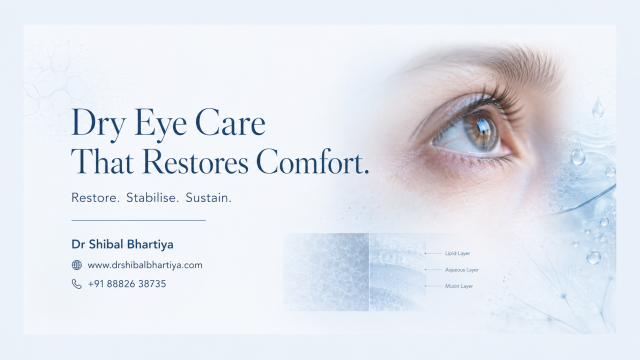
Many people with dry eye are told their eyes are “normal” even while struggling with burning, fluctuating vision, eye strain, or discomfort during screen use. Advanced dry eye evaluation looks beyond redness alone to understand tear film instability, ocular surface disease, and the real-world visual symptoms affecting daily life.
Dry eye disease is not simply a lack of tears. It is a chronic condition of the ocular surface — driven by tear film instability, inflammation, meibomian gland dysfunction, or environmental exposure — that causes persistent discomfort, visual fluctuation, and in some cases, measurable damage to the surface of the eye. Effective management requires identifying which component is driving your symptoms, not simply prescribing lubricant drops.
Dry Eye Disease in Gurgaon: When Your Eyes Never Feel Quite Right
Dry eye is one of the most undertreated conditions in ophthalmology, not because treatment doesn’t exist, but because patients are routinely told that what they are experiencing is minor.
It is not minor. Eyes that burn, sting, water excessively, feel gritty by afternoon, blur when you are tired, or ache after two hours of screen time are not eyes that are functioning normally. And patients who have been handed a bottle of artificial tears and sent home, sometimes repeatedly, know exactly how inadequate that response feels.
Dry eye disease has a pathophysiology. It has subtypes. It has measurable signs. And it has a treatment pathway that goes considerably further than lubricant drops, when it is managed by someone who understands the full picture.
This practice takes dry eye seriously. Because your eyes deserve to feel comfortable.
What Dry Eye Disease Actually Is
Dry eye disease is a multifactorial condition of the ocular surface. The tear film — the thin, layered fluid that coats your eye with every blink — requires three components to function correctly: an aqueous layer produced by the lacrimal gland, a lipid layer produced by the meibomian glands in your eyelids, and a mucin layer produced by goblet cells on the ocular surface.
When any of these components fails, the tear film becomes unstable. The surface dries between blinks. Inflammation follows. And a self-reinforcing cycle begins — surface damage drives more inflammation, which drives more surface damage.
Understanding which component is failing is the starting point of effective treatment.
Evaporative dry eye and meibomian gland dysfunction
The most common form of dry eye in urban Indian populations is evaporative — driven by meibomian gland dysfunction (MGD). The meibomian glands line the upper and lower eyelids and produce the lipid layer that prevents tear evaporation. When these glands become blocked or atrophied, tears evaporate too quickly regardless of how much aqueous is produced.
MGD is dramatically worsened by screen use, air conditioning, low humidity environments, and contact lens wear — the exact conditions that define urban professional life in Gurgaon and Delhi NCR.
Aqueous deficient dry eye
In some patients — particularly post-menopausal women, patients with autoimmune conditions like Sjögren’s syndrome, and those on certain systemic medications — the lacrimal gland simply does not produce enough aqueous tears. This form requires a different treatment approach and often warrants systemic investigation.
Mixed dry eye
Many patients have both components — inadequate lipid and inadequate aqueous — compounded by surface inflammation. These patients are frequently the ones who have tried multiple lubricant drops without relief, because no single drop addresses the full picture.
Ocular surface inflammation
Chronic inflammation is both a cause and a consequence of dry eye disease. In patients with significant inflammation, lubricant drops alone will never be sufficient. Anti-inflammatory therapy — whether topical cyclosporine, lifitegrast, or short-course steroids — is a necessary component of management.
Why Dry Eye Is Worse Than Ever in Urban India
The epidemiology of dry eye has shifted dramatically in the last decade. What was once considered a condition of older women is now presenting across all ages, genders, and occupations — and the drivers are environmental and behavioural.
| Risk Factor | Why It Matters |
|---|---|
| Screen time | Blink rate drops by up to 60% during screen use; tear film destabilises |
| Air conditioning | Low humidity environments accelerate tear evaporation |
| Contact lens wear | Disrupts tear film distribution and lipid layer integrity |
| Glaucoma drops | Preservatives in long-term glaucoma medications cause surface toxicity |
| Post-surgical dryness | LASIK, cataract surgery, and other procedures transiently or persistently disrupt corneal nerves and surface |
| Hormonal changes | Menopause significantly reduces aqueous and lipid tear production |
| Antihistamines and antidepressants | Many systemic medications reduce tear secretion as a side effect |
| Urban air pollution | Particulate matter and pollutants directly damage the ocular surface |
Gurgaon sits at the intersection of several of these factors simultaneously — screen-intensive professional culture, year-round air conditioning, high ambient pollution, and one of the highest LASIK procedure rates in North India.
What We Often Miss in Dry Eye Management
Meibomian gland dysfunction goes unexamined. Most dry eye consultations do not include eyelid margin assessment or meibomian gland expression. Without examining the glands, evaporative dry eye — the most common subtype — is routinely misidentified as aqueous deficiency and treated with the wrong drops.
Post-surgical dryness is underestimated. Dry eye after LASIK, SMILE, or cataract surgery can persist for twelve to eighteen months, and in some patients becomes a chronic condition. Patients are frequently told their symptoms will resolve on their own — without a structured management plan being put in place.
Glaucoma patients’ ocular surface is neglected. Patients on long-term preserved glaucoma drops develop surface toxicity at a rate that is well-documented in the literature but poorly addressed in clinical practice. If you have glaucoma and dry eye, the two conditions must be managed together.
Inflammation is not addressed. Patients cycling through artificial tear brands without improvement almost always have a significant inflammatory component. Without anti-inflammatory therapy, the cycle does not break.
Screen habits are not discussed. Behavioural modification — structured blink exercises, the 20-20-20 rule, screen positioning, humidifier use — forms a critical part of dry eye management that is rarely covered in a brief consultation.
What to Expect at a Dry Eye Consultation
A structured dry eye assessment goes beyond asking how your eyes feel and prescribing drops.
At this practice, assessment includes tear film evaluation, tear break-up time, meibomian gland assessment, corneal and conjunctival staining, and a detailed history of your screen habits, contact lens use, surgical history, and systemic medications. Where indicated, additional investigations including meibography — imaging of the meibomian glands — may be recommended.
Treatment is then built around your specific subtype and severity. This may include targeted lubricants, lipid-containing drops, warm compress and lid hygiene protocols, anti-inflammatory therapy, punctal plugs, or in-office procedures. You will leave with a structured plan — not a single bottle and a follow-up in six months.
The C.L.E.A.R.™ Framework: How We Map Your Dry Eye
A Structured Method to Identify Your Exact Subtype
The full methodology is detailed in our Dry Eye Second Opinion Framework. At our clinic, we apply a condensed version to guide your assessment.
C – Comprehensive Etiology Sub-Classification: Determining your exact type — aqueous deficient, evaporative, mixed, neuropathic or BAK-induced.
L – Lipid & Meibomian Gland Structure Mapping: Infrared meibography to visualise gland shortening, blockage or permanent loss — often missed when patients are told eyes are “normal”.
E – Environmental, Systemic & Iatrogenic Triaging: Screen time, AC, contact lens wear, rosacea, thyroid, menopause, Sjögren’s, glaucoma drops with preservatives.
A – Advanced Inflammation & Biomarker Profiling: NIBUT, osmolarity, corneal staining and redness scoring to quantify inflammation beyond symptoms.
R – Root-Cause Targeted Rehabilitation: Preservative-free regimens, thermal pulsation, IPL where indicated, punctal plugs, and BAK-free alternatives for glaucoma patients.
C.L.E.A.R.™ Deliverable Matrix
| Step | Question Solved | Your Output |
|---|---|---|
| 1. Etiology | What type of dry eye do I have? | Subtype Diagnosis |
| 2. Gland Mapping | Are my oil glands blocked or lost? | Meibography + Gland Loss Score |
| 3. Systemic Triage | Why did this happen? | Trigger Map |
| 4. Biomarker Profile | How severe is inflammation? | NIBUT, Osmolarity, Staining Report |
| 5. Rehabilitation | What beyond drops? | Personalized Plan – IPL / Thermal Pulsation / Plugs |
For full thresholds and algorithms, see our Dry Eye Second Opinion Framework.
Dry Eyes and Digital Eye Strain in Gurgaon
Many people in Gurgaon spend long hours on computers, phones, and other digital devices. Reduced blinking during screen use can contribute to dry eyes, eye strain, headaches, blurred vision, burning, watering, and difficulty focusing.
These symptoms may be further aggravated by factors common in Gurgaon, including air-conditioned office environments, long working hours, dry weather, air pollution, dust, and ongoing construction activity. Together, these factors can affect the stability of the tear film and make the eyes feel tired, irritated, or uncomfortable throughout the day.
A comprehensive eye examination can help determine whether symptoms are related to dry eye disease, digital eye strain, an uncorrected vision problem, or a combination of factors. Early assessment can often improve comfort, productivity, and visual quality.
Dr Shibal Bhartiya works with corporates, professionals, and frequent screen users in Gurgaon on the diagnosis and management of dry eye disease, digital eye strain, and healthy screen-use habits. To book an eye examination or arrange an eye health awareness session for your organisation, call +91 88826 38735 or visit drshibalbhartiya.com.
Dry Eye Topics Covered in This Practice
Understanding Dry Eye
- What is dry eye disease: causes, subtypes, and diagnosis
- Meibomian gland dysfunction: the most missed cause of dry eye
- Dry eye and screen time: what the evidence actually shows
- Dry eye in Gurgaon: why urban environment matters
Specific Populations
- Dry eye after LASIK and refractive surgery
- Dry eye after cataract surgery
- Dry eye in glaucoma patients on long-term drops
- Dry eye and menopause: the hormonal connection
- Contact lens-related dry eye
Treatment and Management
- Dry eye drops: which one is right for your subtype
- Anti-inflammatory treatment for chronic dry eye
- Punctal plugs: what they are and when they help
- Warm compresses and lid hygiene: the evidence base
- Treatment-resistant dry eye: what to do when drops aren’t enough
Second Opinions
- Getting a dry eye second opinion in Gurgaon
- When dry eye symptoms mean something more serious
Here is what you can read, to understand your symptoms
Why Do Women Get Dry Eye More Often?
Why Dry Eye Is Worse in Air Conditioning and on Flights
Why Your Eyes Water Constantly
Diabetes and Eye Complications
Autologous Serum Eye Drops for Severe
Dry Eye Disease: A Chronic Eye Disease
Dry Eyes: Tips to Soothe Sore Eyes
Managing Glaucoma Eye Drop Side Effects
Ocular GVHD & Its Implications
PROWL: Listening to LASIK Patients
Why Are Your Dry Eye Drops Not Working
Why Dry Eye Symptoms and Tests Don’t Match
When to Come In
Book a dry eye assessment if:
- Your eyes burn, sting, or feel gritty — especially by afternoon or after screen use
- Your vision fluctuates and clears when you blink
- Your eyes water excessively — paradoxical tearing is a common dry eye sign
- You wear contact lenses and your comfortable wearing time has reduced
- You have had LASIK, SMILE, or cataract surgery and your eyes have not felt normal since
- You are on long-term glaucoma drops and your eyes feel uncomfortable
- You have been using lubricant drops for months without meaningful relief
- You have been diagnosed with an autoimmune condition and have eye symptoms
Dry eye is a chronic condition — but it is a manageable one. The patients who do best are those who receive an accurate subtype diagnosis early and follow a structured management plan. Lubricant drops are a starting point, not a solution.
Frequently Asked Questions
What is the best treatment for dry eye disease?
There is no single best treatment — because dry eye has multiple subtypes that require different approaches. Evaporative dry eye from meibomian gland dysfunction is treated with warm compresses, lid hygiene, and lipid-containing drops. Aqueous deficient dry eye may require anti-inflammatory therapy and punctal plugs. Inflammatory dry eye requires targeted anti-inflammatory treatment. Accurate subtype diagnosis is the essential first step.
Can dry eye be cured permanently?
In most patients, dry eye disease is a chronic condition that requires ongoing management rather than a one-time cure. However, with consistent and correctly targeted treatment, the majority of patients achieve significant and sustained relief. Some causes — such as post-surgical dryness or medication-related dryness — may resolve once the underlying cause is addressed.
Why do my eyes water if I have dry eye?
Paradoxical tearing — excessive watering in a dry eye patient — is one of the most common and confusing symptoms of dry eye disease. When the ocular surface becomes irritated from tear film instability, the lacrimal gland produces reflex tears as a protective response. These reflex tears do not replace the stable tear film and do not relieve the underlying dryness.
Is dry eye worse in Gurgaon and Delhi NCR?
Yes. Urban environments with high screen use, year-round air conditioning, significant ambient pollution, and low outdoor humidity create conditions that are particularly hostile to tear film stability. Gurgaon’s professional demographic — high screen exposure, frequent air travel, contact lens use — compounds these environmental factors significantly.
Can dry eye damage my vision permanently?
In mild to moderate dry eye, vision fluctuates but does not sustain permanent damage. In severe, untreated dry eye — particularly in aqueous deficient conditions or after significant surface damage — corneal scarring and permanent visual reduction can occur. This is rare but preventable with appropriate management.
I have been using artificial tears for months with no improvement. What should I do?
This is the most common presentation at a dry eye second opinion consultation. Patients cycling through lubricant drop brands without relief almost always have either an unaddressed inflammatory component, undertreated meibomian gland dysfunction, or a subtype mismatch between the drops they are using and the dry eye they actually have. A structured reassessment — including eyelid examination and tear film evaluation — usually identifies the gap quickly.
You may also want to read this article written by Dr Bhartiya for NDTV online. And listen to her talk about dry eyes here.
About the Author
This article was written by Dr Shibal Bhartiya, fellowship-trained glaucoma specialist and Mayo Clinic Research Collaborator, Clinical Director at Marengo Asia Hospitals, Gurugram, known for ethical, patient-centred glaucoma care and independent glaucoma second opinions. She is also the Program Director for Community Outreach & Wellness; and for the Marengo Asia International Institute of Neuro and Spine.
Dr Bhartiya has published peer-reviewed research onglaucoma management, examining how treatment decisions should balance medical evidence, patient preferences, and long-term vision outcomes. She is also a committed patient advocate and mainstream medical columnist, translating complex ophthalmic evidence into actionable public health insights across leading national platforms including NDTV and OnlyMyHealth
As Editor-in-Chief of Clinical and Experimental Vision and Eye Research and Executive Editor of the Journal of Current Glaucoma Practice (Pubmed Indexed, official journal of the International Society of Glaucoma Surgery). Her 200+ publications, including 90+ PubMed-indexed publications and 28 edited textbooks span glaucoma biology, surgical outcomes, health equity, and emerging diagnostics.
1600+ Five Star Patient Reviews Google Business Profile
If you are unable to come to Dr Bhartiya’s clinic: Read more about teleconsultation
Read her research on PubMed | Google Scholar | ResearchGate | ORCID | Github | Wikidata
📋Upload your reports for a structured review.| 🌐 Contact Us| 📞 +91 88826 38735
⭐ Helped by this article? Leave a Google review — it helps other patients find reliable eye care.
Last Reviewed: October 2026