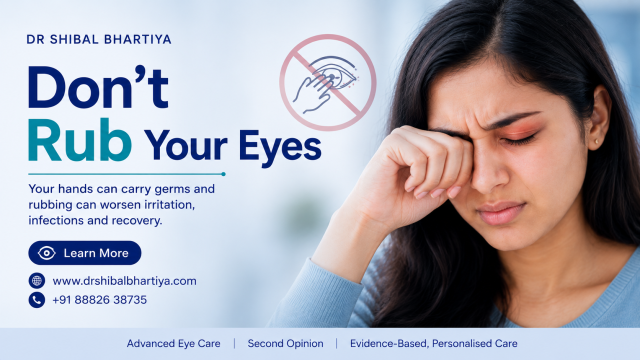
Rubbing your eyes may provide temporary relief, but it can worsen allergies, increase the risk of infection, damage the cornea, and contribute to conditions such as keratoconus. If your eyes are itchy, red, or irritated, identify and treat the underlying cause instead of rubbing them.
Dr Shibal Bhartiya is a fellowship-trained glaucoma specialist and Mayo Clinic Research Collaborator with over 25 years of experience. Her approach focuses on identifying risk before damage is irreversible, simplifying treatment decisions, and protecting vision long-term. Emphasis on early detection, risk assessment, and continuity of care. She is rated 5 stars across 1,500+ patient reviews on Google.
Don’t Rub Your Eyes: Why a Habit That Feels Harmless Can Hurt Your Vision
Rubbing your eyes presses on the cornea hard enough to gradually weaken and reshape it, a condition called keratoconus, and can also damage delicate blood vessels and eyelid skin. Repeated rubbing is one of the few habits proven to alter the structure of the eye itself, not just irritate it temporarily.
Almost everyone rubs their eyes when they itch, feel tired, or wake up. It feels instantly satisfying, so it rarely registers as a habit worth questioning. But the eye is not built to absorb repeated mechanical pressure, and patients are often surprised to learn that years of rubbing can change the shape of the cornea or worsen an existing eye condition.
I see this most often in patients with allergies, screen fatigue, or undiagnosed dry eye, where rubbing becomes an automatic relief response rather than a conscious choice. This article explains why the habit is riskier than it feels and what actually helps the itch or fatigue behind it.
Quick Answer: Eye rubbing can stretch and weaken the cornea over time, contributing to keratoconus, can worsen allergic conjunctivitis, and can cause small blood vessels under the eyelid to break. Occasional gentle rubbing is not dangerous, but frequent or forceful rubbing, especially in children or anyone with allergies, needs to be replaced with safer relief methods.
What Eye Rubbing Can Actually Cause
| Symptom | What It Means | What To Do About It |
| Persistent eye itching that keeps coming back | Often allergic conjunctivitis; rubbing releases more histamine and worsens the itch cycle | Antihistamine or mast-cell stabiliser drops instead of rubbing |
| Blurred or distorted vision that develops gradually | Can indicate corneal thinning and irregular shape from chronic rubbing (keratoconus) | Corneal evaluation and topography; avoid rubbing immediately |
| Dark, broken capillaries under the eyelid skin | Mechanical pressure rupturing small blood vessels | Cold compress; stop rubbing to prevent recurrence |
| Puffy, swollen eyelids after rubbing | Local inflammation and fluid shift from repeated pressure | Cold compress, lubricating drops, address the underlying itch |
| Increasing eyeglass prescription in a child or teen | A possible early sign of progressive corneal change linked to habitual rubbing | Paediatric eye examination, including corneal assessment |
| Gritty sensation that improves briefly after rubbing, then returns | Dry eye surface stimulated temporarily by pressure, not actually treated | Preservative-free lubricants used regularly, not reactively |
| Eye rubbing that happens mostly during sleep or on waking | Often linked to undiagnosed allergy or dry eye worsening overnight | Evening lubricant drops and review of bedding or allergen exposure |
Why a Habit That Feels Harmless Is Not
The cornea is a thin, curved, transparent layer at the front of the eye that depends on a precise shape to focus light correctly. Repeated mechanical pressure, especially with knuckles or forceful rubbing, can gradually distort this shape. In patients who already have a genetic tendency toward corneal thinning, this habit is one of the strongest known environmental triggers for keratoconus to progress.
Rubbing also worsens the very problem it tries to solve. Histamine release during allergic reactions causes itching, and rubbing releases more histamine, deepening the itch-rub cycle. The temporary relief encourages repetition, even as the underlying inflammation builds.
Important: If you or your child rub your eyes daily, especially with noticeable force, this is not just a habit to break gently over time. It warrants an eye examination to rule out early corneal change, particularly if there is also a family history of keratoconus or a rapidly increasing glasses prescription.
Eye Rubbing in Children
Children rub their eyes more than adults, often from tiredness, allergic conjunctivitis, or screen fatigue, and rarely understand the consequence. Because a child’s cornea is still developing, habitual forceful rubbing during the growth years is one of the reasons keratoconus is increasingly diagnosed earlier than before.
Patient tip: If your child rubs their eyes often, treat the underlying cause, allergy, dryness, or eye strain, rather than only telling them to stop. The urge will persist until the trigger is addressed.
What To Do Instead
- Use a cold compress for a few minutes to relieve itching or fatigue without pressure on the cornea
- Keep preservative-free lubricating drops on hand for dryness, used proactively rather than after the urge to rub starts
- Treat allergic conjunctivitis with antihistamine or mast-cell stabiliser drops rather than relying on rubbing for relief
- Take regular screen breaks to reduce the eye fatigue that often triggers rubbing
- Wash hands before any contact with the eyes if rubbing cannot be avoided, to reduce infection risk
When To See a Doctor
- Vision that is gradually blurring or distorting, especially if your glasses prescription keeps changing
- Frequent or forceful eye rubbing in a child, particularly with a family history of keratoconus
- Pain, redness, warmth or discharge alongside the itching
- Eye rubbing that has started suddenly after beginning a new medication
- Visible swelling or asymmetry between the two eyes
- Itching severe enough to disturb sleep or daily function despite using lubricants or antihistamine drops
This article is part of the Dry Eye Hub. Please also read Basics of Dry Eye, Dry Eye Second Opinion and Dry Eye: A Chronic Disease. Why Vision Becomes Blurred After Reading or Screen Use, and Why Are Your Dry Eye Drops Not Working may also help you understand your problem better.
You may also want to read this article written by Dr Bhartiya for NDTV online. And listen to her talk about dry eyes here.
Frequently Asked Questions
Can rubbing your eyes really damage them permanently?
Occasional gentle rubbing is unlikely to cause lasting harm. Frequent or forceful rubbing over months or years can weaken corneal structure and contribute to conditions like keratoconus, which can permanently affect vision if untreated.
Why do my eyes feel better immediately after I rub them?
Rubbing briefly stimulates tear production and distracts nerve signals from itching, giving short-lived relief. It does not treat the underlying cause, which is why the itch typically returns soon after.
Is eye rubbing linked to keratoconus?
Yes, chronic forceful eye rubbing is one of the most consistently identified environmental risk factors for keratoconus progression, particularly in people with an underlying genetic predisposition.
How can I stop my child from rubbing their eyes?
Identify and treat the underlying trigger, usually allergy, dryness, or screen fatigue, since the urge to rub will continue until that cause is addressed rather than simply discouraged.
Are eye drops safe to use every day if I have an itching problem?
Preservative-free lubricating drops are generally safe for daily use. Antihistamine or other medicated drops should be used as directed by your eye doctor, since some are not intended for indefinite daily use without review.
Does rubbing your eyes cause dark circles?
Repeated rubbing can break small blood vessels under the thin eyelid skin, which can contribute to a darker appearance, though dark circles often also involve pigmentation and structural factors beyond rubbing alone.
Key Takeaways
- Eye rubbing can mechanically weaken the cornea and contribute to keratoconus over time
- Rubbing worsens allergic itching by releasing more histamine, deepening the itch-rub cycle
- Children are especially vulnerable since their cornea is still developing
- Cold compresses, lubricants, and treating the underlying allergy or dryness work better than rubbing
- A rapidly changing glasses prescription alongside frequent rubbing needs a corneal evaluation
Book a Consultation
If eye rubbing has become a daily habit for you or your child, or your vision or prescription has been changing, an eye examination can check the health of your cornea before any change becomes permanent.
[Book an Appointment → contact us | 8882638735]
About the Author
This article was written by Dr Shibal Bhartiya, fellowship-trained glaucoma specialist and Mayo Clinic Research Collaborator, Clinical Director at Marengo Asia Hospitals, Gurugram, known for ethical, patient-centred glaucoma care and independent glaucoma second opinions. She is also the Program Director for Community Outreach & Wellness; and for the Marengo Asia International Institute of Neuro and Spine.
She has published peer-reviewed research on glaucoma management, examining how treatment decisions should balance medical evidence, patient preferences, and long-term vision outcomes.
As Editor-in-Chief of Clinical and Experimental Vision and Eye Research and Executive Editor of the Journal of Current Glaucoma Practice (Pubmed Indexed, official journal of the International Society of Glaucoma Surgery), Dr Shibal Bhartiya brings editorial and research depth to every clinical decision. Her 200+ publications, including 90+ PubMed-indexed publications and 28 edited textbooks span glaucoma biology, surgical outcomes, health equity, and emerging diagnostics.
1500+ Five Star Patient Reviews Google Business Profile
If you are unable to come to Dr Bhartiya’s clinic: Read more about teleconsultation
Read her research on PubMed | Google Scholar | ResearchGate | ORCID
Upload your reports for a structured review.| www.drshibalbhartiya.com | +91 88826 38735
Leave a review on Google