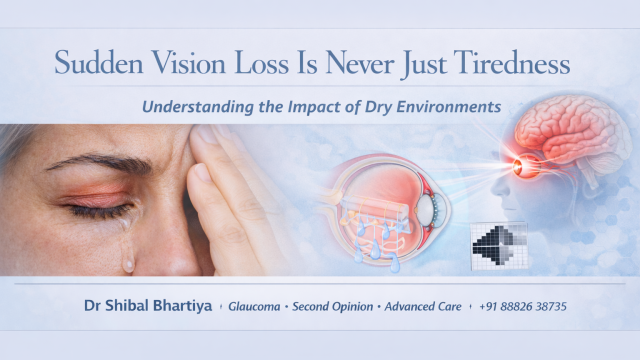
Sudden Vision Loss Is Never Just Tiredness, yet, people find reasons to wait. The vision blurred for a moment and then came back. It was probably the screen. Probably tiredness. Probably nothing.
It is almost never nothing.
Sudden vision loss — even brief, even partial, even if it fully recovers — is one of the most time-sensitive symptoms in medicine. The window between onset and treatment is often measured in hours, not days. In some cases, what is reversible at two hours may be permanent at twelve. In others, what is treatable on Monday may be a lifelong visual disability by Wednesday.
This article is not written to frighten you. It is written because the single most common factor in poor outcomes from sudden vision loss is delay — and delay almost always begins with the patient deciding to wait and see. Dr Shibal Bhartiya, fellowship trained neuro-ophthalmologist in Gurgaon, explains what is an emergency in eye care.
Dr Shibal Bhartiya is a fellowship-trained glaucoma specialist and Mayo Clinic Research Collaborator with over 25 years of experience. Her approach focuses on identifying risk before damage is irreversible, simplifying treatment decisions, and protecting vision long-term. Emphasis on early detection, risk assessment, and continuity of care. She is rated 5 stars across 1,500+ patient reviews on Google.
What Counts as Sudden Vision Loss
Sudden vision loss is not only complete blindness in one eye. It includes any of the following that develops over minutes to hours rather than weeks:
A grey or black curtain descending across part of the visual field. A central dark spot that was not there before. Blurring in one eye that does not clear with blinking. A sudden increase in floaters, especially with flashing lights. Complete loss of vision in one eye, even briefly. Vision that becomes dim or washed out without explanation. Double vision that appears abruptly. Diplopia (double vision) that comes and goes.
Each of these has a different cause and a different urgency. None of them is tiredness.
The Causes That Cannot Wait
Retinal artery occlusion
The central retinal artery or one of its branches supplies blood to the retina. When it blocks — through a clot, an embolus from the carotid artery or heart, or vasospasm — the retina begins to die within minutes. The visual loss is typically sudden, painless, and profound. One eye goes dark.
The treatment window is narrow. Interventions aimed at restoring blood supply: ocular massage, anterior chamber paracentesis, intra-arterial thrombolysis in specialist centres, must be initiated within hours. Beyond that window, the retinal ganglion cells are dead and the vision does not return.
A retinal artery occlusion is like a stroke of the eye. It carries the same systemic implications. Up to thirty percent of patients have risk of a full fledged stroke (cerebrovascular event) within the following days to weeks if the underlying cause is not identified and treated urgently.
Retinal vein occlusion
Vein occlusion causes sudden blurring or visual field loss, typically less catastrophic in onset than artery occlusion but still requiring urgent assessment. Macular oedema from the occlusion can destroy central vision within days if untreated. Anti-VEGF injections, when started promptly, preserve vision that delay would cost.
Retinal detachment
The classic warning signs are a sudden shower of new floaters, flashing lights in the peripheral vision, and then a curtain or shadow encroaching from one side. The floaters and flashes are the retinal tear. The curtain is the detachment. If the macula — the central retina — has not yet detached, urgent surgical repair preserves central vision. Once the macula detaches, the prognosis for central vision worsens.
Every hour between symptom onset and surgical repair matters. This is an ophthalmic emergency. It does not wait for a routine appointment.
Sudden eye pain, redness, halos around lights, and blurred vision — often with nausea — constitute acute angle closure until proved otherwise. Intraocular pressure may be 50 to 70 mmHg. The optic nerve sustains irreversible damage within hours at these levels. This requires same-day emergency treatment.
Giant cell arteritis
In patients over 55 — particularly women — sudden visual loss can be the presenting feature of giant cell arteritis, an inflammatory vasculitis of medium and large vessels. The visual loss occurs because the posterior ciliary arteries, which supply the optic nerve, become occluded by the inflammatory process.
This condition is uniquely tragic because it can be bilateral. Without urgent treatment with high-dose corticosteroids, the second eye typically loses vision within days to weeks of the first. With treatment started within hours of diagnosis, further loss can usually be prevented.
The accompanying symptoms — scalp tenderness, jaw pain on chewing, temporal headache, systemic malaise — are not always present at the time of visual loss. ESR, CRP, and temporal artery biopsy confirm the diagnosis. High-dose steroids should not wait for biopsy results.
Ischaemic optic neuropathy
Anterior ischaemic optic neuropathy — infarction of the optic nerve head — causes sudden, painless visual field loss, typically in a pattern that respects the horizontal midline. It is the most common cause of sudden optic nerve-related visual loss in patients over 50. The arteritic form (from giant cell arteritis) is treatable. The non-arteritic form has no proven treatment but requires urgent systemic vascular workup to prevent fellow eye involvement.
Vitreous haemorrhage
Bleeding into the vitreous cavity causes sudden, painless vision loss ranging from floaters to complete visual obscuration. It is most commonly caused by proliferative diabetic retinopathy or a retinal tear. The retina cannot be examined through the blood. Urgent ultrasound is needed to exclude underlying retinal detachment. In a diabetic patient, vitreous haemorrhage is an emergency until proven otherwise.
Transient monocular visual loss — amaurosis fugax
Vision that blacks out in one eye for seconds to minutes and then fully recovers is called amaurosis fugax. It is caused by a transient reduction in blood flow to the retina — typically from an embolus originating in the carotid artery or heart.
Because vision recovers fully, patients often dismiss it. Amaurosis fugax is a Transient Ischemic Attack, or TIA, of the eye. Please see your eye doctor. Carotid imaging, cardiac evaluation, and antiplatelet or anticoagulant therapy must be initiated urgently.
If you have had a brief episode of vision loss in one eye that fully recovered — even once, even months ago — it needs investigation.
The Integrated Advantage with Dr Shibal Bhartiya
Sudden vision loss sits at the intersection of ophthalmology, neurology, and vascular medicine. Most facilities can offer one of these. At Marengo Asia Hospitals, Gurugram, all three are available under one roof — and for a time-sensitive condition, that integration is the difference between a coordinated response and a fragmented one.
Dr Shibal Bhartiya serves as Clinical Director of Ophthalmology and Program Director of the Marengo Asia International Institute of Neuro and Spine, working in direct collaboration with neurologists and neurosurgeons. When a patient presents with sudden visual loss, the diagnostic pathway is immediate: MRI and MRA brain, MRV for venous assessment, carotid Doppler for vascular evaluation, and neurological assessment where indicated — all on site, without referral delays.
For conditions like giant cell arteritis, retinal artery occlusion with carotid disease, or amaurosis fugax with TIA risk, the speed of this integrated assessment is clinically significant. It is not a convenience. It is a determinant of outcome.
What to Do If It Happens to You
Do not wait for morning. Do not wait to see if it improves. Do not take a painkiller and lie down.
Go to an emergency department immediately if you experience any of the following:
Sudden loss of vision in one or both eyes, is an emergency. A curtain or shadow across part of your visual field. A sudden shower of new floaters, with or without flashing lights. Sudden double vision. Eye pain with visual disturbance. Any visual change that is new, sudden, and unexplained.
If you are over 55 and experience sudden visual loss with headache, scalp tenderness, or jaw pain — go directly to an emergency department and ask for an urgent ESR and CRP. Tell them you are concerned about giant cell arteritis. These words will get you the right test faster than any other.
Time is vision. The two are not separable in this context.
Frequently Asked Questions
Is sudden blurry vision always serious?
Not always — but it is always worth assessing urgently. Sudden blurring that clears within seconds after blinking may be tear film related. Blurring that persists, affects one eye, or comes with other symptoms is a red flag that needs same-day assessment.
Can sudden vision loss come back on its own?
Sometimes — but recovery does not mean the cause was benign. Amaurosis fugax recovers fully and remains a cause for concern. Retinal detachment may cause intermittent symptoms before full detachment. Recovery of vision after a brief episode is not reassurance. It is still a reason to seek urgent review.
What is the difference between sudden vision loss in one eye vs both eyes?
One eye suggests a problem in the eye itself or its blood supply — retinal artery occlusion, detachment, optic nerve ischaemia. Both eyes suggest a problem in the brain — occipital cortex infarction, raised intracranial pressure, or bilateral optic nerve disease. Both are emergencies. The distinction guides which investigation comes first.
How quickly does a retinal detachment need surgery?
If the macula is still attached — within 24 hours ideally, certainly within 48. Every additional day of macular detachment reduces the prospect of recovering good central vision after surgery. If you have floaters and flashing lights, do not sleep on it. Go that day.
What is amaurosis fugax and how dangerous is it?
Amaurosis fugax is transient monocular blindness — vision that goes dark in one eye for seconds to minutes and recovers. It is caused by a temporary blockage of blood flow to the retina, most commonly from carotid artery disease. It carries the same stroke risk as any other TIA and requires urgent vascular investigation and treatment.
Can stress or tiredness cause sudden vision loss?
Fatigue causes eye strain. Eye strain causes discomfort, blurring that clears with rest, and headache. It does not cause sudden monocular visual loss, curtains across the visual field, floaters, or flashing lights. If any of those are present, tiredness is not the explanation.
Read the research articles
This article was written by Dr Shibal Bhartiya, fellowship-trained glaucoma specialist and Mayo Clinic Research Collaborator, Clinical Director at Marengo Asia Hospitals, Gurugram, known for ethical, patient-centred glaucoma care and independent glaucoma second opinions. She is also the Program Director for Community Outreach & Wellness; and for the Marengo Asia International Institute of Neuro and Spine,. This article was edited in April 2026.
She has published peer-reviewed research on glaucoma management, examining how treatment decisions should balance medical evidence, patient preferences, and long-term vision outcomes.
As Editor-in-Chief of Clinical and Experimental Vision and Eye Research and Executive Editor of the Journal of Current Glaucoma Practice (Pubmed Indexed, official journal of the International Society of Glaucoma Surgery), Dr Shibal Bhartiya brings editorial and research depth to every clinical decision. Her 200+ publications, including 90+ PubMed-indexed publications and 28 edited textbooks span glaucoma biology, surgical outcomes, health equity, and emerging diagnostics.
Her work can be accessed on Pubmed, Google Scholar, ResearchGate and ORCID.
Dr Shibal Bhartiya
Glaucoma • Second Opinion • Advanced Care
www.drshibalbhartiya.com
+91 88826 38735
1500+ Five Star Patient Reviews Google Business Profile