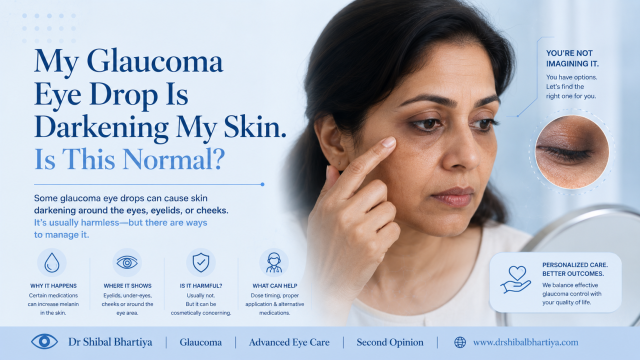
Yes. Some glaucoma eye drops can darken the skin around your eyes. Prostaglandin analogues such as latanoprost, bimatoprost and travoprost may cause periorbital pigmentation, longer eyelashes, a deeper upper-eyelid fold, and sometimes darkening of the iris. These are recognised side effects—but you should not stop your glaucoma medication without discussing the change with your ophthalmologist.
Yes. Prostaglandin analogue eye drops, the most commonly prescribed glaucoma drops, can darken the skin around the eye, deepen the eyelid fold, lengthen lashes, and in some patients darken the iris. These changes are real, recognised, and should have been explained before your prescription was written. These changes are usually cosmetic rather than a sign of glaucoma damage, but any new or unexpected change around the eye should be discussed with your ophthalmologist.
Dr Shibal Bhartiya is a fellowship-trained glaucoma specialist and Mayo Clinic Research Collaborator with over 25 years of experience. Her approach focuses on identifying risk before damage is irreversible, simplifying treatment decisions, and protecting vision long-term. Emphasis on early detection, risk assessment, and continuity of care. She is rated 5 stars across 1,500+ patient reviews on Google.
What Is a Prostaglandin Analogue?
Prostaglandin analogues are the first-line treatment for most patients with glaucoma. They work by improving drainage of fluid from the eye, lowering pressure, and protecting the optic nerve. They are effective, well-tolerated, and taken once daily, usually at night.
Common examples include latanoprost, bimatoprost, travoprost, and tafluprost. If your glaucoma drop ends in -prost, it is almost certainly in this class.
| Eye drop class | Examples | Periorbital pigmentation |
|---|---|---|
| Prostaglandin analogues | Latanoprost, bimatoprost, travoprost, tafluprost | Can occur |
| Beta blockers | Timolol | Not typical |
| Alpha agonists | Brimonidine | Not typical |
| Carbonic anhydrase inhibitors | Dorzolamide, brinzolamide | Not typical |
This does not mean another class is automatically better for you. The choice of glaucoma medication depends on your eye pressure, glaucoma type and severity, other medical conditions, other medicines, and your treatment goals.
What Changes Around the Eye With Prostaglandin Eye Drops?
- Periorbital skin pigmentation — the skin around the eyelids may gradually become darker.
- Longer, thicker eyelashes — often most noticeable after several months.
- Iris pigmentation — the iris may become darker in some patients, and this change can be permanent.
- Upper-eyelid sulcus deepening — the upper eyelid crease may become more pronounced.
- Periorbital fat loss — loss of tissue around the eye can make the eye appear more hollow or sunken.
Prostaglandin analogues stimulate melanin-producing cells around the eye. Over months of use, this produces several visible changes.
The skin of the eyelids and the area around the eye socket darkens gradually. This is called periorbital pigmentation. It happens slowly enough that many patients do not notice it themselves until someone else points it out, or until they see a photograph.
The eyelashes grow longer, thicker, and darker. Some patients welcome this. Others find it uneven or unexpected.
In some patients, particularly those with lighter or mixed-colour irises, the iris itself can darken permanently. In brown-eyed patients, this change is usually not visible.
There is also a structural change called prostaglandin-associated periorbitopathy. The fatty tissue around the eye socket thins. The upper eyelid develops a deeper fold. The eye may appear more sunken. This is subtle in most patients but noticeable in some, particularly after years of use.
How Soon Can Glaucoma Eye Drops Darken the Skin?
The change is usually gradual rather than sudden. Some patients notice pigmentation or other periocular changes within a few months, while others may develop more subtle changes over longer periods of treatment. The likelihood and extent vary between individuals and between different prostaglandin analogues.
Research has documented periocular pigmentation and eyelid changes after several months of treatment, although the frequency varies considerably between drugs and patients.
Skin darkening and iris darkening are not the same thing
Periorbital skin pigmentation may partially fade after treatment is changed or stopped, although this can take months. Iris pigmentation is different: once established, it is generally considered permanent.
Why These Side Effects May Not Be Discussed
Glaucoma consultations involve pressure measurements, optic nerve assessment, visual fields, medication schedules and long-term treatment planning. Cosmetic side effects can sometimes receive less attention because they do not directly indicate progression of glaucoma.
Glaucoma consultations carry a great deal of information. Pressure numbers. Nerve scans. Field tests. Drop instructions. Cosmetic side effects that carry no medical risk sometimes do not make it into the conversation.
Patients who notice an unexpected change in their appearance and do not know why it is happening sometimes stop their drops. Stopping glaucoma drops without guidance can cause serious, irreversible vision loss.
You are entitled to know everything a treatment may do. Not just the part that fixes the problem. So please discuss with your doctor, and she will talk to you about managing the side effects.
Should You Stop the Drop
No. Not without speaking to your glaucoma specialist first.
The priority is controlling your glaucoma and protecting the optic nerve. A cosmetic side effect should therefore be discussed in the context of how well the medication is controlling your eye pressure and your overall risk of glaucoma progression.
Remember:
Do not stop or change glaucoma medication on your own. Your ophthalmologist can assess whether continuing the medication, changing to another treatment, using laser treatment, or considering another approach is appropriate for you.
Uncontrolled glaucoma causes permanent optic nerve damage. These cosmetic changes do not. The risk comparison is not close.
What you should do is tell your doctor. There are other classes of glaucoma drops that do not carry this effect. Beta blockers, alpha agonists, and carbonic anhydrase inhibitors work differently and do not cause periorbital pigmentation. In some patients, switching is appropriate. In others, the prostaglandin is the best option for controlling pressure and the cosmetic effect is manageable.
That conversation should happen with your specialist, with your actual pressure readings and nerve scans on the table. Not as a self-managed decision.
What to Do If You Have Already Noticed This
Bring it up at your next appointment. If it is significantly affecting you, request an earlier one. Ask specifically whether an alternative drop or laser would control your pressure equally well.
If you are newly diagnosed and being started on a prostaglandin drop, ask your doctor to walk you through what changes to expect and over what timeframe. This is not an unreasonable question. It is your face, and your treatment.
If your glaucoma eye drops are changing the appearance of your eyes, you don’t have to make the decision alone.
I can help you understand the side effect, assess your glaucoma control, and discuss whether continuing or changing treatment is right for you.
Book a Consultation:
📍 Gurgaon 📞 +91 88826 38735 | 🌐 Contact Us | Second Opinion Form for teleconsults
Why Does One Eye Sometimes Look Different?
When a prostaglandin eye drop is used in only one eye, the treated eye may develop longer eyelashes, darker periocular skin or other changes that are not present on the untreated side. This can make the difference particularly noticeable.
Read more: One eye feels different
When Should You Speak to Your Ophthalmologist?
Make an appointment if:
- the skin around one or both eyes is becoming noticeably darker;
- one eye looks different from the other after starting treatment;
- your eyelids appear more hollow or the upper eyelid fold has changed;
- you are concerned about a change in your iris colour;
- the cosmetic effect is making you consider stopping your glaucoma medication; or
- you are wondering whether another treatment could control your glaucoma
📍 Gurgaon 📞 +91 88826 38735 | 🌐 Contact Us | Second Opinion Form for teleconsults
FAQs:
Will the Skin Darkening Go Away If I Stop the Drop?
Periorbital skin pigmentation partially reverses after stopping the drop, but this takes months and may not fully resolve. The structural changes of periorbitopathy are slower to reverse. Iris darkening, if it has occurred, is permanent. This is another reason why the conversation about side effects should happen before starting treatment, not after changes have already appeared.
Does This Happen to Everyone on Prostaglandin Drops?
No. The degree of change varies considerably between patients. Some patients use prostaglandin drops for years with minimal visible effect. Others notice changes within a few months. Patients with lighter skin tones may notice periorbital pigmentation more readily. Those with mixed-colour irises are more likely to develop iris darkening. Your specialist can discuss your individual risk based on your eye colour, skin tone, and the specific drop prescribed.
Can I Use the Drop in Only One Eye to Avoid Asymmetric Changes?
If your glaucoma affects only one eye, your doctor may prescribe the drop for that eye only. In this case, asymmetric cosmetic changes are possible — the treated eye may develop darker periorbital skin or longer lashes than the untreated side. This is worth discussing with your specialist before starting, so you can make an informed decision about treatment options.
Are There Glaucoma Drops That Do Not Cause This?
Yes. Beta blockers such as timolol, alpha agonists such as brimonidine, and carbonic anhydrase inhibitors such as dorzolamide do not cause periorbital pigmentation or periorbitopathy. Combination drops that include these classes are also available. Whether they are suitable for you depends on your pressure control needs, your general health, and other medications you may be taking. Your glaucoma specialist can advise.
Is This a Sign That the Drop Is Harming My Eye?
No. These are surface and structural changes around the eye, not damage to the optic nerve or retina. The drop is doing its job inside the eye. The cosmetic effects are a separate matter. Stopping the drop because of skin darkening, without medical guidance, risks the thing that actually matters: your vision.
Can glaucoma eye drops cause changes other than skin darkening?
Yes. Prostaglandin analogue eye drops can cause several periocular changes, including darker skin around the eyes, longer and thicker eyelashes, deepening of the upper-eyelid fold and loss of periorbital fat. Some patients may also develop darkening of the iris. The extent varies between individuals and between medications.
About the Author
This article was written by Dr Shibal Bhartiya, fellowship-trained glaucoma specialist and Mayo Clinic Research Collaborator, Clinical Director at Marengo Asia Hospitals, Gurugram, known for ethical, patient-centred glaucoma care and independent glaucoma second opinions. She is also the Program Director for Community Outreach & Wellness; and for the Marengo Asia International Institute of Neuro and Spine.
She has published peer-reviewed research on glaucoma management, examining how treatment decisions should balance medical evidence, patient preferences, and long-term vision outcomes.
As Editor-in-Chief of Clinical and Experimental Vision and Eye Research and Executive Editor of the Journal of Current Glaucoma Practice (Pubmed Indexed, official journal of the International Society of Glaucoma Surgery), Dr Shibal Bhartiya brings editorial and research depth to every clinical decision. Her 200+ publications, including 90+ PubMed-indexed publications and 28 edited textbooks span glaucoma biology, surgical outcomes, health equity, and emerging diagnostics.
1600+ Five Star Patient Reviews Google Business Profile
If you are unable to come to Dr Bhartiya’s clinic: Read more about teleconsultation
Read her research on PubMed | Google Scholar | ResearchGate | ORCID | Github
📋Upload your reports for a structured review.| 🌐 Contact Us| 📞 +91 88826 38735
⭐ Helped by this article? Leave a Google review — it helps other patients find reliable eye care.