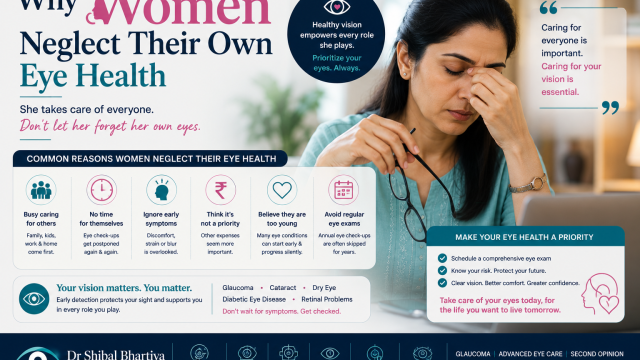
| Women develop glaucoma, angle-closure disease, and dry eye at higher rates than men, yet women are more likely to delay eye examinations. The barrier is not ignorance. It is a deeply practised habit of deprioritising their own care. This article is for every woman who has been too busy to book that appointment, says Dr Shibal Bhartiya. |
You know you should go. The appointment has been rescheduled twice. There is always something more urgent; a school event, a parent’s medication review, a deadline. You make a mental note that you will go next month, and next month arrives with its own list.
This pattern is not unique to you. In clinic, I see it constantly, women who arrive with significant glaucoma damage that has taken years to develop, who tell me they noticed something was wrong but waited. Waiting costs vision. Vision, once lost to glaucoma, does not come back.
Dr Shibal Bhartiya is a fellowship-trained glaucoma specialist and Mayo Clinic Research Collaborator with over 25 years of experience. Her approach focuses on identifying risk before damage is irreversible, simplifying treatment decisions, and protecting vision long-term. Emphasis on early detection, risk assessment, and continuity of care. She is rated 5 stars across 1,500+ patient reviews on Google.
Why Women Are at Higher Risk Than They Realise
Women outlive men and therefore carry a longer lifetime exposure to glaucoma risk. Women also have shallower anterior chambers on average, making angle-closure glaucoma, a form that can cause rapid, severe vision loss, significantly more common in women than in men. After menopause, falling oestrogen levels alter ocular perfusion and may increase glaucoma susceptibility further.
Dry eye disease, which affects up to three times as many women as men, shares no overlap with glaucoma but creates a paradox: women with symptomatic dry eye often believe their eye problems are already explained. They do not realise their glaucoma risk is separate, and silent.
| Risk Factor | Why It Matters More for Women |
| Longer lifespan | Lifetime glaucoma risk increases with age. More years = more cumulative exposure. |
| Narrow angles | Women have shallower anterior chambers. Angle-closure risk is two to three times higher in women. |
| Post-menopausal hormonal shift | Oestrogen may protect optic nerve perfusion. Its loss after menopause is an emerging risk factor. |
| Dry eye diagnosis | Creates false reassurance — ‘My eyes are already being treated.’ Glaucoma screening is still needed. |
| Autoimmune conditions | Conditions more common in women (e.g., thyroid eye disease, lupus) can independently affect optic nerve health. |
| Family caregiver role | Women who manage others’ healthcare often defer their own appointments longest. |
The Symptoms Women Most Often Dismiss
Glaucoma typically causes no symptoms until significant damage has already occurred. But there are early signs that women frequently attribute to tiredness, screens, or ageing.
- Difficulty seeing in dim light or needing more light to read — often blamed on age.
- Peripheral vision loss noticed only when bumping into objects or misjudging distances.
- Eye fatigue after screen use beyond what seems normal for the amount of work done.
- One eye that seems slightly less clear than the other, without an obvious explanation.
- Halos around lights at night, particularly when driving, dismissed as ‘bad vision without glasses.’
- Headaches located around the eye or brow, especially in the morning.
None of these guarantee glaucoma. But each one is a reason to book an appointment rather than wait.
Angle-Closure Glaucoma: An Emergency That Disproportionately Affects Women
Acute angle-closure glaucoma is a sudden, painful rise in eye pressure that can cause permanent vision loss within hours. It is two to three times more common in women. It presents with severe eye pain, headache, nausea, vomiting, and blurred vision with coloured halos — symptoms that are sometimes mistaken for a migraine or food poisoning, delaying the emergency treatment that could preserve sight.
If you or someone you know experiences sudden eye pain with any of these associated symptoms, this is an emergency. Do not wait until morning. Do not take a painkiller and sleep. Go to an ophthalmology emergency unit immediately.
What a Proper Glaucoma Screen Involves
A genuine glaucoma screening is not a vision chart test. It includes measurement of intraocular pressure, examination of the optic nerve with dilation or imaging, a visual field test, and assessment of your corneal thickness and drainage angle. The whole process takes approximately 45 to 60 minutes for a thorough evaluation. It is not something that can be replicated by a home monitoring app or a basic eye test at an optical shop.
How Often Should Women Have a Glaucoma Screen?
| Age / Risk Profile | Recommended Frequency |
| Under 40, no risk factors | Every 5 years from age 35 |
| 40–60, no known risk | Every 2 years |
| 40+, family history or myopia | Annually |
| Any age, post-menopausal with risk factors | Annually or as advised |
| Known ocular hypertension | Every 6–12 months as directed |
The Conversation Women Need to Have With Themselves
You are not being negligent. You have genuinely not had time. But consider: if your child, your parent, or your partner needed an eye examination, would it have been booked? Of course it would. You would have made time. The question worth sitting with is why your own vision does not qualify for the same urgency.
Glaucoma does not negotiate. It does not pause while your schedule clears. The peripheral vision it removes does not return. And the examination that catches it early takes less time than the rescheduled appointments that never happen.
Book the appointment. If not today, this week. Your vision is not a low-priority item.
FAQs
Are women more likely to lose their sight than men?
Yes. Women account for nearly two-thirds of all blindness worldwide, largely because conditions like glaucoma and age-related macular degeneration progress silently and go undetected longer in women.
Why do women delay eye check-ups more than men?
Women consistently prioritise family health appointments over their own. Caregiver roles, time pressure, and the absence of pain in most serious eye conditions all make it easy to postpone an exam indefinitely.
Can hormonal changes affect a woman’s vision?
Yes. Oestrogen fluctuations during pregnancy, perimenopause, and menopause affect intraocular pressure, dry eye severity, and the risk of conditions like central serous retinopathy. These changes are often missed because they are not flagged as eye-related.
At what age should women start having regular eye pressure checks?
Women with a family history of glaucoma should begin by age 35. All women should have a comprehensive eye examination by age 40, and annually after 60. Earlier screening is advised for those with diabetes, high blood pressure, or high myopia.
Is dry eye really a vision-threatening condition or just an irritant?
Untreated chronic dry eye can damage the corneal surface and blur vision permanently. Women are twice as likely as men to develop it, yet most dismiss it as minor discomfort rather than a condition needing proper treatment.
Can I Book a Glaucoma Screen in Gurgaon?
Yes. Dr. Shibal Bhartiya offers comprehensive glaucoma evaluations at Marengo Asia Hospitals, Gurugram, including optic nerve imaging, visual field testing, and gonioscopy. Appointments can be booked at +91 88826 38735 or through the website.
This page is part of the Women’ Eye Health Hub. Please also read Menopause and Eye Health, Menopause and Dry Eyes, Myopia in Teenagers, Why Women Get Dry Eyes, Women’s Eye Health, PCOD and Eye Symptoms, and Why Women Neglect Their Eye Health.
About the Author
This article was written by Dr Shibal Bhartiya, fellowship-trained glaucoma specialist and Mayo Clinic Research Collaborator, Clinical Director at Marengo Asia Hospitals, Gurugram, known for ethical, patient-centred glaucoma care and independent glaucoma second opinions. She is also the Program Director for Community Outreach & Wellness; and for the Marengo Asia International Institute of Neuro and Spine.
She has published peer-reviewed research on glaucoma management, examining how treatment decisions should balance medical evidence, patient preferences, and long-term vision outcomes.
As Editor-in-Chief of Clinical and Experimental Vision and Eye Research and Executive Editor of the Journal of Current Glaucoma Practice (Pubmed Indexed, official journal of the International Society of Glaucoma Surgery), Dr Shibal Bhartiya brings editorial and research depth to every clinical decision. Her 200+ publications, including 90+ PubMed-indexed publications and 28 edited textbooks span glaucoma biology, surgical outcomes, health equity, and emerging diagnostics.
1500+ Five Star Patient Reviews Google Business Profile
If you are unable to come to Dr Bhartiya’s clinic: Read more about teleconsultation for glaucoma
Read her research on PubMed | Google Scholar | ResearchGate | ORCID
Upload your reports for a structured review.| www.drshibalbhartiya.com | +91 88826 38735
Leave a review on Google