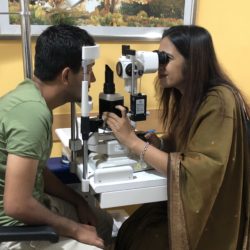
During exam season, prolonged reading and screen use can cause eye strain, headaches, blurred vision, dry eyes, and difficulty concentrating. Encourage regular breaks, good lighting, adequate sleep, and timely eye examinations to help your child study comfortably and perform at their best.
Every year, as board exams and competitive entrance tests approach, a familiar pattern plays out in homes across India. Children wake earlier, sleep later, and spend hour after hour hunched over textbooks, revision notes, and screens — searching answers, watching explainer videos, solving past papers. Parents watch, worry about marks, and stock up on almonds and Horlicks.
What most parents don’t think about is their child’s eyes.
Exam Season and Your Child’s Eyes: What Every Parent Needs to Know
Eye strain during exam season is not a minor inconvenience. For children who are already spending 8–10 hours a day doing near work — reading, writing, and screen use — the sudden, sustained spike in visual demand during revision months can tip them into real discomfort. In some cases, it can worsen an underlying condition that was never noticed before.
As a glaucoma and neuro-ophthalmology specialist, I see children in clinic every year who were brought in after exams because they started getting headaches, blurring, or simply refused to read. In most cases, the signs were there earlier. The parents just didn’t know what to look for.
This article is for those parents.
Why Exams Are Hard on Children’s Eyes
Near Work and the Visual System
The human eye is designed to see at distance. When we read — whether a book or a screen — the eye has to do something called accommodation: the lens inside the eye changes shape to focus on something close. This is an active, muscular effort. Do it for long enough without a break, and the muscles fatigue. This is called accommodative strain, and it is one of the most common causes of eye-related complaints in school-age children.
During normal school days, children move. They look up from their desks, go to the playground, look out of windows. These are natural visual breaks — moments when the eye relaxes into distance focus and the accommodative muscles recover.
During exam season, that rhythm disappears. Children sit at a desk for four, six, sometimes eight hours at a stretch, switching only between a textbook and a screen. The eyes never get a chance to fully rest.
Screens Add a Different Kind of Strain
Books and screens are not the same as far as the eyes are concerned.
When reading a screen, children blink less — often half as frequently as normal. Blinking is how the eye’s surface is kept moist and refreshed. Reduced blinking means the tear film breaks down, and the surface of the eye becomes dry and irritated. This is digital eye strain, and it compounds the accommodative fatigue from reading.
Screens also emit blue light, which, over prolonged exposure, can contribute to visual fatigue and disrupted sleep — two things exam-season children are already dealing with.
The modern exam-season child does not use books or screens. They use both, for hours at a time, often in poor lighting, often late into the night.
Sleep Deprivation Makes Everything Worse
The eye is not separate from the rest of the body. Poor sleep affects tear production, increases light sensitivity, and slows the visual processing that helps children concentrate and retain what they’re reading. Children who stay up past midnight to study are not just tired the next morning — their visual system is genuinely impaired.
This matters because many children who struggle to concentrate during exams are written off as anxious or underprepared. Sometimes, they simply cannot see clearly, or their eyes are too fatigued to sustain focus.
Signs That Your Child’s Eyes Are Under Stress
Children — especially older ones — often don’t volunteer that their eyes are bothering them. They don’t have the vocabulary for it, or they assume it’s normal, or they’re too focused on studying to stop and notice. Parents need to be the observers.
Watch for:
- Frequent rubbing of the eyes, especially during or after study sessions
- Complaints of headache, particularly at the front of the head or behind the eyes, that appear in the afternoon or evening and not in the morning
- Squinting at the board, textbook, or screen
- Holding the book very close — closer than the child normally does
- Tilting the head to one side while reading
- Avoiding reading or losing interest in revision quickly — this can be visual fatigue, not laziness
- Watery or red eyes at the end of a study session
- Blurring that comes and goes — present after reading for a while, then clears after a rest
- Difficulty reading for more than 20–30 minutes without discomfort
Any one of these, occurring regularly during exam preparation, deserves attention. Several together warrant an eye examination before you assume it is stress or anxiety alone.
Here are some eye exercises to reduce eye strain.
Quick Reference: What Your Child’s Symptoms May Mean
| What You See | What It May Indicate | What To Do |
|---|---|---|
| Headache at the forehead or behind eyes, appears in the afternoon | Accommodative strain from sustained near work | Enforce 20-20-20 breaks; book an eye test if it persists beyond a week |
| Holds book or phone very close; creeps toward the page | Uncorrected or under-corrected myopia | Eye examination — do not delay |
| Tilts head to one side while reading | Possible astigmatism or binocular vision issue | Eye examination with binocular vision assessment |
| Loses place while reading; re-reads lines | Convergence insufficiency or tracking problem | Specifically ask for a binocular vision evaluation, not just a standard refraction |
| Covers one eye to read or watch | Intermittent exotropia or suppression | Urgent eye examination |
| Avoids reading; loses focus after 15–20 minutes | Visual fatigue from undetected hyperopia or binocular dysfunction | Eye examination; do not attribute to attention or motivation alone |
| Eyes water or go red during study sessions | Digital eye strain; reduced blink rate | Conscious blinking; screen breaks; if persistent, check for dry eye |
| Blurring that comes and goes; clears after rest | Accommodative spasm or early myopia | Eye examination; cycloplegic refraction may be needed |
| Sees double, especially when tired | Decompensating phoria under visual stress | Same-day or urgent eye examination |
If your child has more than two symptoms from this table occurring together, do not wait. An eye examination during exam season, not after, is the right call.
What Can Actually Help: The Practical Guide for Exam Season
The 20-20-20 Rule
This is the single most evidence-based intervention for near-work eye strain, and it costs nothing.
Every 20 minutes, look at something 20 feet away, for 20 seconds.
Twenty feet is roughly the distance across a medium-sized room — a window, a wall, a tree outside. The goal is to give the accommodative system a genuine break. This is not the same as looking up at the ceiling or closing one’s eyes; it is specifically the act of focusing at distance that allows the eye muscles to relax.
Put a reminder on your child’s phone. Make it non-negotiable.
Lighting Matters More Than Most Parents Realise
Reading in dim light does not damage the eyes, but it does make them work harder and tire faster. The ideal study environment has:
- Ambient room lighting (not just a desk lamp in a dark room — the contrast between the bright page and the dark surroundings is exhausting for the eyes)
- A desk lamp positioned to the side rather than directly behind or above, to avoid glare and shadow
- Natural light where possible during daytime study — not direct sunlight on the page, but general daylight in the room
For screen use, screen brightness should match the room — neither too bright relative to a dark room, nor too dim. Most devices have an auto-brightness setting; use it.
The Correct Reading Distance
Books should be held at roughly 30–40 centimetres from the eyes — approximately elbow to knuckle distance. Closer than this increases the accommodative demand significantly. If a child consistently holds books closer than this, it may indicate that they need glasses or a change in their current prescription.
For screens, 50–60 centimetres is recommended for laptop or desktop monitors.
Posture Is an Eye Issue Too
Children who slouch or hunch forward bring their face closer to the book or screen, increasing near-work strain. Good reading posture — sitting upright, feet flat, book or device at the right distance — is a visual health habit, not just an orthopaedic one. If your child keeps creeping closer to the page despite reminders, that is a sign, not a habit.
Night Study and Screen Use
If your child must study at night:
- Enable Night Mode or Warm Display on all devices after 8 PM. This reduces blue light and supports natural melatonin production.
- Dim the screen relative to the lighting in the room.
- Stop screens 30–45 minutes before sleep if at all possible. This is not just advice for the eyes — it is for the quality of sleep that follows, which affects how much the child actually retains.
Hydration and Blinking
It sounds simple because it is: children who are dehydrated have worse tear film quality and worse eye comfort. During intense study periods, children often forget to drink water. Keep water within reach of the study desk.
Remind your child to consciously blink when using screens. It sounds odd, but prolonged screen use genuinely suppresses the blink reflex. A deliberate full blink every few minutes during screen use helps maintain surface moisture.
When to Take Your Child for an Eye Examination
Exam season is not when most parents think of booking an eye test. But it is often exactly when undiagnosed vision problems declare themselves, because the visual demand suddenly exceeds what a child’s uncorrected or undercorrected vision can manage.
- Your child complains of headaches specifically related to reading or screen use
- They are avoiding reading, or tiring of it unusually quickly
- You notice squinting, head tilting, or holding material very close
- Their performance has dropped and there is no clear academic explanation
- They haven’t had an eye test in the past year
An eye examination takes 30–45 minutes. Finding out that a child needs glasses — or needs a stronger prescription — before or during exam season can make a measurable difference to both comfort and performance.
A Note on Myopia and Exam Season
India is in the middle of a myopia epidemic. Studies show that children in urban India have some of the highest rates of short-sightedness in the world, and rates are rising with every passing year. Intensive near work — exactly the kind that happens during exam preparation — is one of the environmental factors that drives myopia progression in children who are already myopic, and may contribute to its onset in those who are borderline.
If your child has myopia, exam season is a particularly important time to ensure they are using the correct, current prescription — and to build in as much outdoor time as remains possible, since natural light exposure has a well-established protective effect against myopia progression.
You may want to listen to me talking about myopia control.
What Doctors Often Miss
This section is written for parents who have already taken their child to a doctor — and been told everything is fine — but something still feels off.
Standard eye examinations in a busy clinic are designed to answer one question: does this child need glasses, and if so, what prescription? That question gets answered. But it is not the only question worth asking about a child who is struggling visually, especially during periods of intense near work.
Here are the conditions that are routinely missed.
Convergence Insufficiency
Convergence is the ability of both eyes to turn inward together and maintain focus on a near object. It is what allows you to read a line of text without it doubling or blurring. In children with convergence insufficiency, this mechanism is weak — the eyes struggle to work together at close range, and the effort of forcing them to do so is exhausting.
The classic presentation is a child who can read, but not for long. They lose their place, skip lines, re-read sentences, and tire quickly. Some may complain that words “move” or “swim.” They are often told they have attention problems. They may have been assessed for learning difficulties. Their standard eye test comes back normal because convergence is not routinely tested in a basic refraction appointment.
Convergence insufficiency is one of the most underdiagnosed conditions in school-age children. It responds well to targeted treatment — vision therapy and specific convergence exercises — but only if it is actually looked for.
If your child’s reading complaints persist despite a “normal” eye test, specifically ask for a binocular vision assessment.
Latent Hyperopia
Most parents know about myopia (short-sightedness). Fewer know about hyperopia (long-sightedness), and fewer still know about latent hyperopia — the hidden kind.
In young children, the lens of the eye is highly flexible. A child with mild to moderate hyperopia can often compensate by using their accommodative muscles to bring near and far objects into focus. They appear to see normally. A standard vision test may not reveal the underlying problem because the child is actively correcting for it during the test itself.
The cost of this constant compensation is effort. The accommodative system is working continuously — all day, every day — just to maintain normal vision. During exam season, when near-work demand spikes, that system becomes exhausted. The child develops headaches, eye fatigue, and difficulty sustaining reading. They may become irritable. They may seem to “hit a wall” in their ability to study.
The only way to detect latent hyperopia reliably is with a cycloplegic refraction — an eye examination done after eye drops that temporarily paralyse the accommodative muscles, forcing the true refractive error to reveal itself. This is not done routinely. You may need to specifically request it, or ask whether it is indicated.
Intermittent Exotropia
Intermittent exotropia is a condition in which one eye periodically drifts outward — but not all the time. Between episodes, the eyes appear and function normally. The child may be completely unaware it is happening.
Under normal circumstances, the visual system compensates for the drift through effort. When the child is tired — which exam-season children chronically are — that compensation fails. The eye drifts, vision becomes uncomfortable or briefly double, and the child instinctively closes or covers one eye to restore single vision. Parents sometimes notice this; more often they don’t.
Because it is intermittent and compensated most of the time, it is frequently missed on examination. A child seen in clinic who is not tired, not stressed, and not doing prolonged near work may show no sign of it at all.
If you have ever noticed your child covering one eye to read, squinting predominantly in one eye, or complaining of double vision when tired, mention this explicitly at the eye examination. Ask the clinician to assess for intermittent exotropia specifically.
Accommodative Spasm
In some children — particularly those doing very intensive near work — the accommodative system does not simply fatigue. It locks. The lens stays in a near-focused position even when the child tries to look into the distance. This is called accommodative spasm or pseudomyopia.
The child suddenly appears to have become myopic — distance vision blurs. They may be prescribed glasses for myopia that they do not actually have, or prescribed a stronger prescription than they need. The underlying cause — a cramped, overworked accommodative system — goes unaddressed.
This is more common than most parents realise, particularly in children who have had a sudden, significant increase in study hours. The treatment is rest, appropriate breaks, and in some cases cycloplegic eye drops — not a stronger glasses prescription.
If your child’s myopia has suddenly worsened during exam season, or if they were prescribed glasses for the first time immediately after a period of intense studying, a cycloplegic refraction to confirm the true prescription is worth discussing with their ophthalmologist.
The Child Labelled “Lazy” or “Inattentive”
This deserves its own mention because it is, in my clinical experience, the most consequential missed diagnosis of all.
A child who cannot sustain reading for more than twenty minutes, who loses focus repeatedly, who avoids revision, who seems disengaged — is often labelled as not trying hard enough. In some cases, particularly when exam performance is disappointing despite apparent effort, a learning disability or attention disorder is suspected.
Before that conclusion is reached, the child’s binocular vision should be comprehensively assessed. Convergence insufficiency, undetected hyperopia, and tracking problems all produce exactly this picture. They are treatable. The child labelled lazy who actually has a binocular vision disorder does not need motivation — they need an ophthalmologist who looks beyond the refraction.
This article is a part of the Paediatric Ophthalmology Hub. Please also read Children’s Eye Care, Nutrition, Are Children’s Eyes More Vulnerable, Lazy Eye, and Myopia Prevention in Children. Eye Care Tips for Screen Use, and 7 Ways to Take Care of Your Child’s Eye Health also may be of interest.
You may want to see some eye care tips for children here, here, and here.
Frequently Asked Questions
Q: My child wears glasses. Do they need to wear them while reading?
It depends on their prescription. Children with myopia (short-sightedness) may or may not need their glasses for close reading — their optometrist or ophthalmologist will advise. Children with hyperopia (long-sightedness) or astigmatism almost certainly do. Do not assume; ask.
Q: Are blue light glasses worth buying for exam season?
The evidence for blue light blocking glasses as a treatment for eye strain is currently limited. The more effective intervention is the 20-20-20 rule and reducing screen time after dark. If your child already wears glasses, a blue-light coating does no harm and may help. It is not a substitute for good study habits.
Q: My child says their eyes are fine. Should I still be concerned?
Children often do not recognise that their visual discomfort is abnormal. If you are observing the signs listed in this article, trust your observation over your child’s self-report.
Q: Can eye strain during exams cause permanent damage?
Eye strain itself is not a cause of permanent damage. However, undiagnosed refractive errors (the need for glasses) can worsen if uncorrected, and myopia can progress. The concern is not that studying will injure the eyes, but that an underlying issue, now stressed, will go unaddressed.
Q: How much screen time is too much during exam season?
There is no precise number, because children vary. What matters more than total time is whether breaks are taken, whether lighting is correct, and whether the child is symptomatic. A child who takes 20-20-20 breaks, studies in good lighting, and sleeps adequately will tolerate more screen time than one who does none of these things.
The Bottom Line
Exam season is a period of genuine visual stress for children. The combination of prolonged near work — books, revision papers, and screens — in often poor conditions, with disrupted sleep and reduced outdoor time, is a real challenge for the developing visual system.
Most of what helps is simple: breaks, good lighting, the right distance, adequate sleep, and an eye examination if symptoms appear.
What parents can do is watch, ask, and not dismiss eye-related complaints as exam nerves. Sometimes the child who cannot concentrate at their desk is not distracted. They are struggling to see, or struggling to keep their eyes comfortable long enough to work.
That is a problem with a solution. And it starts with paying attention.
Dr. Shibal Bhartiya is a fellowship-trained glaucoma and neuro-ophthalmology specialist and Clinical Director of Ophthalmology at Marengo Asia Hospitals, Gurugram. She is founder of Vision Unlimited, a community eye health organisation serving children across underserved communities in India.
For appointments: Book a Consultation | For queries: +91 88826 38735
About the Author
This article was written by Dr Shibal Bhartiya, fellowship-trained glaucoma specialist and Mayo Clinic Research Collaborator, Clinical Director at Marengo Asia Hospitals, Gurugram, known for ethical, patient-centred glaucoma care and independent glaucoma second opinions. She is also the Program Director for Community Outreach & Wellness; and for the Marengo Asia International Institute of Neuro and Spine.
She has published peer-reviewed research on glaucoma management, examining how treatment decisions should balance medical evidence, patient preferences, and long-term vision outcomes.
As Editor-in-Chief of Clinical and Experimental Vision and Eye Research and Executive Editor of the Journal of Current Glaucoma Practice (Pubmed Indexed, official journal of the International Society of Glaucoma Surgery), Dr Shibal Bhartiya brings editorial and research depth to every clinical decision. Her 200+ publications, including 90+ PubMed-indexed publications and 28 edited textbooks span glaucoma biology, surgical outcomes, health equity, and emerging diagnostics.
1500+ Five Star Patient Reviews Google Business Profile
If you are unable to come to Dr Bhartiya’s clinic: Read more about teleconsultation
Read her research on PubMed | Google Scholar | ResearchGate | ORCID
Upload your reports for a structured review.| www.drshibalbhartiya.com | +91 88826 38735
Leave a review on Google