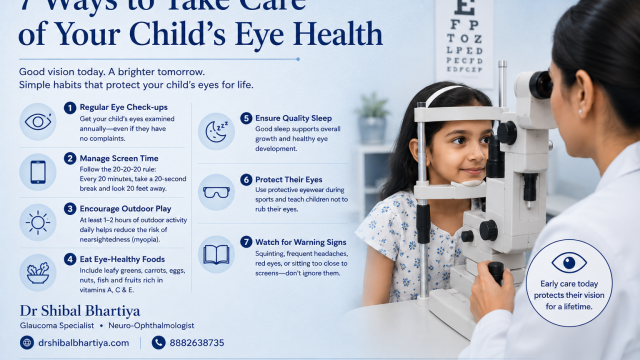
Protect your child’s eye health through regular comprehensive eye exams starting at age 3, daily outdoor time of at least 60 minutes, screen breaks every 20 minutes, a diet rich in vitamin A and omega-3s, UV-protective sunglasses outdoors, proper sports eye protection, and prompt attention to warning signs like squinting or eye rubbing.
Most childhood eye problems are silent. A child rarely complains of blurry vision because she assumes everyone sees the world that way. This makes parents the first line of defence, and small daily habits matter more than most people realise.
I have treated children whose vision loss could have been prevented with an eye exam two years earlier. I have also seen simple changes in screen habits and outdoor time reverse early warning signs. This article covers seven practical, evidence-based steps every parent can start this week.
Common Childhood Eye Symptoms: What They Mean
| Symptom | Cause | When to Worry |
|---|---|---|
| Squinting to see distant objects | Uncorrected refractive error (myopia) | If it persists more than 2 weeks, book an eye exam |
| Frequent eye rubbing | Allergies, fatigue, or eye strain | If accompanied by redness or discharge, see a doctor within days |
| Sitting very close to the TV | Nearsightedness or convergence issues | If it becomes a fixed habit, schedule a vision screening |
| One eye turning in or out | Strabismus (squint) | See a paediatric eye specialist within 1–2 weeks; delay risks amblyopia |
| Watery eyes without crying | Blocked tear duct or allergy | If constant past age 1, needs evaluation |
| White or grey reflex in flash photos | Possible retinal or lens abnormality (leukocoria) | This is urgent; book same-week specialist review |
| Head tilting to read or watch TV | Compensating for double vision or muscle imbalance | If it persists beyond a few days, see a specialist |
| Red eye lasting more than 3 days | Infection or allergic conjunctivitis | See a doctor promptly if pain, swelling, or fever accompany it |
7 Ways to Protect Your Child’s Eye Health
1. Schedule Comprehensive Eye Exams, Not Just School Screenings
School vision screenings check basic acuity, but they miss conditions like amblyopia (lazy eye) and mild strabismus. A comprehensive exam checks eye alignment, focusing ability, and eye health together.
I recommend a first eye exam by age 3, another before starting school, and yearly checks after that. Children with a family history of high refractive error or squint need earlier and more frequent exams.
2. Cap Continuous Screen Time and Use the 20-20-20 Rule
Every 20 minutes, a child should look at something 20 feet away for 20 seconds. This simple habit reduces digital eye strain and the fatigue that comes with near work.
Continuous close-up screen use is also linked to faster progression of myopia in children. Build in short breaks rather than banning screens outright, since realistic limits are the ones children actually follow.
3. Prioritise Outdoor Time Every Day
Outdoor time is one of the strongest protective factors against childhood myopia, independent of how much near work a child does. Natural light exposure appears to slow the elongation of the eye that drives nearsightedness.
Aim for at least 60 to 90 minutes outdoors daily. This does not need to be structured sport; unstructured outdoor play works just as well.
4. Feed Growing Eyes the Right Nutrients
The retina depends on specific nutrients to function well. Vitamin A supports the light-sensing cells, while omega-3 fatty acids support the tear film and retinal structure.
Include eggs, dairy, leafy greens, carrots, and fish like salmon in your child’s diet. Nutritional deficiency is rare in well-fed children but worth checking in picky eaters or restrictive diets.
5. Protect Against UV and Physical Injury
Children spend more time outdoors than adults and absorb more cumulative UV exposure over their lifetime. UV-blocking sunglasses from a young age reduce long-term risk of cataract and other UV-related damage.
For sports, use polycarbonate protective eyewear, especially for racquet sports, cricket, and cycling. A large proportion of childhood eye injuries happen during unsupervised play and could be prevented with basic protection.
6. Watch for Behavioural Red Flags, Not Just Complaints
Young children rarely say “I can’t see well.” Instead, watch for squinting, head tilting, closing one eye in bright light, or avoiding reading and puzzles.
Poor school performance, especially with copying from the board, sometimes traces back to an uncorrected vision problem rather than a learning difficulty. Flag these patterns to your paediatrician or eye specialist early.
7. Maintain Contact Lens and Hand Hygiene for Teens
If your teenager wears contact lenses, hygiene matters as much as the prescription. Poor lens hygiene is a leading cause of corneal infections in adolescents.
Teach proper handwashing before lens handling, correct lens case cleaning, and never sleeping in daily-wear lenses. Replace lens cases every three months regardless of how clean they look.
When to See a Doctor for Your Child’s Eye Health
Book an appointment promptly if your child shows:
- One-sided or unilateral changes in vision or eye appearance
- Pain, redness, warmth, or fever around the eye
- Any sudden change in vision
- Bulging or protrusion of one eye (proptosis)
- New squint or misalignment at any age
- Symptoms starting after a new medication
- Facial or ankle swelling alongside eye symptoms
📍 Gurgaon 📞 +91 88826 38735 | 🌐 Contact Us | Second Opinion Form for teleconsults
Frequently Asked Questions
At what age should my child have their first eye exam?
Most children should have their first comprehensive eye exam by age 3. Children with a family history of squint, high refractive error, or amblyopia may need an exam earlier, sometimes by 6 months. Early detection of misalignment or lazy eye gives treatment the best chance of success.
Does screen time actually cause myopia in children?
Screen time itself does not directly cause myopia, but prolonged near work combined with low outdoor time is a strong risk factor. The 20-20-20 rule and daily outdoor time both help offset this risk. Children who spend more time outdoors show slower myopia progression regardless of screen habits.
How much outdoor time does my child need for eye health?
Most research supports at least 60 to 90 minutes of outdoor time daily to meaningfully reduce myopia risk. The protective effect comes from natural light exposure, not physical activity itself. Even unstructured outdoor play, like walking to school, provides benefit.
What is leukocoria and why is it serious?
Leukocoria is a white or grey reflex seen in the pupil, often noticed first in flash photographs. It can signal serious conditions including retinoblastoma, a childhood eye cancer. Any parent who notices this should seek a same-week specialist evaluation.
Can a squint correct itself without treatment?
A true squint rarely corrects itself and needs specialist evaluation, since delay increases the risk of permanent amblyopia. Some infants have a pseudo-squint from a wide nasal bridge that looks like misalignment but is not. Only an eye exam can reliably tell the two apart.
Are blue-light glasses necessary for children who use screens?
There is limited evidence that blue-light glasses prevent eye strain or protect long-term eye health in children. The 20-20-20 rule, proper screen distance, and adequate outdoor time have stronger evidence behind them. Blue-light glasses are not harmful, but they should not replace these proven habits.
Key Takeaways
- Schedule a first comprehensive eye exam by age 3, then annually.
- Use the 20-20-20 rule to reduce digital eye strain.
- Prioritise 60–90 minutes of outdoor time daily to slow myopia progression.
- Feed your child vitamin A and omega-3 rich foods for retinal health.
- Use UV-protective sunglasses and sports eyewear to prevent injury.
- Watch for behavioural red flags like squinting, head tilting, and one-eye closing.
- Never ignore a white pupillary reflex in photographs; it needs urgent review.
Book a Consultation
Your child’s vision shapes how they learn, play, and see the world for a lifetime. If you have noticed any of the warning signs above, do not wait for the next school screening.
Book a comprehensive paediatric eye exam and get clarity on your child’s eye health today.
Book an Appointment:
📍 Gurgaon 📞 +91 88826 38735 | 🌐 Contact Us | Second Opinion Form for teleconsults
This article is a part of the Paediatric Ophthalmology Hub. Please also read How to Choose an Eye Doctor for Your Child, How to Prepare Your Child for an Eye Exam, Nutrition, Are Children’s Eyes More Vulnerable, Lazy Eye, How Much Screen Time is Safe in Children, and Myopia Prevention in Children. Eye Care Tips for Screen Use, and 7 Ways to Take Care of Your Child’s Eye Health also may be of interest.
This article is a part of the Myopia in Children hub. Please read Myopia in Children, Low Dose Atropine for Myopia, Do Myopia Control Lenses Work, Ortho-K versus Myopia Control Contact Lenses and Myopia Prevention in Children. Read more about how we evaluate a child’s myopia in detail. Please also read Paediatric Myopia Control Clinic in Gurgaon, and Myopia in Teenagers.
You may want to see some eye care tips for children here, here, and here.
About the Author
This article was written by Dr Shibal Bhartiya, fellowship-trained glaucoma specialist and Mayo Clinic Research Collaborator, Clinical Director at Marengo Asia Hospitals, Gurugram, known for ethical, patient-centred glaucoma care and independent glaucoma second opinions. She is also the Program Director for Community Outreach & Wellness; and for the Marengo Asia International Institute of Neuro and Spine.
She has published peer-reviewed research onglaucoma management, examining how treatment decisions should balance medical evidence, patient preferences, and long-term vision outcomes.
As Editor-in-Chief of Clinical and Experimental Vision and Eye Research and Executive Editor of the Journal of Current Glaucoma Practice (Pubmed Indexed, official journal of the International Society of Glaucoma Surgery), Dr Shibal Bhartiya brings editorial and research depth to every clinical decision. Her 200+ publications, including 90+ PubMed-indexed publications and 28 edited textbooks span glaucoma biology, surgical outcomes, health equity, and emerging diagnostics.
1600+ Five Star Patient Reviews Google Business Profile
If you are unable to come to Dr Bhartiya’s clinic: Read more about teleconsultation
Read her research on PubMed | Google Scholar | ResearchGate | ORCID | Github | Wikidata
📋Upload your reports for a structured review.| 🌐 Contact Us| 📞 +91 88826 38735
⭐ Helped by this article? Leave a Google review — it helps other patients find reliable eye care.