Could Poor Vision Be Mistaken for ADHD?

In young children, unrecognised myopia or other vision problems can sometimes look like ADHD: poor attention, avoiding reading, classroom distraction, or seeming “not to listen.” Before assuming behavioural causes, a comprehensive eye examination can help identify whether vision is contributing to learning and attention difficulties.

A child who cannot see cannot pay attention. He cannot sit still. He cannot follow a lesson, read a board, or make sense of a world that is blurred beyond recognition. High uncorrected refractive errors in young children — especially combined myopia and astigmatism — produce every clinical sign that gets labelled as behavioural, neurological, or cognitive. The child is not the problem. The prescription is missing.

Before a four-year-old is labelled ADHD or assessed for intellectual compromise, someone must examine their eyes properly. A cycloplegic refraction and a dilated fundus examination take twenty minutes. The diagnosis they prevent may define many years of that child’s life.

Dr Shibal Bhartiya is a fellowship-trained glaucoma specialist and Mayo Clinic Research Collaborator with over 25 years of experience. Her approach focuses on identifying risk before damage is irreversible, simplifying treatment decisions, and protecting vision long-term. Emphasis on early detection, risk assessment, and continuity of care. She is rated 5 stars across 1,500+ patient reviews on Google.


He Was Told He Was a Slow Learner. He Topped His School.

A radiologist colleague brought her four-year-old son to me. She worked in the same hospital. She understood anatomy, imaging, contrast, shadow — but she did not know what to do with what the doctors were telling her about her child.

He had been born preterm. A forceps delivery. The medical team had concerns about optic nerve damage from the birth. They told her he had ADHD. And that he was a slow learner.

She sat across from me carrying all of that. And her son bounced around the room.

I looked at him. I looked at his eyes.

What the examination found

He had myopia of −2.00 dioptres and astigmatism of −4.50 dioptres cylinder, in both eyes, from birth.

His optic nerves were healthy. Completely healthy. The damage everyone feared was not there.

This child had never been able to see properly. Every blackboard, every face, every alphabet chart — a blur. He was not hyperactive because of a neurological problem. He was hyperactive because he was navigating a world that made no visual sense. Of course he could not sit still. He could not see what he was supposed to be attending to.

What two years of proper correction did

He got the right glasses. The world came into focus. The restlessness settled. The alphabet, once an impossible blur, became something he could learn.

He had some meridional amblyopia from the uncorrected high astigmatism — his visual system had not developed fully along the axis of blur. We treated it. It resolved. By five and a half, he was reading 6/6. By six, he had caught up entirely.

The refraction has been stable since childhood. The optic nerves remain healthy.

Ten years later

He walked into my clinic yesterday. All of fourteen, full of himself and life, with all the answers in the world — as he should be. Taller than me. And his mom.

He had topped his school. He had topped his class. Just to ask me whether he could wear contact lenses, because his mother had said no. His mother was worried about keratoconus risk given the early high astigmatism.

I looked at his corneal topography. His cornea is perfectly normal. His astigmatism is stable and has been stable since he was a baby. I told him he could wear contact lenses, provided he was careful about hygiene. I told his mother what the topography showed, so her mind was fully at rest.

From labelled as cognitively compromised at four years old — to school topper at fourteen.

That is what a missed refractive error costs. And that is what finding it in time returns.


FAQs

Can a refractive error cause a child to be misdiagnosed with ADHD?

Yes — and this happens more often than it should. A child with high uncorrected myopia or astigmatism cannot see clearly at any working distance. She cannot follow what is written on a board, cannot sustain attention on a page, and cannot sit still in a classroom environment that makes no visual sense to her. These behaviours are clinically indistinguishable from ADHD without a proper eye examination. Any child being assessed for ADHD, learning difficulty, or developmental delay should have a full eye examination — including cycloplegic refraction — before any other diagnosis is made.

What is cycloplegic refraction and why does it matter for children?

Cycloplegic refraction uses eye drops to temporarily relax the ciliary muscle — the muscle children use to auto-focus. Without cycloplegia, children unconsciously compensate for refractive errors during the examination, and the true prescription is masked. A child’s power measured without cycloplegia can be significantly undercorrected. This is not optional in young children: it is the only way to measure the actual refractive error and make a correct prescription.

What is meridional amblyopia?

Meridional amblyopia occurs when high astigmatism goes uncorrected during the sensitive period of visual development. The visual cortex does not receive clear input along the axis of blur, and neural connections for that orientation fail to develop fully. The result is reduced visual acuity that cannot be corrected by glasses alone — the brain itself has not learned to process that axis clearly. With early correction and sometimes occlusion therapy, it is largely reversible. This is why detecting and correcting high astigmatism before age six matters so much.

Is high astigmatism in a baby a sign of keratoconus?

Not by itself. High astigmatism in infancy is common and usually represents a normal refractive error, not a corneal disease. Keratoconus is a progressive thinning of the corneal tissue and almost never presents clinically in early childhood. The important thing is to monitor stability over time. If astigmatism remains stable through childhood and adolescence — as it did in this child — the risk of keratoconus is very low. Corneal topography in adolescence gives a clear and definitive answer and reassures both the patient and the parents.

At what age should a child have their first eye examination?

The first comprehensive eye examination should happen at six months, again at three years, and before starting school. This is not the same as a vision screening at a paediatrician’s visit — those catch only gross deficits. A proper examination by an eye specialist includes assessment of refractive error, binocular alignment, and the health of the optic nerve and retina. Children with a family history of high refractive error, squint, or lazy eye should be examined earlier and followed more closely.

Can a child with high myopia and astigmatism safely wear contact lenses?

Yes, in most cases, once the prescription is stable and the child is old enough to manage lens hygiene responsibly — typically from the early teenage years. The key safety step before prescribing contact lenses in a patient with high astigmatism is corneal topography, which maps the shape of the cornea and rules out any early signs of keratoconus. If the topography is normal and the refraction is stable, contact lenses are safe, well-tolerated, and often preferable to spectacles for active teenagers.


This page is part of the Eye Health hub. Read about routine eye examinations for children and common eye problems. Please also read about Children’s Eye Care in Gurgaon here and here.


About the Author

This article was written by Dr Shibal Bhartiya, fellowship-trained glaucoma specialist and Mayo Clinic Research Collaborator, Clinical Director at Marengo Asia Hospitals, Gurugram, known for ethical, patient-centred eye care and independent second opinions. She is also Program Director for Community Outreach & Wellness and for the Marengo Asia International Institute of Neuro and Spine.

She has published peer-reviewed research on glaucoma management and paediatric eye health, examining how treatment decisions should balance medical evidence, patient preferences, and long-term vision outcomes.

As Editor-in-Chief of Clinical and Experimental Vision and Eye Research and Executive Editor of the Journal of Current Glaucoma Practice (PubMed Indexed, official journal of the International Society of Glaucoma Surgery), Dr Shibal Bhartiya brings editorial and research depth to every clinical decision. Her 200+ publications, including 90+ PubMed-indexed publications and 28 edited textbooks, span glaucoma biology, surgical outcomes, paediatric eye health, and emerging diagnostics.

1,500+ Five Star Patient Reviews — Google Business Profile

If you are unable to come to Dr Bhartiya’s clinic: Read more about teleconsultation

Read her research on PubMed | Google Scholar | ResearchGate | ORCID

Upload your reports for a structured review. | www.drshibalbhartiya.com | +91 88826 38735

Leave a review on Google
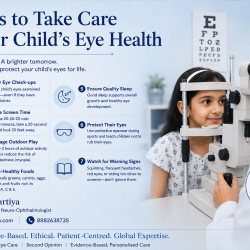

Children’s Eye Care Gurgaon

Children may not always complain about vision problems, even when difficulty seeing affects reading, learning, attention, or eye comfort. Regular eye examinations can help detect refractive errors, lazy eye, squint, and other childhood eye conditions early, when treatment is often most effective.

Children rarely complain about blurry vision, because they have nothing to compare it to. A timely eye exam can be the difference between a fixable problem and a permanent one. Book a Children’s Eye Exam →

Why Children’s Eye Health Cannot Wait

The visual system is not fully formed at birth. It develops rapidly in the first decade of life, shaped by the quality of input each eye receives. If one eye has blurred vision, from an uncorrected spectacle number, a squint, or a drooping lid, the brain quietly deprioritises that eye. Over time, it stops processing its signals altogether. This is amblyopia, or lazy eye. It is painless, invisible to the child, and fully reversible, but only if caught in time.

The treatment window for amblyopia closes around age 7 to 8. After adolescence, it closes almost entirely. This means the age at which a problem is detected matters as much as the problem itself.

Beyond amblyopia, children in India face a rapidly growing myopia epidemic, rising rates of screen-related eye strain, and a consistent backlog of undetected refractive error. Most of these problems are silent. Most are fixable, if found early.

Conditions That May Affect Your Children’s Eyes

Refractive Error

Myopia (short-sightedness), hypermetropia (long-sightedness), and astigmatism are the most common eye conditions in children. Myopia prevalence in urban India is rising sharply, driven by increased near work, reduced outdoor time, and genetic susceptibility. A child with uncorrected myopia cannot see the board. A child with uncorrected hypermetropia may appear to see adequately but suffers headaches and fatigue from the constant effort of focusing. Neither child may ever complain.

Amblyopia (Lazy Eye)

Amblyopia occurs when one eye, or occasionally both, develops weaker vision than expected and the brain suppresses its input. It is caused by uncorrected refractive error, squint, or anything that blocks the visual axis (a drooping lid, a cataract). Treatment includes glasses, patching, or atropine drops. It is effective but must begin early. The earlier treatment starts, the better the outcome.

Squint (Strabismus)

A squint is a misalignment of the eyes. One eye may turn inward, outward, upward, or downward. It may be constant or intermittent. In young children, a squint does not resolve on its own. It is a medical condition requiring assessment. Squint is frequently associated with amblyopia, and both need treatment. Surgery, where needed, corrects the alignment. Glasses and patching address the amblyopia separately.

Myopia Progression

A child diagnosed with myopia is not simply given glasses and discharged. Myopia that progresses unchecked carries lifelong risks, retinal detachment, glaucoma, macular disease. Myopia control, using low-dose atropine drops, specially designed spectacle lenses, or orthokeratology, is now standard of care in children with progressive myopia. Annual monitoring is essential.

Developmental Glaucoma

Rare but sight-threatening. An unusually large eye, cloudy cornea, excessive tearing, or marked light sensitivity in a newborn or infant are warning signs. Any of these warrants urgent specialist review. Developmental glaucoma requires early surgical intervention.

Retinoblastoma

A childhood eye cancer that most commonly presents as a white or yellowish glow in the pupil, often first noticed in a photograph. Any white reflex in a child’s eye in a photo must be evaluated immediately. Retinoblastoma is life-threatening but curable when detected early.

Other Conditions

Nasolacrimal duct obstruction (blocked tear duct) is common in infants and usually resolves with massage and drops. Congenital cataract, ptosis (drooping eyelid), and nystagmus (involuntary eye movement) are less common but important causes of amblyopia that require early intervention.

Warning Signs: When to See an Eye Doctor Now

  • One eye turning in or out
  • Squinting to see distant objects
  • Sitting very close to screens or the TV
  • Tilting or turning the head to look
  • Frequent eye rubbing
  • Headaches after reading or screen use
  • White or yellow glow in pupil in photos
  • Drooping eyelid
  • Watery or persistently red eyes
  • Avoiding reading or near work
  • Holding books very close to the face
  • Poor school performance without clear cause

When Should Children Have an Eye Exam?

Eye check-ups should follow a schedule, just like vaccinations. Children with risk factors: prematurity, family history of squint, amblyopia, high refractive error, or childhood glaucoma, developmental delay, or conditions like diabetes, should be seen sooner and more frequently.

AgeNo Known Risk FactorsAt-Risk Children
At birthScreening by paediatricianOphthalmology consultation
Birth – 24 monthsAt 6 monthsAt 6 months or earlier, as advised
2 – 5 yearsAt age 3At age 3 or earlier, as advised
6 – 18 yearsBefore first grade, then every 2 yearsAnnually or as advised

School screenings are not enough. They detect large refractive errors but miss amblyopia, mild prescriptions, binocular vision problems, and retinal conditions. A normal school screening result does not replace a full eye examination.

Know more about Paediatric Eye Care in Gurgaon

What Does a Children’s Eye Examination Involve?

A paediatric eye exam is adapted to the child’s age and level of cooperation. Younger children do not need to read letters, vision is assessed using pictures, symbols, or preferential looking techniques that require only pointing or turning toward a stimulus.

A complete paediatric eye assessment typically includes:

  • Visual acuity — age-appropriate charts; pre-literacy testing for young children
  • Cycloplegic refraction — eye drops temporarily relax the focusing muscle to reveal the true spectacle number without interference from the child’s own accommodation. This step is essential in children and cannot be replaced by a non-dilated test.
  • Cover test and ocular motility — to detect squint and assess how the eyes move and align together
  • Binocular vision and stereopsis — to check how well both eyes function as a pair in three dimensions
  • Dilated fundus examination — a detailed view of the retina and optic nerve
  • Intraocular pressure measurement — when developmental glaucoma is suspected
  • Nasolacrimal assessment — in infants with persistent watering

Note on cycloplegic drops: These drops blur near vision for 4–6 hours and cause light sensitivity. Bring sunglasses and plan to keep screens and books away for the rest of that day. The blurring is temporary and causes no harm.

The Myopia Epidemic in Indian Children

Myopia prevalence in Indian children has increased significantly over the past two decades. Urban children develop myopia younger and progress faster than previous generations. The two main drivers are well-established: more time spent on near work, screens, reading, studying, and a sharp drop in outdoor time.

Natural outdoor light has a measurable protective effect against myopia onset and progression. Even 60–90 minutes of outdoor time daily reduces risk. The mechanism appears to involve light intensity and dopamine release in the retina.

For children already myopic, glasses correct vision but do not slow progression. Myopia control strategies with good evidence include:

  • Low-dose atropine eye drops (0.01–0.05%) — the most studied option; applied nightly; effective with minimal side effects at low doses
  • Orthokeratology (Ortho-K) — rigid contact lenses worn at night that temporarily reshape the cornea; eliminates daytime glasses or lens use while slowing axial growth
  • Myopia control spectacle lenses — designs such as DIMS, HALT, and DOT technology reduce peripheral defocus and slow elongation of the eye
  • Multifocal soft contact lenses — an option for older children and adolescents

Children on myopia control treatment should be reviewed every 6 months. The goal is to reach adulthood with the lowest possible degree of myopia.

Screen Time: What the Evidence Actually Says

Screens do not permanently damage the eyes. This is worth stating clearly, because parental anxiety about screens is often directed at the light itself rather than what screen time displaces.

The real concerns are: reduced blinking causing dry eye and discomfort; sustained near focus contributing to eye strain and headaches. Most importantly, replacement of outdoor time, which is the primary modifiable driver of myopia in children.

Practical evidence-based guidance:

  • No screens for children under 2 (video calls excepted)
  • Maximum one hour per day for ages 2–5
  • For older children: the 20-20-20 rule. Every 20 minutes of near work, look at something 6 metres away for 20 seconds
  • Screen distance at arm’s length or more; no screens on a bed in a slumped posture
  • No screens in the 30–60 minutes before sleep. Blue light suppresses melatonin and disrupts sleep quality
  • Minimum 60–90 minutes of outdoor activity daily. This is the single most impactful daily habit for myopia prevention

Nutrition and Children’s Eye Health

A varied diet supports healthy visual development through childhood. The key nutrients are:

  • Vitamin A — essential for low-light vision and corneal health. Severe deficiency remains a cause of childhood blindness in parts of India. Sources: eggs, dairy, carrots, sweet potato, dark leafy greens.
  • Omega-3 fatty acids (DHA/EPA) — critical for retinal development, especially in infants and young children. Sources: oily fish (salmon, sardines, mackerel), walnuts, flaxseed.
  • Lutein and zeaxanthin — concentrated in the macula; protect against oxidative damage. Sources: spinach, kale, corn, eggs.
  • Zinc — supports Vitamin A metabolism and retinal function. Sources: lentils, chickpeas, seeds, dairy.

Children with restricted diets, chronic illness, or signs of malnutrition should be specifically assessed for Vitamin A deficiency.

As published in the media

Dr Shibal Bhartiya wrote on children’s eye health for the Times of India (December 2024), covering practical steps parents can take — including screen time management, outdoor activity, protective eyewear, nutrition, and the importance of regular eye exams. Read the Times of India article

Frequently Asked Questions

My child passed the school eye screening. Do they still need a formal exam?

Yes. School screenings identify children with obvious distance vision problems but routinely miss amblyopia, mild refractive errors, binocular vision problems, and all retinal conditions. A passed school test does not substitute for a full eye examination.

My child is 4 and cannot read letters. Can they still have an eye exam?

Absolutely. Paediatric eye exams do not require literacy. Vision can be assessed using pictures, symbols, and preferential looking methods that need only pointing or turning toward a target. Cycloplegic refraction gives an accurate spectacle number at any age.

Will my child need glasses for life if they are prescribed them now?

It depends on the condition. Myopia typically stabilises in the early 20s. Hypermetropia in young children sometimes reduces with age. Glasses for amblyopia may be needed long-term or reduced as vision improves. Your doctor will advise based on the specific diagnosis and the eye’s response to treatment.

My child refuses to wear their glasses. What can I do?

This is common. First, confirm the frames fit well. Poorly fitting glasses are genuinely uncomfortable. Second, ensure the prescription was obtained with cycloplegic drops; an under-corrected prescription is uncomfortable and children resist it. For amblyopia, missed glasses-wearing time in the critical period means lost visual potential that cannot be recovered. A review with your eye doctor is the right first step.

Is low-dose atropine safe for children?

Low-dose atropine (0.01% to 0.05%) has been studied extensively in large multicentre trials and has a strong safety record over years of use. At these doses, side effects, mild pupil dilation and slight reduction in near focus, are minimal and well tolerated. It is currently one of the most evidence-based options for slowing myopia progression in children.

At what age can my child have LASIK?

LASIK is not suitable for children. The spectacle number needs to be stable for at least 1–2 years before laser surgery is considered, which typically means adulthood, usually from age 18 onwards. For children and teenagers with myopia, the priority is myopia control, not refractive surgery.

Your Child’s Vision Develops Once

Early problems are treatable. Missed windows are not. If your child has not had a formal eye examination, now is the right time.

Book an Eye Exam →Exam Schedule Guide

Related Pages

7 Ways to Take Care of Your Child’s Eye Health (Published Article)

Routine Eye Examination for Children

Eye Care Tips for Screen Use

Common Eye Problems

Myopia in children

Myopia prevention

Children’s eyes are more vulnerable

Eye care in children

Lazy eye

About Dr Shibal Bhartiya

Read the research articles

This article was written by Dr Shibal Bhartiya, fellowship-trained glaucoma specialist and Mayo Clinic Research Collaborator, Clinical Director at Marengo Asia Hospitals, Gurugram, known for ethical, patient-centred glaucoma care and independent glaucoma second opinions. She is also the Program Director for Community Outreach & Wellness; and for the Marengo Asia International Institute of Neuro and Spine.

She has published peer-reviewed research on glaucoma management, examining how treatment decisions should balance medical evidence, patient preferences, and long-term vision outcomes.

As Editor-in-Chief of Clinical and Experimental Vision and Eye Research and Executive Editor of the Journal of Current Glaucoma Practice (Pubmed Indexed, official journal of the International Society of Glaucoma Surgery), Dr Shibal Bhartiya brings editorial and research depth to every clinical decision. Her 200+ publications, including 90+ PubMed-indexed publications and 28 edited textbooks span glaucoma biology, surgical outcomes, health equity, and emerging diagnostics.

1500+ Five Star Patient Reviews Google Business Profile

If you are unable to come to Dr Bhartiya’s clinic: Read more about teleconsultation for glaucoma

Read her research on PubMed | Google Scholar | ResearchGate | ORCID

Upload your reports for a structured review.| www.drshibalbhartiya.com | +91 88826 38735

Leave a review on Google

Upload your reports for a structured review.

More About Dr Shibal Bhartiya, a Children’s Eye Doctor

Dr Shibal Bhartiya’s work in pediatric eye care is grounded not only in clinical practice, but in formal academic research into amblyopia and visual neuroplasticity. At a time when amblyopia treatment in older children was widely considered limited, her postgraduate thesis investigated the use of levodopa as an adjuvant to conventional occlusion therapy—exploring whether dopamine precursors could help reopen the brain’s visual plasticity window in children who had missed early treatment opportunities.

This work reflected a deeper clinical question that continues to shape her approach to children’s eye care today: how much vision can still be protected if a child reaches care later than ideal? Her research was presented at the XXIX International Congress of Ophthalmology in Sydney in 2002, alongside work in strabismus surgical technique and binocular visual function, and was subsequently published in the Journal of Pediatric Ophthalmology and Strabismus and the Indian Journal of Ophthalmology.

Beyond academic ophthalmology, Dr Bhartiya has worked extensively in community pediatric eye care through Vision Unlimited, the not-for-profit organisation she founded. Through school and urban slum outreach programmes across Gurugram, more than 15,000 children have undergone eye screening—many receiving their first eye examination. Refractive errors, squint, and early amblyopia were frequently identified in children who might otherwise have remained undiagnosed during critical developmental years.

This combination of research, clinical ophthalmology, and community screening work informs a strong emphasis on early detection in pediatric eye care. Because in amblyopia and childhood visual development, waiting is rarely neutral. The earlier a problem is recognised, the greater the opportunity to preserve not just eyesight, but binocular visual function, learning comfort, confidence, and long-term visual outcomes.

Eye Discharge in Toddlers and Babies

Eye discharge in toddlers and babies is a common concern for parents. In most cases, it is caused by factors such as allergies, infections, blocked tear ducts, and more. Understanding the causes and appropriate treatments is crucial for ensuring your child’s eye health. Let’s explore the common reasons for eye discharge and how to manage it effectively.