The reassuring answer is that screens themselves do not cause glaucoma and are not known to directly worsen the disease….
Tag: best glaucoma advice
Can Glaucoma Be Cured?
No, glaucoma cannot be cured, and any vision loss is permanent. That said, glaucoma treatment can control eye pressure and…
Can Routine Eye Tests Miss Glaucoma?
Routine eye tests can appear normal in early glaucoma because they measure visual clarity, not optic nerve damage or functional loss patterns. Glaucoma often develops silently, with structural damage occurring before any noticeable change in vision.
It is difficult to believe that sometimes routine eye tests miss glaucoma. Most patients diagnosed with glaucoma say the same thing:
“But I was getting regular eye check-ups.”
This question is painful, but very important. Glaucoma can exist with completely normal vision, especially in early stages.
Routine eye tests can sometimes miss early glaucoma. Not because doctors are careless, and not because patients have done anything wrong, but because glaucoma is a quiet disease that often hides in plain sight. Equally, a routine eye examination may be the first to raise the suspicion of glaucoma, leading to specialised tests that confirm or exclude the diagnosis.
Understanding this helps patients make calmer, better decisions, says Dr Bhartiya.
Dr Shibal Bhartiya is a fellowship-trained glaucoma specialist and Mayo Clinic Research Collaborator with over 25 years of experience. Her approach focuses on identifying risk before damage is irreversible, simplifying treatment decisions, and protecting vision long-term. Emphasis on early detection, risk assessment, and continuity of care. She is rated 5 stars across 1,500+ patient reviews on Google.
Why Routine Eye Tests Miss Glaucoma
Glaucoma usually affects your peripheral vision long before it affects the letters you read on the eye chart. That is why many people with glaucoma still have 6/6 vision.
1. Glaucoma Has No Early Symptoms
In early glaucoma, vision is usually perfect. You can read clearly, drive, and work normally while small optic-nerve fibres are already lost. This is called structural damage before functional loss.
Routine exams focused on glasses or cataract may not detect this.
2. Eye Pressure Can Be Normal
Many patients have normal-tension glaucoma. So a quick pressure check does not rule out disease. Moreover, your eye pressure fluctuates through the day. This is called diurnal variation of IOP.
Eye pressure is only one part of glaucoma evaluation, and moreover, one single reading is not adequate representation of what happens through the day. This is one of the reasons why routine eye tests miss glaucoma.
3. Single Tests Can Mislead
Glaucoma diagnosis needs a combination of:
• optic nerve examination
• OCT imaging
• visual field testing
• corneal thickness
• angle examination (gonioscopy / ASOCT)
• family history
• comparison over time
Looking at one test alone can miss subtle disease, or cause unnecessary fear.
If your OCT shows red areas or your field test is flagged, do not panic. Many of these findings need careful interpretation before they mean anything definitive.
4. The Brain Compensates
Patients adapt quietly. They stop night driving. Read more slowly. Walk carefully in dim light. the vision charts and power of glasses remain normal.
Routine exams rarely ask about these subtle changes.
5. Follow-Up Drift
Documentation of clinical findings is often inadequate. Patients are told to return after one year. Some don’t. Others just get their power of glasses checked. Some change doctors, others lose records. Sometimes reports are not compared carefully. Small progression is thus missed.
This is a systems problem, not a patient mistake.
How Often Do Routine Eye Tests Miss Glaucoma?
More often than most people realise. Population-based studies in India, including large community studies in South India, have shown that glaucoma frequently remains undetected. This is true even in people who had already undergone cataract surgery. Cataract surgery improves vision but does not rule out glaucoma.
Across India, it is estimated that around 90% of glaucoma cases remain undiagnosed.
Even in developed countries, glaucoma diagnosis is difficult. Studies show both under-diagnosis and over-diagnosis are common. This is because glaucoma cannot be diagnosed from one test alone. It requires interpretation of patterns over time.
These numbers remind us that glaucoma is a subtle disease, not a simple one.
What a Proper Glaucoma Check Should Include
A structured glaucoma evaluation includes:
• optic nerve assessment
• OCT nerve fibre analysis
• visual field testing
• corneal thickness measurement
• angle examination
• risk stratification
• comparison over time
Because glaucoma is a slow disease, continuity of care matters more than a single visit.
Who Should Be Checked Even If Vision Is Normal
• Age above 40
• Family history of glaucoma
• High myopia
• Diabetes or hypertension
• Long-term steroid use
• Women caring for families who delay their own care
These groups need structured follow-up. This does not mean everyone with these risk factors needs glaucoma investigations. It means they need a comprehensive eye evaluation, with special focus on glaucoma.
Who Needs Glaucoma Investigations, and When?
Glaucoma testing is recommended whenever risk factors are present, even if vision feels normal. This includes people with a suspicious optic nerve appearance, ocular hypertension (eye pressure above 21 mmHg), thin corneas, a strong family history of glaucoma, or previous eye injury. Patients with high myopia, diabetes, or long-term steroid use also need evaluation. Because glaucoma is usually silent early, investigations should begin when these risk factors are first detected and be repeated at intervals based on individual risk so that subtle progression is not missed.
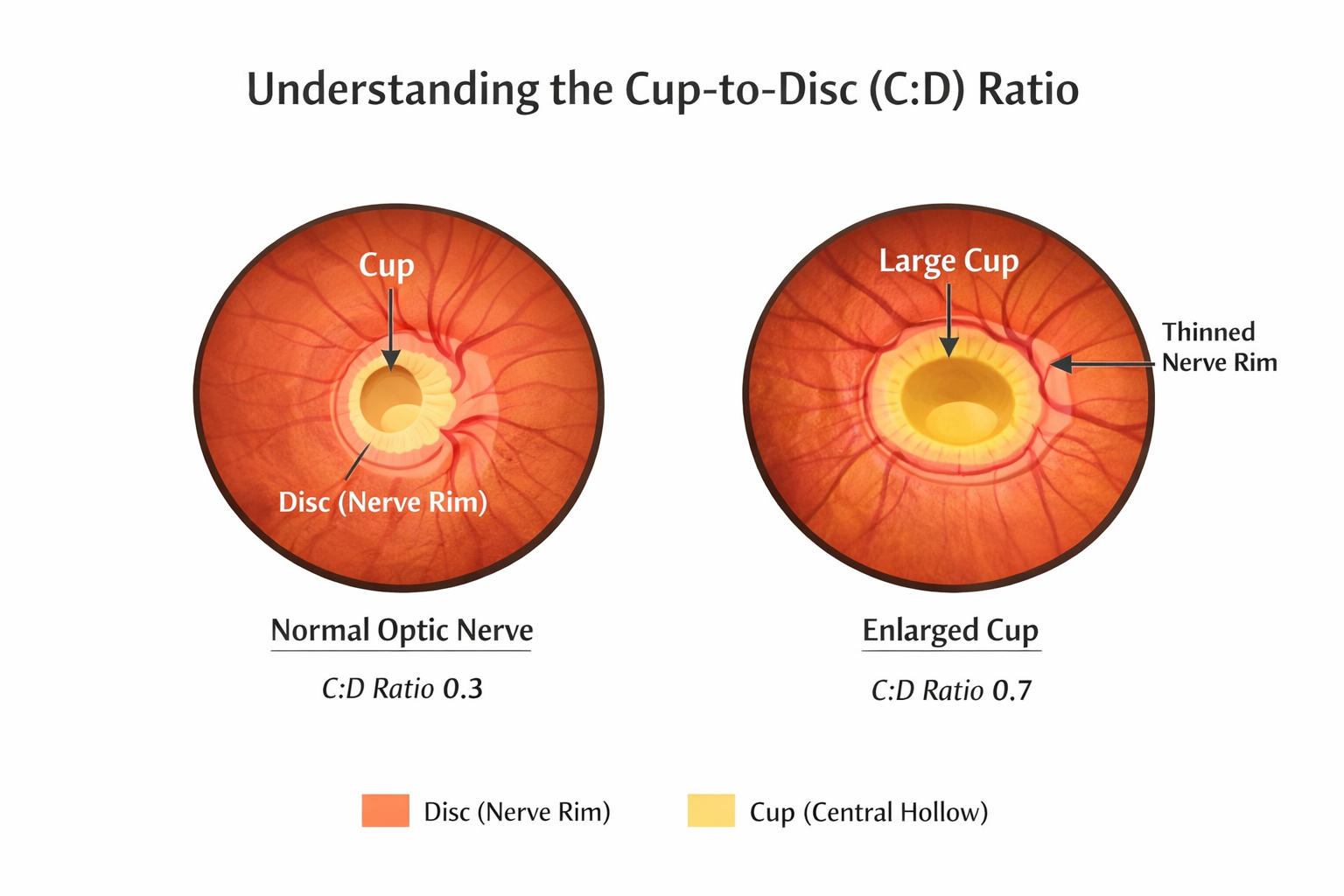
What Does “C:D Ratio” Mean?
The optic nerve has a small central hollow called the cup, surrounded by nerve tissue called the disc.
The cup-to-disc ratio (C:D) compares the size of this hollow to the whole optic nerve.
A C:D ratio greater than about 0.5, especially if it is increasing or the different between the two eyes is more than 0.2, can suggest possible nerve fibre loss and may need glaucoma testing.
However, C:D size varies naturally between people. Some individuals have large cups but healthy nerves. This is why the C:D ratio must always be interpreted along with OCT scans, visual field testing, and comparison over time. Numbers alone do not diagnose glaucoma, patterns do.
What Does “IOP > 21 mmHg” Mean?
IOP stands for intra-ocular pressure, the pressure inside the eye.
Pressures above 21 mmHg are considered higher than average. Ocular hypertension is defined as high eye pressures with no fucntional or structural damage to the optic nerve.
Not everyone with high pressure develops glaucoma, and some people develop glaucoma with normal pressure. But raised pressure increases risk and requires careful monitoring and sometimes treatment to protect the optic nerve.
Because glaucoma is usually invisible early, patients with ocular hypertension need structured follow-up even if vision is clear.
The Bigger Lesson
Early, consistent care prevents regret later. In glaucoma, we are not protecting eyesight today. We are protecting your vision for the rest of your life.
Healthcare systems are built around treating visible disease. Glaucoma is invisible early. So routine eye tests miss glaucoma. This is not anyone’s fault. But it means patients must ask questions and doctors must think long-term.
When a Second Opinion Helps
A second opinion is not about doubting your doctor. It is about understanding your own risk clearly.
Because glaucoma is subtle, a structured second opinion can be useful when:
• Reports are confusing
• Advised surgery suddenly
• Multiple drops started without explanation
• OCT and visual field results disagree
• Strong family history of glaucoma/ glaucoma blindness
A calm review of tests over time often clarifies risk. My goal is not simply to diagnose glaucoma. It is to detect it early enough to protect your vision for life. A careful examination today can prevent irreversible vision loss many years from now.
📍 Gurgaon 📞 +91 88826 38735 | 🌐 Contact Us | Second Opinion Form
The Importance of Serial Comparison
The most important glaucoma test is comparison.
We compare:
• OCT over years
• visual fields over years
• optic nerve photos
Progression becomes visible only in hindsight. That is why follow-up matters.
Common Misinterpretations
• Red OCT areas in high myopia
• Field defects from cataract
• Machine artefacts
• Ignoring early thinning
Patients should not panic. Or be falsely reassured, without explanation. A structured interpretation is essential to clarify, and stratify, risk.
My Approach
My approach to glaucoma evaluation begins with reviewing all prior reports in sequence: not just the most recent one. I look for patterns across OCT, visual field, and optic nerve imaging over time, because glaucoma progression only becomes visible when tests are compared, not read in isolation. Every patient receives a written risk summary and a clear explanation of what needs monitoring and why. I review all reports systematically with attention to long-term risk.
Closing Thought
Seeing clearly is not the same as seeing safely. In glaucoma, we are not protecting eyesight today. We are protecting your eyes for the rest of your life.
Early, consistent care matters more than dramatic late treatment. Most patients who contact me are not yet sure they have glaucoma. That is exactly the right time to ask.
FAQs
Can I have glaucoma if I can see perfectly?
Yes. Most people with early glaucoma have normal central vision. The disease usually affects peripheral vision first, so many patients notice no symptoms until significant damage has occurred.
Is checking eye pressure enough to rule out glaucoma?
No. Many people with glaucoma have normal eye pressure, while some people with raised eye pressure never develop glaucoma. Diagnosis requires examination of the optic nerve and specialised tests.
Does every eye test include glaucoma screening?
No. Routine eye examinations focus on overall eye health and vision. A comprehensive glaucoma evaluation includes additional tests that may not be performed during every eye examination.
How is glaucoma diagnosed?
Glaucoma is diagnosed using a combination of optic nerve examination, OCT imaging, visual field testing, eye pressure measurement, gonioscopy, corneal thickness assessment, and evaluation of your individual risk factors.
When should I have a glaucoma evaluation?
Adults over 40 and anyone with a family history of glaucoma, diabetes, high myopia, steroid use, or raised eye pressure should discuss glaucoma screening with their ophthalmologist.
This page is a part of the Glaucoma Hub. you may want to read about Glaucoma Progression, and Risk Stratification in Glaucoma. You may want to read more about OCT and Visual Field, Glaucoma Tests Explained, Normal OCT but Vision Symptoms and How to Understand Your OCT Better. Also of help could be Why Do I Need a Visual Field Test? Glaucoma Diagnosis in Gurgaon, Get a GlaucomaSecond Opinion in Gurgaon and Get an Online Glaucoma Consult.
About the Author
This article was written by Dr Shibal Bhartiya, fellowship-trained glaucoma specialist and Mayo Clinic Research Collaborator, Clinical Director at Marengo Asia Hospitals, Gurugram, known for ethical, patient-centred glaucoma care and independent glaucoma second opinions. She is also the Program Director for Community Outreach & Wellness; and for the Marengo Asia International Institute of Neuro and Spine.
She has published peer-reviewed research on glaucoma management, examining how treatment decisions should balance medical evidence, patient preferences, and long-term vision outcomes.
As Editor-in-Chief of Clinical and Experimental Vision and Eye Research and Executive Editor of the Journal of Current Glaucoma Practice (Pubmed Indexed, official journal of the International Society of Glaucoma Surgery), Dr Shibal Bhartiya brings editorial and research depth to every clinical decision. Her 200+ publications, including 90+ PubMed-indexed publications and 28 edited textbooks span glaucoma biology, surgical outcomes, health equity, and emerging diagnostics.
1600+ Five Star Patient Reviews Google Business Profile
If you are unable to come to Dr Bhartiya’s clinic: Read more about teleconsultation
Read her research on PubMed | Google Scholar | ResearchGate | ORCID
📋Upload your reports for a structured review.| 🌐 Contact Us| 📞 +91 88826 38735
⭐ Helped by this article? Leave a Google review — it helps other patients find reliable eye care.
Related Reading
Get an Online Glaucoma Consult
Why Do I Need a Visual Field Test?
Understanding Your OCT Report in Glaucoma
Visual Field and OCT: Structure & Function Correlation
How I Think About Eye Care

Is Glaucoma Hereditary?
Glaucoma is hereditary. This means that if someone in your family, especially a first degree relative, has glaucoma, your risk for developing glaucoma is definitely higher than the general population.