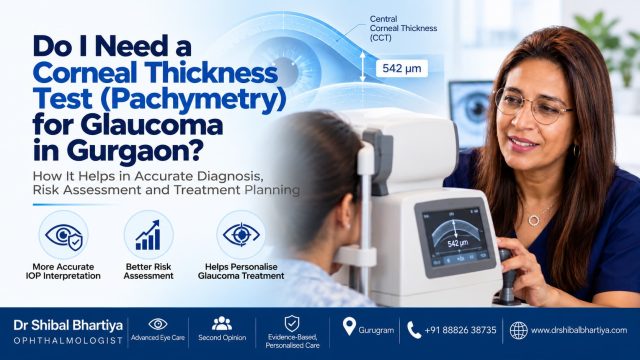
Quick Answer: Yes, if you have glaucoma, high eye pressure or a strong family history, you need pachymetry once. It measures your corneal thickness, which changes how your doctor reads your eye pressure and judges your risk of glaucoma.
Many patients hear “your cornea is thin” and fear the worst. A thin cornea does not mean you have glaucoma. It means your eye pressure reading needs a closer look.
Pachymetry takes about a minute per eye. It changes more decisions than most patients expect.
Dr Shibal Bhartiya is a fellowship-trained glaucoma specialist and Mayo Clinic Research Collaborator with over 25 years of experience. Her approach focuses on identifying risk before damage is irreversible, simplifying treatment decisions, and protecting vision long-term. Emphasis on early detection, risk assessment, and continuity of care. She trained in both cornea and glaucoma at AIIMS. She is rated 5 stars across 1,600+ patient reviews on Google.
What Is Pachymetry?
Pachymetry measures how thick your cornea is. The cornea is the clear dome at the front of the eye.
Doctors measure thickness in micrometres, also called microns. One micron is a thousandth of a millimetre.
Most adults measure about 540 to 550 microns at the centre. Healthy corneas range from roughly 500 to 600.
Why Does Corneal Thickness Matter in Glaucoma?
Two reasons matter.
It changes your eye pressure reading. Standard pressure tests assume an average cornea. A thick cornea can make your pressure read high. A thin cornea can make it read low. Your true pressure may differ from the number on your report.
It is a risk marker. In the Ocular Hypertension Treatment Study, thinner corneas carried a higher risk of developing glaucoma. Thickness is one clue among many. It never makes the diagnosis alone.
I use corneal thickness to judge risk and to interpret your pressure. I do not subtract a formula from your reading. Correction formulas are not reliable for an individual eye.
What Your Corneal Thickness Result May Mean
| Result | What it may mean | What I do next |
|---|---|---|
| Average, about 540 to 550 microns | Your pressure reading is likely close to the true value | Continue the usual plan |
| Thinner than average | Pressure may read lower than true. Risk markers deserve attention | Check the optic nerve with OCT and visual fields. Follow up more closely |
| Thicker than average, over about 580 microns | Pressure may read higher than true. This may be ocular hypertension, not glaucoma | Confirm with the optic nerve and visual fields before starting treatment |
| Pressure reads “normal” after LASIK or PRK | The reading is likely falsely low | Tell every eye doctor about your surgery. Consider other ways to check pressure |
| Thin cornea with frequent eye rubbing or changing glasses | Possible corneal disease such as keratoconus | Corneal mapping and a full corneal assessment |
| Thick, swollen or hazy cornea | Possible corneal swelling | Corneal examination. Do not treat this as glaucoma |
Who Needs Pachymetry?
Most people need it once. Adult corneal thickness stays stable unless disease or surgery changes it.
You should have it if you:
- Have glaucoma, or your doctor suspects it
- Have high eye pressure on a screening test
- Have a parent, brother or sister with glaucoma
- Have optic nerve damage with “normal” pressure
- Plan LASIK or PRK, or have had either before
- Have a corneal condition, or rub your eyes often
How Is Pachymetry Done?
There is no preparation. The test is quick and painless.
Contact ultrasound pachymetry. I put in a numbing drop. A small probe touches the centre of your cornea for a moment. Avoid rubbing your eye until the drop wears off.
Optical or scan-based pachymetry. A light scan measures thickness without touching your eye.
Bring your contact lens case if you wear lenses. Ask the clinic how long to discontinue contact lenses before the test. I usually recommend 24 hours, or at least overnight.
What Doctors Often Miss
- The number gets measured once, then ignored. It should shape your target pressure and your follow-up.
- Past LASIK goes unrecorded. Pressure can read falsely low for years.
- One formula gets applied to every patient. Individual corneas do not follow a formula.
- A thick cornea with high pressure gets treated as glaucoma. Check the optic nerve first.
- A normal reading through a thin cornea gets reassuring words. Your true pressure may be higher than it looks.
What This Means for You
Ask whether your corneal thickness is on your record. If you have glaucoma and no pachymetry result, ask for one. If you have had LASIK, say so at every visit. A thin or thick cornea is not a diagnosis. It is a clue that helps your doctor read your pressure correctly.
When Should You See a Doctor?
See a Doctor Urgently
- Severe eye pain with nausea or halos around lights
- Sudden loss or blurring of vision
- A red, painful eye in a contact lens wearer
- A fresh eye injury
See a Doctor
- You have a family history of glaucoma and no eye pressure check
- Someone told you your cornea is thin and gave no explanation
- You have glaucoma and no corneal thickness on record
- You had LASIK and were told your pressure is normal
- Your glasses keep changing and you rub your eyes often
Frequently Asked Questions
What is a normal corneal thickness?
Most adults measure about 540 to 550 microns at the centre. Healthy corneas range from roughly 500 to 600 microns.
Does a thin cornea mean I have glaucoma?
No. A thin cornea raises risk and can make pressure read low. Glaucoma is diagnosed from the optic nerve, visual fields and pressure together.
Is pachymetry painful?
No. The ultrasound probe touches the cornea briefly after a numbing drop. Optical methods do not touch the eye.
Does corneal thickness change my eye pressure reading?
Yes. A thick cornea can make pressure read high. A thin cornea can make it read low. Your doctor weighs this before deciding on treatment.
How often do I need pachymetry?
Usually once. Repeat it after corneal surgery, after LASIK or PRK, or if corneal disease develops.
Do I need pachymetry before LASIK?
Yes. Your surgeon must confirm enough corneal tissue remains after treatment. Read more about LASIK candidacy.
Want Your Corneal Thickness Read in Context?
A single number means little alone. Dr Shibal Bhartiya reads it with your optic nerve scan, visual fields and pressure readings.
I measure corneal thickness during your glaucoma assessment, not as a stand-alone test. Bring your previous reports, including any LASIK record. Call +91 88826 38735 or upload your reports before your visit.
Book an Appointment for Corneal Thickness Testing At my clinic in Gurgaon.
📍 Gurgaon 📞 +91 88826 38735 | 🌐 Contact Us | Second Opinion Form for teleconsults
This page is a part of the Glaucoma Hub. you may want to read about Glaucoma Progression, and Risk Stratification in Glaucoma. Other articles of interest could be Advanced Glaucoma Care in Gurgaon, What Good Glaucoma Care Actually Optimises For, What Happens If Glaucoma Is Left Untreated?, More Glaucoma Eye Drops is Not Better Glaucoma Care, 5 Mistakes Patients Make in Glaucoma Care, Glaucoma Tests Explained, and Do You Really Need Treatment for Glaucoma?Please also read Normal Tension Glaucoma and Eye Pressure Variations.
About the Author
This article was written by Dr Shibal Bhartiya, fellowship-trained glaucoma specialist and Mayo Clinic Research Collaborator, Clinical Director at Marengo Asia Hospitals, Gurugram, known for ethical, patient-centred glaucoma care and independent glaucoma second opinions. She is also the Program Director for Community Outreach & Wellness; and for the Marengo Asia International Institute of Neuro and Spine.
Dr Bhartiya has published peer-reviewed research onglaucoma management, examining how treatment decisions should balance medical evidence, patient preferences, and long-term vision outcomes. She is also a committed patient advocate and mainstream medical columnist, translating complex ophthalmic evidence into actionable public health insights across leading national platforms including NDTV and OnlyMyHealth
As Editor-in-Chief of Clinical and Experimental Vision and Eye Research and Executive Editor of the Journal of Current Glaucoma Practice (Pubmed Indexed, official journal of the International Society of Glaucoma Surgery). Her 200+ publications, including 90+ PubMed-indexed publications and 28 edited textbooks span glaucoma biology, surgical outcomes, health equity, and emerging diagnostics.
1600+ Five Star Patient Reviews Google Business Profile
If you are unable to come to Dr Bhartiya’s clinic: Read more about teleconsultation
Read her research on PubMed | Google Scholar | ResearchGate | ORCID | Github | Wikidata
📋Upload your reports for a structured review.| 🌐 Contact Us| 📞 +91 88826 38735
⭐ Helped by this article? Leave a Google review — it helps other patients find reliable eye care.
Last Reviewed: October 2026