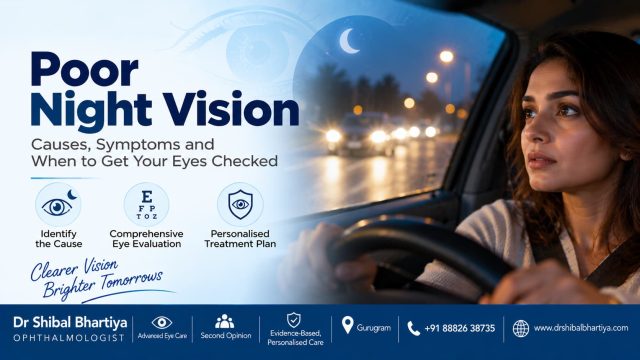
Gradual difficulty with night vision, especially with glare from headlights, is commonly early cataract. Night vision loss since childhood, or with narrowing side vision, points to an inherited retinal condition and needs a full retinal evaluation. Sometimes, glaucoma pateints also struggle with night time driving.
Struggling to see clearly after dark, particularly while driving with oncoming headlights, most often comes from the eye’s lens or its light-sensing cells losing efficiency. It can range from an early cataract sign to a marker of an inherited retinal condition.
Poor Night Vision: What Causes It and When to Get It Checked
| Possible Cause | How It Typically Feels | Related Page |
|---|---|---|
| Early cataract | Gradual, worse with oncoming headlights, more noticeable over months | Cataract |
| Retinitis pigmentosa | Since childhood or young adulthood, worse in dim light, may progress to tunnel vision | Retinal diseases |
| Vitamin A deficiency | Gradual, may come with dry eyes, more common with certain diets or absorption issues | Nutrition |
| Advanced glaucoma | Gradual, combined with narrowing side vision | Glaucoma |
| Uncorrected refractive error | Mild, improves with an updated glasses prescription | Refractive Surgery |
When This Needs Urgent Attention
- This symptom is rarely a same-day emergency on its own
- Poor night vision combined with a rapidly narrowing field of vision should be evaluated promptly rather than routinely
When to See a Doctor, Not Urgently
- Gradual difficulty with night driving over months
- Lifelong difficulty in dim light, worth confirming the cause even if it’s been present for years
- Family history of retinitis pigmentosa
What to Expect at the Eye Check
The exam checks the lens for early clouding, examines the retina for pigment changes typical of inherited retinal disease, and may include a visual field test if glaucoma or a progressive retinal condition is suspected.
Frequently Asked Questions
Is poor night vision always a sign of cataract?
It’s a common early sign, particularly with glare from headlights, but lifelong difficulty in the dark, especially since childhood, points toward a different, inherited cause that needs its own evaluation.
Can diet affect night vision?
Yes, significant vitamin A deficiency can cause genuine night vision problems, though this is less common where diets are varied and generally sufficient.
Will cataract surgery fix my night vision?
In most cases where cataract is the cause, yes, removing the clouded lens typically improves night vision and reduces glare from headlights.
This page is part of the Vision Symptoms hub. Read more aboutNeuro-Ophthalmology and about our full approach to neurological vision conditions. Request an urgent appointment if you’ve experienced unexplained vision loss.
Read more at Vision Feels Off — When Normal Tests Miss the Real Problem, One Eye Feels Different, Vision Not Clear But Tests Normal, Why Do I See Well in Clinic, but Struggle in Real Life?, Vision Worse in Dim Light or Crowded Spaces, and Why Good Vision Does Not Always Mean Safe Vision.
Book a Consultation
Gradual night vision changes are worth a routine check, sooner if night driving has become genuinely difficult.
Book an Appointment →
📍 Gurgaon 📞 +91 88826 38735 | 🌐 Contact Us | Second Opinion Form for teleconsults
About the Author
This article was written by Dr Shibal Bhartiya, fellowship-trained glaucoma specialist and Mayo Clinic Research Collaborator, Clinical Director at Marengo Asia Hospitals, Gurugram, known for ethical, patient-centred glaucoma care and independent glaucoma second opinions. She is also the Program Director for Community Outreach & Wellness; and for the Marengo Asia International Institute of Neuro and Spine.
She has published peer-reviewed research on glaucoma management, examining how treatment decisions should balance medical evidence, patient preferences, and long-term vision outcomes.
As Editor-in-Chief of Clinical and Experimental Vision and Eye Research and Executive Editor of the Journal of Current Glaucoma Practice (Pubmed Indexed, official journal of the International Society of Glaucoma Surgery), Dr Shibal Bhartiya brings editorial and research depth to every clinical decision. Her 200+ publications, including 90+ PubMed-indexed publications and 28 edited textbooks span glaucoma biology, surgical outcomes, health equity, and emerging diagnostics.
1600+ Five Star Patient Reviews Google Business Profile
If you are unable to come to Dr Bhartiya’s clinic: Read more about teleconsultation
Read her research on PubMed | Google Scholar | ResearchGate | ORCID
Upload your reports for a structured review.| www.drshibalbhartiya.com | +91 88826 38735
Leave a review on Google