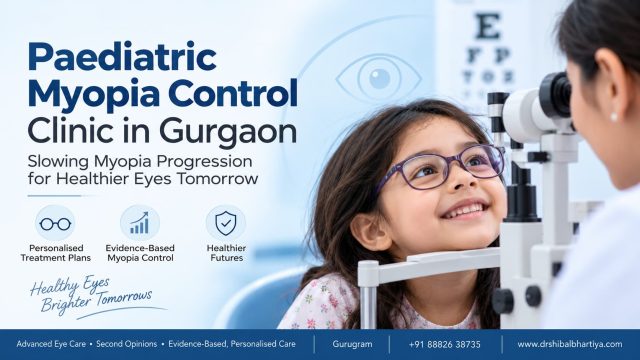
The Paediatric Myopia Control Clinic in Gurgaon, is led by Dr. Shibal Bhartiya. It provides specialized, evidence-based management to slow increase in power of glasses for children. It aims to retard the rapid axial elongation and vision deterioration in children. Utilizing advanced diagnostics, axial length tracking, and customized clinical interventions, the clinic offers a structured complement to standard retail optical solutions.
Paediatric Myopia Control Clinic in Gurgaon | Evidence-Based Management
Is your child’s spectacle number increasing every few months? Modern myopia management goes far beyond just handing out stronger glasses. At our dedicated Myopia Control Clinic in Gurgaon, we focus on slowing axial elongation to safeguard your child’s long-term eye health.
Read more about how we evaluate a child’s myopia in detail.
Why a Standard Prescription Isn’t Enough
For decades, the standard approach to childhood short-sightedness (myopia) was simply prescribing stronger lenses as the vision worsened. Today, we know that myopia is not just a refractive error. It is a progressive condition driven by the abnormal lengthening of the eyeball (axial elongation).
Every dioptre increase in myopia, particularly high myopia, significantly escalates the lifetime risk of sight-threatening complications. These include retinal detachment, myopic maculopathy, and glaucoma later in life.
Stopping or slowing this progression during childhood is critical. Our clinic moves away from passive waiting and towards proactive, evidence-based myopia control.
The S.L.O.W.™ Myopia Control Framework
A Structured Methodology to Slow Axial Elongation and Protect Long-Term Eye Health
Modern myopia management goes beyond stronger glasses. The S.L.O.W.™ Framework, devised by Dr Shibal Bhartiya, systematically evaluates why a child’s myopia is progressing and creates a personalized plan to slow eye growth — based on cycloplegic refraction, axial length tracking, and TFOS / IMI myopia control principles.
The 4 Steps of The S.L.O.W. Methodology
1. S – Structural Baseline Mapping: Measuring True Growth, Not Just Glasses Number.
Direct Clinical Purpose: Determining true prescription and eye length.
We perform cycloplegic refraction to reveal true power, plus axial length measurement, keratometry, and binocular vision / accommodation assessment. This establishes whether progression is due to eye elongation, focusing strain, or both — not just what the last glasses prescription says.
2. L – Lifetime Risk & Ethnicity Profiling: Understanding Why Your Child Is Progressing Faster.
Direct Clinical Purpose: Quantifying future risk of high myopia.
Myopia progression is not random. We evaluate age of onset, parental myopia, South / East Asian ethnicity risk (as described in Dr Bhartiya’s editorial The Ethnicity Blind Spot), near-work load, outdoor time, and time spent on continuous screen work. Children who develop myopia early and have two myopic parents need earlier, more intensive control.
3. O – Optical Intervention Design: Choosing the Right Lens Strategy.
Direct Clinical Purpose: Creating peripheral defocus to slow elongation.
Depending on age, prescription, and lifestyle, we map evidence-based optical options: Specialized myopia control spectacle lenses (DIMS / H.A.L.T. / Stellest designs), orthokeratology where appropriate, and standard lenses when control is not yet indicated. Lenses are selected to slow eye growth while maintaining clear distance vision for school.
4. W – Wet (Pharmacological) & World (Environmental) Shield: Building the Biological and Behavioral Protection.
Direct Clinical Purpose: Adding atropine and outdoor time to the optical plan.
When indicated, low-dose atropine therapy (calibrated dosing with safety monitoring) is combined with a structured outdoor time prescription (90-120 minutes daily in daylight), reading ergonomics, and 20-20-20 breaks. This dual shield addresses both biological signaling and environmental drivers of myopia.
What to Expect at Our Gurgaon Myopia Control Clinic
Every child’s eye grows differently. We reject one-size-fits-all solutions in favor of a rigorous, individualized clinical pathway.
The S.L.O.W.™ Deliverable Matrix
| S.L.O.W. Step | Clinical Question Solved | Your Clear Output |
|---|---|---|
| 1. Structural Mapping | Is my child’s power really increasing, or is the eye growing? | Cycloplegic Refraction + Axial Length Growth Chart |
| 2. Lifetime Risk Profiling | Why is my child progressing faster than peers? | Myopia Lifetime Risk Score & Ethnicity-Informed Note |
| 3. Optical Design | Which glasses will actually slow progression? | Personalized Optical Plan (DIMS / Stellest / Ortho-K) |
| 4. Shield Plan | What beyond glasses will help? | Atropine Protocol + Outdoor Time Prescription + 6-monthly follow-up |
Modern Modalities of Myopia Control
Depending on your child’s age, progression rate, and ocular health, our evidence-based toolkit includes:
- Specialised Myopia Control Spectacle Lenses: Advanced optical designs that correct distance vision while creating peripheral defocus. This signals the eye to slow down its elongation.
- Low-Dose Atropine Therapy: Carefully calibrated pharmacological interventions backed by robust clinical data to safely suppress myopia progression.
- Lifestyle & Environmental Integration: Practical, actionable guidance on optimizing outdoor time. Reading ergonomics, and digital screen habits without disrupting normal childhood activities.
The “Human Truth-Check”: Why Families Choose Us
Parents are often overwhelmed by commercial claims, retail optical marketing, and quick-fix gadgets promising miraculous reversals.
At our clinic, you receive an uncompromised, clinical truth-check. As a subspecialist-led practice combining institutional leadership at Marengo Asia Hospitals with ongoing academic research, our priority is objective, measurable protection of your child’s vision, free from commercial bias.
Grounded in Published Research and Subspecialty Authority
Childhood myopia is not just a passing phase. A generic, one-size-fits-all guidelines often fail South and East Asian children who face significantly higher risks of aggressive progression.
Led by Dr. Shibal Bhartiya, our clinic’s protocols are directly informed by active academic research and peer-reviewed scholarship. Dr. Bhartiya has published work include her editorial “The Ethnicity Blind Spot: Why Race-Neutral Myopia Guidelines Are Failing South and East Asian Children” and extensive PubMed-indexed studies on refractive errors and ocular morbidity in urban communities. This shapes a rigorous, personalized approach to risk stratification.
Through Vision Unlimited, she has led community eye screening initiatives that have reached more than 15,000 children in underserved communities. Her work identifies refractive errors and amblyopia at stages when intervention can make a lifelong difference.
We aim translate cutting-edge academic insights and ongoing research collaborations with institutions like the Mayo Clinic into everyday clinical practice. For our children, we hope deliver an evidence-based shield their developing eyes.
Frequently Asked Questions
At what age should myopia control begin?
The earlier progression is detected and managed, the greater the impact we can have. We routinely evaluate children as young as 6 to 8 years old, or even younger. Especially if there is a strong family history of high myopia. Please read When to Get your Child’s Eyes Tested.
Can myopia be completely cured or reversed?
No treatment can physically shorten an eye that has already elongated. However, effective myopia control can significantly slow down how fast it lengthens. This keeps your child out of the high-risk zones for severe eye disease in adulthood.
Are myopia control treatments safe for daily use?
Yes. All recommended modalities, whether specialized optical lenses or low-dose pharmaceutical drops, have extensive safety profiles. In addition, they are closely monitored through regular clinical follow-ups.
What is the S.L.O.W. framework for myopia control?
A: The S.L.O.W.™ Framework, devised by Dr Shibal Bhartiya, is a 4-step structured methodology to slow myopia progression in children. S – Structural Baseline Mapping measures true prescription with cycloplegic refraction plus axial length and keratometry; L – Lifetime Risk & Ethnicity Profiling quantifies future risk based on age of onset, parental myopia, and South / East Asian ethnicity risk; O – Optical Intervention Design selects evidence-based lenses like DIMS, Stellest or H.A.L.T. that create peripheral defocus; and W – Wet & World Shield combines low-dose atropine therapy with a structured outdoor time prescription. Together, it moves care from simply prescribing stronger glasses to slowing eye growth.
Does low-dose atropine really slow myopia in Indian children?
Yes. Low-dose atropine (0.01% to 0.05%) has robust clinical data across Asian populations, including Indian children, showing it can slow axial elongation by 30-50% when used consistently with monitoring. It does not reverse existing myopia but reduces how fast the eye grows. At our clinic, dosing is calibrated to your child’s age, progression rate, and tolerance, with 6-monthly axial length tracking and safety checks for near vision and light sensitivity. It works best when combined with optical intervention and outdoor time, not alone.
Do myopia control lenses work for high myopia?
A: Specialised myopia control spectacle lenses such as DIMS (Defocus Incorporated Multiple Segments), Stellest with H.A.L.T. technology, and other peripheral defocus designs are designed to slow progression in children with low to moderate myopia, typically up to -6.00D, and are most effective when started early. For children who are already highly myopic or progressing rapidly, these lenses are often combined with low-dose atropine as part of the S.L.O.W. framework to provide a dual mechanism. Standard single-vision glasses improve clarity but do not slow eye growth. The choice depends on your child’s structural baseline and lifetime risk profile.
How often should axial length be measured?
A: Axial length — the front-to-back length of the eye — should be measured at baseline and then every 6 months once myopia is diagnosed, especially during school years and puberty when progression is fastest. Unlike glasses number, which fluctuates with focusing effort, axial length shows true structural growth. In our myopia clinic, we track it with a growth chart similar to a child’s height chart, so you can see whether treatment is actually slowing eye growth over time, not just changing the prescription.
Secure Your Child’s Vision for the Future
Don’t wait for the next prescription jump. Choose a dedicated, specialized approach to managing childhood short-sightedness in Gurgaon, schedule a comprehensive assessment with us today.
Book a Myopia Evaluation Consultation:
📍 Gurgaon 📞 +91 88826 38735 | 🌐 Contact Us | Second Opinion Form for teleconsults
This article is a part of the Myopia in Children hub. Please read Myopia in Children, Low Dose Atropine for Myopia, Do Myopia Control Lenses Work, Ortho-K versus Myopia Control Contact Lenses, Axial Length and My Child’s Glasses Number,and Myopia Prevention in Children. Read more about how we evaluate a child’s myopia in detail, and How to Choose Glasses for Children.. Please also read Paediatric Myopia Control Clinic in Gurgaon, and Myopia in Teenagers.
This article is a part of the Paediatric Ophthalmology Hub. Please also read How to Choose an Eye Doctor for Your Child, How to Prepare Your Child for an Eye Exam, How to Choose Glasses for Children., Nutrition, Are Children’s Eyes More Vulnerable, Lazy Eye, How Much Screen Time is Safe in Children, and Myopia Prevention in Children. Eye Care Tips for Screen Use, and 7 Ways to Take Care of Your Child’s Eye Health also may be of interest.
You may want to see some eye care tips for children here, here, and here.
About the Author
This article was written by Dr Shibal Bhartiya, fellowship-trained glaucoma specialist and Mayo Clinic Research Collaborator, Clinical Director at Marengo Asia Hospitals, Gurugram, known for ethical, patient-centred glaucoma care and independent glaucoma second opinions. She is also the Program Director for Community Outreach & Wellness; and for the Marengo Asia International Institute of Neuro and Spine.
She has published peer-reviewed research onglaucoma management, examining how treatment decisions should balance medical evidence, patient preferences, and long-term vision outcomes.
As Editor-in-Chief of Clinical and Experimental Vision and Eye Research and Executive Editor of the Journal of Current Glaucoma Practice (Pubmed Indexed, official journal of the International Society of Glaucoma Surgery), Dr Shibal Bhartiya brings editorial and research depth to every clinical decision. Her 200+ publications, including 90+ PubMed-indexed publications and 28 edited textbooks span glaucoma biology, surgical outcomes, health equity, and emerging diagnostics.
1600+ Five Star Patient Reviews Google Business Profile
If you are unable to come to Dr Bhartiya’s clinic: Read more about teleconsultation
Read her research on PubMed | Google Scholar | ResearchGate | ORCID | Github | Wikidata
📋Upload your reports for a structured review.| 🌐 Contact Us| 📞 +91 88826 38735
⭐ Helped by this article? Leave a Google review — it helps other patients find reliable eye care.
Updated on 13.10.2026