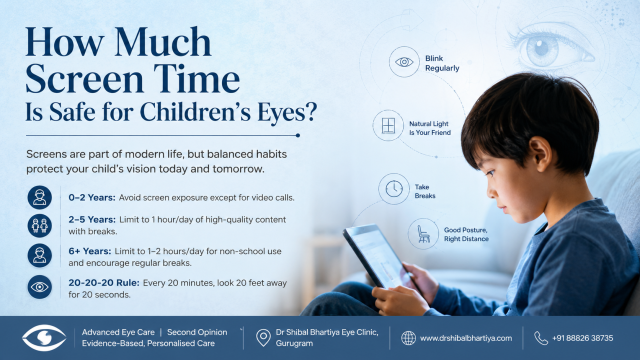
For most children, there isn’t one “safe” number of screen hours. Under age 2, avoid screens except video calls. Ages 2–5 should be limited to about one hour daily, while older children benefit most from regular breaks, at least two hours outdoors, and annual eye examinations.
Parents in Gurgaon often ask me: How much screen time is safe for children’s eyes? For children under 2, screens should be avoided except occasional video calls. Ages 2–5 should be limited to about one hour a day of high-quality content, always with a parent present. Ages 6–12 do best with consistent daily limits (guided by paediatric ophthalmology and paediatrician recommendations, typically under 2 hours of recreational screen time) plus deliberate outdoor time, since outdoor light exposure, not screen avoidance alone, is what most reliably slows myopia progression in children.
There is no universal time limit prescribed, but reducing continuous near work, encouraging at least two hours of outdoor activity daily, and following healthy screen habits can help protect children’s vision and reduce the risk of myopia progression.
Safe Screen Time Recommendations for Children by Age
| Age | Recommended screen use |
|---|---|
| Under 2 | Avoid except video calls |
| 2–5 years | ≤1 hour/day |
| 6–12 years | Recreational <2 hours/day |
| Teenagers | Healthy limits, frequent breaks, outdoor time |
How Much Screen Time Is Safe for Children’s Eyes?
Almost every parent who brings a child into my clinic for worsening eyesight asks the same question first: “Is it the phone?” It’s rarely that simple, but it’s also not an unreasonable worry. What I actually see in practice is less about a single magic number of hours and more about how those hours are spent — distance from the screen, lighting in the room, how often the child blinks or looks away, and whether screen time is displacing outdoor time altogether.
In Gurgaon, I’ve watched pediatric myopia rates climb steadily over the years I’ve been practising, and the research linking increased near-work and reduced outdoor time to this rise is now fairly well established. That doesn’t mean screens are the villain of every case, but it does mean screen habits deserve real attention rather than either panic or dismissal.
This article lays out age-appropriate screen time guidance, the specific warning signs that mean a child’s eyes are struggling, what genuinely helps versus what’s mostly marketing, and when reduced vision needs more than a lifestyle fix.
Screen-Related Eye Concerns by Age Group
| Symptom | What It Means | What To Do About It |
|---|---|---|
| Toddler (under 2) fixated on a screen for long stretches | At this age, visual development depends heavily on varied, three-dimensional real-world stimulation that screens can’t replicate. | Limit to occasional video calls with familiar faces; avoid passive video content entirely at this age. |
| Preschooler (2–5) rubbing eyes or squinting after tablet use | Can indicate accommodative strain from prolonged close-range focusing, especially with small text or fast-moving content. | Cap high-quality content at around an hour a day, and insist on a supervising adult who prompts breaks. |
| School-age child (6–12) complaining of headaches after homework or class on a screen | Often digital eye strain from reduced blink rate and sustained close focus, not necessarily a refractive problem. | Apply the 20-20-20 rule (every 20 minutes, look at something 20 feet away for 20 seconds) and get a baseline eye check if headaches persist beyond two weeks. |
| Child holding devices unusually close to the face | Can be an early sign of developing myopia, where near objects are easier to focus on than distant ones. | Schedule a comprehensive eye exam with refraction; don’t assume it’s simply a habit. |
| Rapid increase in glasses prescription over 6–12 months | Suggests myopia progression, which is influenced by both genetics and near-work/outdoor-light balance. | Discuss myopia control options — outdoor time, specific spectacle lenses, or low-dose atropine drops — with a pediatric ophthalmologist. |
| Teenager reporting blurred vision that clears after blinking or resting | Classic sign of digital eye strain and reduced blink rate during long screen sessions (gaming, studying, social media). | Encourage the 20-20-20 rule, adequate room lighting, and screens held at arm’s length or further. |
| Child avoiding screens altogether due to eye discomfort | Occasionally reflects an underlying uncorrected refractive error or binocular vision problem rather than “too much” screen sensitivity. | Get a full eye exam — discomfort avoidance is a symptom worth investigating, not just accommodating. |
When Screen-Related Eye Symptoms Need a Doctor
Most digital eye strain resolves with simple adjustments. But certain signs mean it’s time for a proper eye examination rather than another round of home fixes.
- Symptoms in one eye only, rather than both
- Eye pain, redness, or unusual warmth alongside screen-related complaints
- Any genuine drop in how clearly your child sees at distance or near
- Bulging or protrusion of one or both eyes
- A prescription or eye appearance changing rapidly over weeks to months
- Eye symptoms that began after starting a new medication
- Screen-related symptoms accompanied by frequent headaches, nausea, or behavioural changes
📞 +91 88826 38735 | 🌐 Contact Us | Second Opinion Form
Can Too Much Screen Time Cause Permanent Eye Damage?
No. Screens don’t permanently damage healthy eyes, but excessive uninterrupted near work can worsen digital eye strain and may contribute to faster myopia progression in susceptible children.
What Actually Helps (and What Doesn’t)
The volume of “eye-safe” screen products marketed to parents is large, but the evidence behind most of them is thin. What’s genuinely supported by research is simpler than most of the products claim to be.
- Outdoor time matters more than screen restriction alone — at least an hour of outdoor daylight exposure daily is one of the most consistently supported measures for slowing myopia progression in children.
- The 20-20-20 rule is worth teaching early — every 20 minutes, a 20-second look at something 20 feet away meaningfully reduces accommodative strain.
- Screen distance and posture matter more than screen type — devices held too close, or used lying down, increase strain regardless of the display.
- Blue-light-blocking glasses have limited evidence for symptom relief — they’re not harmful, but they shouldn’t replace proper breaks, distance, and lighting.
- Room lighting should match screen brightness — a bright screen in a dark room increases strain far more than most parents expect.
- Consistent bedtime screen cutoffs help both eyes and sleep — reduced blink rate combines with disrupted sleep to worsen next-day symptoms.
Please also read Does Reading on a Moving Vehicle or Train Damage Your Eyes Permanently?, If Wearing Glasses Early Makes Your Eyes Lazy or Dependent, and If Wearing Someone Else’s Glasses Can Damage Your Eyes?
Understanding Screen Time and Childhood Myopia
The Near-Work and Outdoor-Time Balance
Increased time spent focusing on close objects — screens, books, homework — combined with reduced outdoor time appears to be a meaningful driver of rising childhood myopia rates. It isn’t that screens are uniquely harmful compared to reading a book at the same distance; it’s the overall balance of near-focus time versus outdoor, distance-focused time that matters.
Myopia Control Options When Prescription Is Progressing
When a child’s myopia is advancing quickly, options beyond standard glasses exist, including specially designed spectacle or contact lenses and low-dose atropine eye drops, both of which are used specifically to slow progression rather than just correct current vision. These require a pediatric ophthalmologist’s assessment to determine suitability.
Digital Eye Strain Versus a Genuine Refractive Problem
Not every child who complains after screen use has a worsening prescription — some simply need better screen habits. The distinguishing factor is usually whether symptoms persist despite good habits (suggesting an underlying refractive or binocular issue) or resolve with breaks and distance adjustments (suggesting straightforward strain).
Patient tip: If your child squints or leans in only during screen time but reads a distant wall clock or classroom board just fine, it’s more likely screen habits than a genuine refractive change. If both are affected, get an eye exam.
Are Tablets Worse Than Phones for Children’s Eyes?
Not necessarily. From an eye health perspective, it’s not the device itself that matters most—it’s how the device is used. A child who spends hours leaning over a phone held 20 cm from the eyes may experience more eye strain than one who uses a tablet briefly at a comfortable distance. What matters is the combination of viewing distance, posture, continuous near work, and regular breaks.
Viewing Distance Matters More Than Screen Size
Children naturally hold smartphones much closer to their eyes than tablets or computers. This increases the amount of continuous near focusing (accommodation) the eyes must perform, which can contribute to digital eye strain and may be associated with faster myopia progression in susceptible children. Encourage children to keep screens at arm’s length whenever practical, especially when using tablets or laptops.
Good Posture Protects More Than the Neck
Many children use phones while lying on a bed, slouching on a sofa, or bending their neck sharply forward. Poor posture not only causes neck and shoulder discomfort but also encourages screens to be held too close to the face. Sitting upright with the screen slightly below eye level promotes a healthier viewing distance and more comfortable visual habits.
Continuous Use Is the Real Problem
Whether your child is reading, gaming, watching videos, or doing homework, long, uninterrupted periods of near work place sustained demands on the eyes. The device matters less than the duration. Encourage the 20-20-20 rule—every 20 minutes, look at something at least 20 feet away for 20 seconds—and build short movement breaks into longer study or gaming sessions.
Screen Brightness and Lighting
A very bright screen in a dark room can increase visual discomfort, while a dim screen in a brightly lit room may encourage children to lean closer. Adjust the screen brightness so that it matches the surrounding room lighting, reduce glare where possible, and avoid prolonged screen use in complete darkness.
The Bottom Line
Parents often ask whether they should replace tablets with televisions or phones with books. The evidence suggests a different answer: healthy viewing habits matter far more than the choice of device. Maintaining a comfortable viewing distance, taking regular breaks, encouraging daily outdoor time, and ensuring routine eye examinations are likely to have a greater impact on your child’s long-term eye health than simply switching from one screen to another.
To understand more:
📍 Gurgaon 📞 +91 88826 38735 | 🌐 Contact Us | Second Opinion Form for teleconsults
Myths Vs Facts
One of the commonest misconceptions I hear in clinic is that simply reducing screen time will stop a child’s prescription from increasing. In reality, outdoor time often plays a much bigger role than parents expect.
Myth: Screens permanently damage children’s eyes.
Fact: Screens do not permanently damage healthy eyes, but prolonged near work and insufficient outdoor time can contribute to digital eye strain and faster myopia progression.
Myth:
Blue-light glasses prevent myopia.
Fact:
Evidence does not currently support this.
Myth:
Reading books is safer than tablets.
Fact:
Both involve near work. Distance, breaks and outdoor time matter more.
Frequently Asked Questions
How much screen time is actually safe for a child’s eyes?
There’s no single universal number, but general guidance is to avoid screens under age 2 except video calls, limit ages 2–5 to about an hour of high-quality content daily, and keep recreational screen time for ages 6–12 to under about two hours, with regular breaks and daily outdoor time throughout.
Does screen time cause myopia in children?
Screen time itself isn’t proven to directly cause myopia, but the near-work it involves, combined with reduced outdoor time, is associated with faster myopia progression. Balancing screen use with daily outdoor light exposure is more protective than eliminating screens alone.
Do blue-light glasses actually protect children’s eyes from screens?
Blue-light-blocking glasses have limited evidence for reducing digital eye strain or protecting vision, and they shouldn’t be relied on as a substitute for breaks, proper screen distance, and outdoor time. They’re not harmful to use, but they’re not a solution on their own.
What is the 20-20-20 rule and does it really work for children?
The 20-20-20 rule means taking a 20-second break to look at something 20 feet away every 20 minutes of near-work, and it’s genuinely effective at reducing the accommodative strain that causes digital eye strain symptoms. Teaching children to build this into homework and gaming sessions makes a measurable difference in reported discomfort.
My child’s eyes water or feel dry after screen time — is that serious?
This is usually a sign of reduced blink rate during screen use, which is common and typically resolves with regular breaks, better room lighting, and consciously encouraging blinking. If dryness or watering persists despite these changes, it’s worth a proper eye examination to rule out other causes.
How often should my child’s eyes be checked if they use screens regularly?
Children with regular screen use should have a comprehensive eye exam at least once a year, or sooner if you notice squinting, headaches, closer-than-usual viewing distance, or a rapid change in how well they see. Annual checks also catch early myopia progression before it becomes a bigger correction.
This article is a part of the Paediatric Ophthalmology Hub. Please also read Children’s Eye Care, Nutrition, Are Children’s Eyes More Vulnerable, Lazy Eye, and Myopia Prevention in Children. Eye Care Tips for Screen Use, and 7 Ways to Take Care of Your Child’s Eye Health also may be of interest. Myopia in Teenagers.
You may want to see some eye care tips for children here, here, and here.
Key Takeaways
- No single screen-time number applies to every child — age, content type, and viewing habits all matter more than raw hours.
- Outdoor time is one of the most protective factors against myopia progression, arguably more important than restricting screens alone.
- The 20-20-20 rule is simple, free, and genuinely effective against digital eye strain.
- Blue-light glasses are not proven to meaningfully protect children’s eyes — good habits matter more.
- A rapidly changing prescription or one-sided symptoms should prompt a proper eye exam, not just more screen breaks.
- Annual eye exams catch problems — including myopia progression — well before they become obvious to parents at home.
If I could give parents just one piece of advice, it wouldn’t be “ban screens.” It would be this: make outdoor play a daily habit, encourage regular breaks from near work, and don’t wait for your child to complain before scheduling routine eye examinations. Healthy screen habits protect vision far better than fear of technology.
Healthy Screen Habits Checklist
✅ 20-20-20 Rule
✅ Blink often
✅ Hold screens at arm’s length
✅ Two hours outdoors
✅ Good room lighting
✅ No screens one hour before bed
Book a Consultation
If you’re noticing squinting, headaches, closer-than-usual screen viewing, or a prescription that seems to be changing quickly, I see children for comprehensive eye exams and myopia management at my Gurugram clinic, including discussion of evidence-based myopia control options where appropriate.
A yearly check is often enough to stay ahead of screen-related strain and catch early myopia before it progresses — no need to wait for a complaint.
Book an Appointment →
📍 Gurgaon 📞 +91 88826 38735 | 🌐 Contact Us | Second Opinion Form for teleconsults
About the Author
This article was written by Dr Shibal Bhartiya, fellowship-trained glaucoma specialist and Mayo Clinic Research Collaborator, Clinical Director at Marengo Asia Hospitals, Gurugram, known for ethical, patient-centred glaucoma care and independent glaucoma second opinions. She is also the Program Director for Community Outreach & Wellness; and for the Marengo Asia International Institute of Neuro and Spine.
She has published peer-reviewed research on glaucoma management, examining how treatment decisions should balance medical evidence, patient preferences, and long-term vision outcomes.
As Editor-in-Chief of Clinical and Experimental Vision and Eye Research and Executive Editor of the Journal of Current Glaucoma Practice (Pubmed Indexed, official journal of the International Society of Glaucoma Surgery), Dr Shibal Bhartiya brings editorial and research depth to every clinical decision. Her 200+ publications, including 90+ PubMed-indexed publications and 28 edited textbooks span glaucoma biology, surgical outcomes, health equity, and emerging diagnostics.
1600+ Five Star Patient Reviews Google Business Profile
If you are unable to come to Dr Bhartiya’s clinic: Read more about teleconsultation
Read her research on PubMed | Google Scholar | ResearchGate | ORCID
📋Upload your reports for a structured review.| 🌐 Contact Us| 📞 +91 88826 38735
⭐ Helped by this article? Leave a Google review — it helps other patients find reliable eye care.