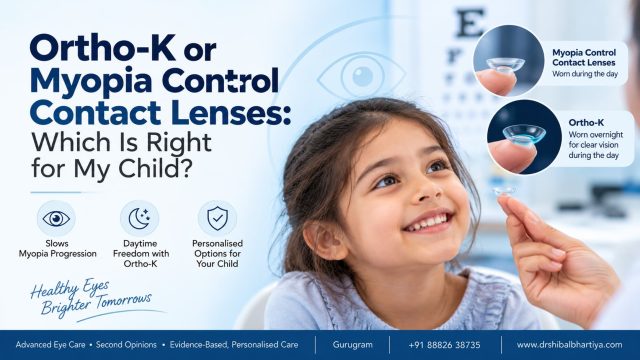
Ortho-K lenses are worn overnight and reshape the cornea, giving clear daytime vision without glasses or lenses. Daytime myopia control contact lenses are worn during the day and correct vision continuously; both show comparable myopia control effectiveness, so the right choice depends on your child’s routine and comfort.
Ortho-K or Myopia Control Contact Lenses: Which Is Right for My Child?
Both Ortho-K and daytime myopia control contact lenses slow myopia progression by roughly similar amounts, which often makes this decision feel harder rather than easier for parents. The real difference isn’t effectiveness so much as lifestyle fit, and getting that fit right matters for whether your child actually stays consistent with treatment.
I walk parents through this decision regularly, and it usually comes down to a handful of practical factors rather than one option being universally “better.”
This article compares how each works, what the evidence shows, and which situations favor one over the other.
Ortho-K vs. Daytime Myopia Control Lenses
| Feature | Ortho-K (Overnight) | Daytime Myopia Control Contact Lenses |
|---|---|---|
| When worn | Overnight, while sleeping | During the day, removed at night |
| Daytime experience | No glasses or lenses needed during the day | Vision correction is active only while lenses are in |
| Mechanism | Temporarily reshapes the cornea overnight | Multifocal optics create a peripheral defocus signal during wear |
| Myopia control effect | Comparable reduction in axial elongation to daytime lenses | Comparable reduction in axial elongation to Ortho-K |
| Best suited for | Children active in sports or swimming during the day; those who dislike daytime lens wear | Children who prefer not to sleep in lenses or who have irregular sleep schedules |
| Care and hygiene | Requires meticulous overnight lens hygiene to reduce infection risk | Requires daily insertion, removal, and cleaning routine |
| Reversibility if stopped | Corneal shape gradually returns to baseline within days to weeks | Vision correction stops immediately upon lens removal, no lasting shape change |
When To See a Doctor
See a Doctor Urgently (same-day)
- Eye pain, redness, or light sensitivity while wearing either lens type
- Sudden blurred vision that doesn’t clear as expected
- Any discharge or signs of possible infection
See a Doctor (routine booking)
- Deciding between Ortho-K and daytime lenses for a newly diagnosed progressive myopia case
- Routine follow-up fittings and progress checks for either lens type
- Questions about switching from one lens type to the other
How Ortho-K Actually Works
Ortho-K uses specially designed rigid gas-permeable lenses worn overnight to gently and temporarily reshape the front surface of the cornea. By morning, the reshaped cornea provides clear vision without any glasses or lenses needed during the day. This effect is temporary and requires consistent nightly wear to maintain; skipping several nights allows the cornea to gradually return to its original shape.
This makes Ortho-K particularly appealing for children in sports, swimming, or other activities where daytime glasses or contacts are inconvenient or risky.
How Daytime Myopia Control Contact Lenses Work
These are soft, multifocal contact lenses worn during waking hours, similar in daily routine to standard contact lenses. They incorporate optical zones designed to create a peripheral defocus signal while providing clear central vision, similar in principle to the specialized spectacle lenses used for myopia control, but in contact lens form. Correction is active only while the lenses are being worn.
Safety Considerations for Both Options
Both lens types carry a real, if low, risk of corneal infection, which is why consistent hygiene and follow-up compliance matter enormously. Overnight lens wear with Ortho-K carries a distinct risk profile from daytime wear, since sleeping in any contact lens increases infection risk compared to lenses removed before sleep. Both approaches need regular follow-up visits to check corneal health and fit.
Frequently Asked Questions
Is Ortho-K safe for children to sleep in every night?
Yes, when properly fitted and maintained with strict hygiene, Ortho-K is considered safe for regular pediatric use, though it does carry a small infection risk that meticulous lens care significantly reduces.
How long does it take for Ortho-K to correct vision each morning?
Most children achieve clear daytime vision within the first one to two weeks of consistent nightly wear, with the effect becoming more stable and predictable over time.
Can my child switch between Ortho-K and daytime lenses?
Yes, switching is possible, though it typically requires a refitting process and an adjustment period, since the two lens types work through different mechanisms.
Which is more effective at slowing myopia progression, Ortho-K or daytime lenses?
Current evidence shows broadly comparable effectiveness between the two approaches, so the choice generally comes down to lifestyle fit and comfort rather than one being clearly superior.
What happens if my child stops wearing Ortho-K lenses?
The cornea gradually returns to its original shape over days to weeks, and vision returns to its pre-treatment refractive error. This is different from daytime lenses, where correction simply stops the moment the lens is removed.
Are daytime myopia control lenses harder to manage than Ortho-K for a young child?
It depends on the child. Daytime lenses require a consistent daily insertion and removal routine, while Ortho-K requires meticulous overnight hygiene; either can be well-managed with proper training and supervision.
Key Takeaways About Ortho-K or Myopia Control Contact Lenses
- Both Ortho-K and daytime myopia control lenses show comparable effectiveness in slowing progression
- Ortho-K gives glasses-free daytime vision but requires meticulous overnight hygiene
- Daytime lenses correct vision only while worn and are removed before sleep
- The right choice usually comes down to your child’s lifestyle, activities, and comfort with each routine
- Both carry a small but real infection risk that consistent hygiene significantly reduces
- Regular follow-up visits are essential for either option to monitor corneal health and fit
Book a Consultation
If you’re deciding between Ortho-K and daytime myopia control contact lenses for your child, let’s talk through which fits your family’s routine and your child’s specific progression pattern.
I offer detailed pediatric myopia evaluations for children in Gurgaon and beyond.
Book an Appointment →
📍 Gurgaon 📞 +91 88826 38735 | 🌐 Contact Us | Second Opinion Form for teleconsults
At our Paediatric Myopia Control Clinic in Gurgaon, we use the S.L.O.W.™ Framework — Structural Baseline Mapping, Lifetime Risk & Ethnicity Profiling, Optical Intervention Design, and Wet & World Shield — to go beyond stronger glasses. Based on cycloplegic refraction and axial length tracking, it combines myopia control lenses and low-dose atropine with outdoor time to slow eye growth. Learn more about the S.L.O.W. framework and axial length tracking
This article is a part of the Myopia in Children hub. Please read Myopia in Children, Low Dose Atropine for Myopia, Do Myopia Control Lenses Work, Ortho-K versus Myopia Control contact Lenses and Myopia Prevention in Children. Read more about how we evaluate a child’s myopia in detail. Please also read Paediatric Myopia Control Clinic in Gurgaon, and Myopia in Teenagers.
This page is also a part of the Eye Care for Children hub. You may also want to read about Eye Specialist for Children, Routine Eye Exam for Children, Lazy Eye, and How to Choose Glasses for Children. Please also read Children’s Eye Care, Nutrition, Are Children’s Eyes More Vulnerable, Lazy Eye, and Eye Care Tips for Screen Use, and 7 Ways to Take Care of Your Child’s Eye Health also may be of interest.
About the Author
This article was written by Dr Shibal Bhartiya, fellowship-trained glaucoma specialist and Mayo Clinic Research Collaborator, Clinical Director at Marengo Asia Hospitals, Gurugram, known for ethical, patient-centred glaucoma care and independent glaucoma second opinions. She is also the Program Director for Community Outreach & Wellness; and for the Marengo Asia International Institute of Neuro and Spine.
She has published peer-reviewed research onglaucoma management, examining how treatment decisions should balance medical evidence, patient preferences, and long-term vision outcomes.
As Editor-in-Chief of Clinical and Experimental Vision and Eye Research and Executive Editor of the Journal of Current Glaucoma Practice (Pubmed Indexed, official journal of the International Society of Glaucoma Surgery), Dr Shibal Bhartiya brings editorial and research depth to every clinical decision. Her 200+ publications, including 90+ PubMed-indexed publications and 28 edited textbooks span glaucoma biology, surgical outcomes, health equity, and emerging diagnostics.
1600+ Five Star Patient Reviews Google Business Profile
If you are unable to come to Dr Bhartiya’s clinic: Read more about teleconsultation
Read her research on PubMed | Google Scholar | ResearchGate | ORCID | Github | Wikidata
📋Upload your reports for a structured review.| 🌐 Contact Us| 📞 +91 88826 38735
⭐ Helped by this article? Leave a Google review — it helps other patients find reliable eye care.