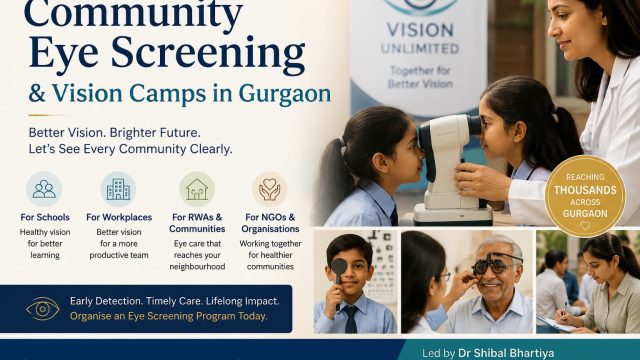
Community eye screening or eye camps helps identify vision problems and common eye conditions early, before they begin to affect learning, work or daily life. In Gurgaon, screening programmes can be organised for schools, workplaces, RWAs, NGOs and community groups, with appropriate referral for further eye care.
Eye problems often go undetected because people learn to adapt to blurred or reduced vision. A child may struggle to see the board without ever complaining. An adult may gradually lose the ability to read comfortably and simply hold things further away. An older person may stop recognising faces clearly, or become less confident moving around independently, and put it down to age.
Community Eye Screening in Gurgaon: Vision Camps for Schools, Workplaces & RWAs
Community eye screening or eye camps helps catch these problems earlier, in the places people already spend their time, and connects anyone who needs further care with the right clinical services.
I lead community eye health initiatives through Vision Unlimited, and have extensive experience running school, workplace and population-based eye screening programmes across Gurugram and the surrounding areas.
Quick answer: Community eye screening brings basic vision and eye-health assessment into schools, workplaces, RWAs and community groups in Gurgaon, so that people who need glasses, further testing or specialist care are identified early and referred appropriately. Programmes are led by Dr Shibal Bhartiya through Vision Unlimited, which has screened more than 13,000 children and 5,000 adults across Gurugram in 2025-2026.
If your school, workplace, residential community, NGO or organisation would like to organise an eye-screening programme, get in touch to discuss what you need.
What is community eye screening?
Community eye screening takes basic eye health assessment beyond the clinic and into places where people already live, study and work.
A structured screening programme can help identify people who may have:
- Reduced distance or near vision
- Uncorrected refractive errors
- Presbyopia
- Possible glaucoma or other eye disease requiring assessment
- Symptoms requiring further ophthalmic evaluation
- Other common vision problems that may affect learning, work or independence
Screening is not a substitute for a comprehensive eye examination. Its purpose is to identify people who may benefit from further assessment and appropriate care.
Who can organise an eye-screening programme in Gurgaon?
Schools
Children may not realise their vision is abnormal, especially if they have never experienced clear vision to compare it to. School eye screening can identify children who need refraction, a full paediatric eye examination, or specialist assessment.
Workplaces and corporates
Uncorrected refractive errors and near-vision problems affect comfort, productivity and day-to-day functioning at work. Corporate eye checkup camps can be tailored to employee numbers and the specific needs of the organisation.
Residential communities and RWAs
RWA eye screening makes basic vision assessment more accessible to residents who might otherwise keep postponing an eye examination. This is especially useful for older adults and anyone who finds it difficult to travel to a clinic.
NGOs and community organisations
Community-based programmes help reach populations where routine eye care is limited by financial, geographic or social barriers.
Senior citizen groups
Presbyopia and other age-related eye problems can interfere with reading, sewing, using a phone, recognising faces and everyday independence. Screening identifies people who need glasses, refraction or further ophthalmic assessment.
What does a community eye-screening programme include?
The exact protocol depends on the population, setting and objective. A programme can include:
- Basic visual acuity assessment
- Near-vision assessment where appropriate
- Identification of refractive errors
- Basic eye-health screening
- Identification of symptoms or findings needing further assessment
- Referral for refraction or a comprehensive ophthalmic examination
- Eye-health education and counselling
- Spectacle provision
- Referral to higher centre where appropriate
Protocols for children are adapted to age and setting. For adults, particularly those over 40, programmes can assess both distance and near vision.
The aim isn’t to screen as many people as possible. It’s to find the people who need help, and give them a practical path to the right care.
From screening to care
A meaningful screening programme doesn’t end when the camp closes for the day. The approach is:
Screen → Identify → Counsel → Refer → Follow up
Anyone who screens positive, or has symptoms suggesting an eye condition, is advised on the appropriate next step. Depending on what’s found, this may include:
- Refraction and spectacles
- A comprehensive ophthalmic examination
- Glaucoma evaluation
- Paediatric eye assessment
- Cataract evaluation
- Further diagnostic testing
- Referral to an appropriate ophthalmologist or eye-care facility
A screening programme identifies people who may have a problem. Diagnosis and treatment need proper clinical assessment, which is a distinct next step.
Community eye health through Vision Unlimited
Community eye care has been part of my work for several years. Through Vision Unlimited, the not-for-profit organisation I founded, school and community-based programmes have reached thousands of children and adults in underserved communities across Gurugram.
These programmes have included school vision screening, community eye camps, refractive assessment, spectacle distribution, eye-health education and referral for further care.
More than 13,000 children have been screened through recent school eye-screening programmes. Community eye camps have examined more than 5,000 adults, and thousands of presbyopia spectacles have been distributed to adults who needed help with near vision.
The experience keeps reinforcing one principle: eye care shouldn’t depend entirely on whether someone can reach a clinic. Where possible, care should reach people where they live, study and work.
Learn more about Vision Unlimited from these conversations with Dr Shibal Bhartiya.
Why community screening matters
Uncorrected vision problems reach beyond eyesight.
Children: poor vision can affect reading, classroom participation, learning, confidence and academic performance.
Adults: it can affect work, digital device use, reading, driving and mobility, productivity and independence.
Elders: reduced vision can interfere with everyday activities and quality of life.
Early identification means a manageable problem can be caught before it becomes a real barrier.
Community eye screening is not just an eye camp
A well-designed screening programme is more than a vision chart set up for a few hours. It needs:
- A clearly defined target population
- An appropriate screening protocol
- Trained personnel
- Proper documentation
- Identification of people who need further assessment
- A referral pathway
- Follow-up where feasible
- Clear communication with participants and organisers
Every programme is designed around the needs of that specific community rather than a one-size-fits-all model.
Organise a community eye-screening programme
If your school, organisation, workplace, RWA, NGO or community would like to run an eye-screening programme, get in touch. We can discuss:
- The size and profile of the population
- Location and duration of the programme
- Screening objectives
- Personnel and logistical requirements
- Referral pathways
- Spectacle or follow-up requirements
- Documentation and reporting
Programmes can be designed for children, adults, older adults or mixed community populations.
Interested in organising an eye-screening programme? Get in touch →
📍 Gurgaon 📞 +91 88826 38735 | 🌐 Contact Us | Second Opinion Form for teleconsults
Frequently Asked Questions
Is community eye screening the same as a comprehensive eye examination?
No. Screening identifies people who may have a vision or eye-health problem and need further assessment. A comprehensive eye examination is required for diagnosis and treatment.
Can schools organise eye screening programmes in Gurgaon?
Yes. School eye screening can identify children with reduced vision or other concerns who need refraction or a comprehensive paediatric eye examination.
Can companies organise eye screening for employees?
Yes. Workplace programmes are designed around the size of the organisation, employee profile and the objectives of the screening.
Can an RWA or residential community organise a screening programme?
Yes. Community screening can be organised for residential communities and RWAs, including programmes focused on older adults and near-vision problems.
Does screening include spectacles?
It depends on the programme design and the needs of the population. Where appropriate, participants are referred for refraction and spectacles.
What happens if someone is found to have an eye problem?
They’re advised on the appropriate next step. Depending on the findings, this may include refraction, a comprehensive ophthalmic examination, diagnostic testing or specialist referral.
How do I organise an eye camp in Gurgaon?
Contact us with the approximate number and age group of participants, location and preferred dates. We can then discuss the appropriate screening protocol, logistics, referral pathway and any spectacle or follow-up requirements. Free of cost community eye-screening programmes can be organised for schools, NGOs, RWAs and underserved communities, subject to programme availability and requirements.
Organise a Vision Check for Your Community
Dr Shibal Bhartiya is a fellowship-trained glaucoma specialist and Mayo Clinic Research Collaborator with over 25 years of experience, and the founder of Vision Unlimited, a not-for-profit working with underserved communities in Gurugram.
Advanced Eye Care | Second Opinion | Evidence-Based, Personalised Care
Her work combines clinical care with research, health education and community-based eye-health programmes, with a particular focus on improving access to early detection and appropriate eye care.
To Organise a Community Eye Screening Programme → Contact Dr Shibal Bhartiya’s Team
📍 Gurgaon 📞 +91 88826 38735 | 🌐 Contact Us | Second Opinion Form for teleconsults
About the Author
This article was written by Dr Shibal Bhartiya, fellowship-trained glaucoma specialist and Mayo Clinic Research Collaborator, Clinical Director at Marengo Asia Hospitals, Gurugram, known for ethical, patient-centred glaucoma care and independent glaucoma second opinions. She is also the Program Director for Community Outreach & Wellness; and for the Marengo Asia International Institute of Neuro and Spine.
She has published peer-reviewed research on glaucoma management, examining how treatment decisions should balance medical evidence, patient preferences, and long-term vision outcomes.
As Editor-in-Chief of Clinical and Experimental Vision and Eye Research and Executive Editor of the Journal of Current Glaucoma Practice (Pubmed Indexed, official journal of the International Society of Glaucoma Surgery), Dr Shibal Bhartiya brings editorial and research depth to every clinical decision. Her 200+ publications, including 90+ PubMed-indexed publications and 28 edited textbooks span glaucoma biology, surgical outcomes, health equity, and emerging diagnostics.
1600+ Five Star Patient Reviews Google Business Profile
If you are unable to come to Dr Bhartiya’s clinic: Read more about teleconsultation
Read her research on PubMed | Google Scholar | ResearchGate | ORCID | Github
📋Upload your reports for a structured review.| 🌐 Contact Us| 📞 +91 88826 38735
⭐ Helped by this article? Leave a Google review — it helps other patients find reliable eye care.