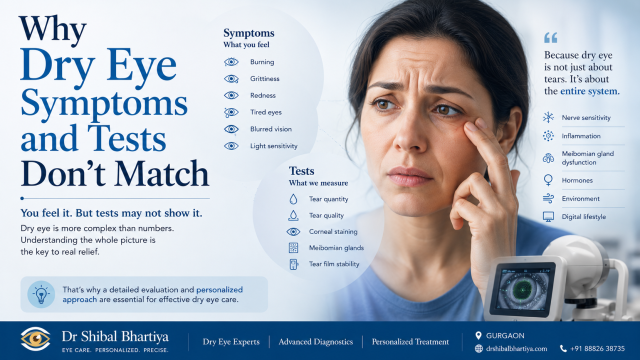
Dry eye symptoms and test results often do not match because dry eye disease involves multiple biological pathways that standard tests do not fully capture. You can have severe burning, blurring, and light sensitivity with a Schirmer score that looks completely normal, explains Dr Shibal Bhartiya.
Dr Shibal Bhartiya is a fellowship-trained glaucoma specialist, who was a Senior Research Associate for three years in the cornea clinic at AIIMS Delhi. She is a Mayo Clinic Research Collaborator with over 25 years of experience. Her approach focuses on identifying risk before damage is irreversible, simplifying treatment decisions, and protecting vision long-term. Emphasis on early detection, risk assessment, and continuity of care. She is rated 5 stars across 1,500+ patient reviews on Google.
Why Your Dry Eye Tests Look Normal When Your Eyes Feel Terrible
Your symptoms are real. The mismatch between how your eyes feel and what a test shows is one of the most frustrating parts of dry eye disease. It also happens to be one of the most important things your doctor must understand to treat you correctly.
Dry eye is not a single disease. It is a spectrum of overlapping conditions involving tear volume, tear quality, inflammation, nerve sensitivity, and lid function. Standard clinic tests measure only one or two of these factors at a time. A test can miss the others entirely.
What Standard Dry Eye Tests Actually Measure
Schirmer Test
This test measures how much tear fluid your eyes produce in five minutes. It tells your doctor about aqueous tear deficiency. It tells you nothing about whether your tears evaporate too quickly, whether your tear film breaks up before you blink, or whether your corneal nerves are firing abnormally.
Tear Break-Up Time (TBUT)
TBUT measures how fast your tear film collapses after a blink. A short break-up time indicates evaporative dry eye, which is the more common form. But TBUT varies with room temperature, humidity, air conditioning, and examiner technique. Results can differ widely between two readings taken minutes apart.
Fluorescein Staining
Staining shows where the cornea surface has broken down. In early dry eye, staining may be absent even when symptoms are severe. Surface damage takes time to appear. The test shows what has already happened, not what your nerves are experiencing right now.
Meibomian Gland Assessment
Meibography images the glands in your eyelids that produce the oily layer of your tear film. Gland dropout can be visible even before you have symptoms. It can also be absent when symptoms are significant. Gland structure and gland function are not the same thing.
The Core Reason Tests Miss Symptoms: Neuropathic Pain
The most important explanation for severe symptoms with normal tests is corneal nerve sensitisation. In this condition, the nerve endings on your corneal surface become hyperactive. They fire pain signals in response to stimuli that would not bother a normal eye. Mild dryness, a slight breeze, or screen light can feel unbearable.
Standard dry eye tests do not measure nerve function. Corneal confocal microscopy can image nerve structure, but this is not yet available in most clinics. In vivo confocal microscopy and corneal aesthesiometry are research tools that are not part of routine practice.
This gap between nerve experience and objective measurement is not a flaw in your report. It is a flaw in the tools currently used to assess dry eye.
Other Reasons for the Mismatch
Fluctuating disease activity. Dry eye symptoms worsen with screen use, air travel, poor sleep, hormonal changes, and stress. Clinic tests happen in a controlled environment for a few minutes. They capture a single moment, not your lived experience across a full day.
Subclinical inflammation. Inflammation on the ocular surface can drive significant symptoms before it causes visible damage. Standard slit lamp examination may show nothing. Conjunctival impression cytology and inflammatory marker testing can detect this, but most clinics do not perform them routinely.
Lid wiper epitheliopathy. The thin strip of conjunctiva on the inside of your upper eyelid wipes the eye with every blink. When this strip is damaged, it causes significant discomfort. It is invisible on routine examination. Lissamine green staining of the lid wiper is required to see it.
Incomplete blink. If you do not complete your blink fully, the lower third of your cornea dries out repeatedly. This causes real symptoms but shows no abnormality on tear production tests.
Systemic conditions. Thyroid disease, autoimmune conditions, and hormonal shifts affect the ocular surface in ways that may not show up on standard dry eye tests. Your doctor needs your full medical history, not just your eye measurements.
Remember This
| Test | What It Measures | What It Misses |
|---|---|---|
| Schirmer test | Aqueous tear volume | Tear quality, nerve sensitivity, evaporation |
| TBUT | Tear film stability | Nerve pain, inflammation, lid function |
| Fluorescein staining | Surface damage already present | Early disease, subclinical inflammation |
| Meibography | Gland structure | Gland secretion quality, nerve function |
| Slit lamp examination | Visible surface changes | Lid wiper damage, incomplete blink |
What This Means for Your Treatment
A normal test result does not mean your symptoms are not real. It means the test did not find what it was designed to find.
If your symptoms are severe and your tests are unremarkable, your doctor should consider several possibilities. These include evaporative dry eye not captured by Schirmer alone, meibomian gland dysfunction with preserved gland structure, subclinical inflammation, corneal nerve sensitisation, lid wiper epitheliopathy, and incomplete blink pattern.
Treatment based on test results alone will fail. Treatment must address what you are experiencing, not just what a number shows. This is why detailed history-taking, symptom questionnaires like OSDI or SPEED, and a thorough slit lamp examination with multiple stains matter more than a single test result.
When to Seek a Specialist Opinion
Seek a second opinion if your symptoms have not improved after three to six months of standard treatment. If your doctor has not assessed your meibomian glands under magnification, examined your lid wiper, or asked about your blink pattern and screen exposure, your evaluation may be incomplete.
The C.L.E.A.R.™ Framework, is a Dry Eye Second Opinion Framework devised by Dr Shibal Bhartiya, which systematically evaluates each factor to create an individualised treatment plan.
A glaucoma or cornea specialist with a particular interest in ocular surface disease will bring additional diagnostic tools and a different clinical lens to your case. Do not accept “your tests are normal” as a final answer when your quality of life is significantly affected.
As Senior Research Associate at AIIMS Delhi, I spent three years in the cornea clinic: where dry eye presented in every form it takes, from the straightforward to the deeply misunderstood. That training shapes how I approach every patient who comes in with tired, burning, uncertain eyes. Dry eye is rarely just dry eye. Learning to look beneath the surface took years. It still does.
Book an Appointment:
📍 Gurgaon 📞 +91 88826 38735 | 🌐 Contact Us | Second Opinion Form for teleconsults
Frequently Asked Questions
Can dry eye be severe with a normal Schirmer test?
Yes. Schirmer tests measure only tear volume. Most patients with symptomatic dry eye have normal or near-normal Schirmer scores because their problem is evaporation, inflammation, or nerve sensitivity rather than reduced production.
What test best matches dry eye symptoms?
No single test does. The OSDI symptom questionnaire combined with TBUT, meibomian gland evaluation, and lissamine green staining gives the most complete picture. Symptom scores consistently correlate better with quality of life than objective measurements do.
Why do my dry eye symptoms vary so much day to day?
Dry eye is dynamic. Triggers like screen time, air conditioning, wind, hormones, hydration, and sleep all change your tear film. Tests taken on a good day look better than tests taken during a flare. This variability is itself a diagnostic clue.
Is neuropathic eye pain the same as dry eye?
No, but they overlap. Neuropathic eye pain involves sensitised or damaged corneal nerves. It can coexist with dry eye, occur after dry eye treatment, or exist without measurable tear film abnormality. It requires specific assessment and often a different treatment approach.
Can dry eye affect my vision even if my eye pressure is normal?
Yes. Dry eye affects the tear film, which is the first refracting surface of the eye. An unstable tear film causes fluctuating blur independent of intraocular pressure or lens clarity. This is one reason dry eye must be treated before accurate glasses prescriptions can be assessed.
This article is part of the Dry Eye Hub. Please also read Basics of Dry Eye, Dry Eye Second Opinion and Dry Eye: A Chronic Disease. Why Vision Becomes Blurred After Reading or Screen Use, and Why Are Your Dry Eye Drops Not Working may also help you understand your problem better.
You may also want to read this article written by Dr Bhartiya for NDTV online. And listen to her talk about dry eyes here.
About the Author
This article was written by Dr Shibal Bhartiya, fellowship-trained glaucoma specialist and Mayo Clinic Research Collaborator, Clinical Director at Marengo Asia Hospitals, Gurugram, known for ethical, patient-centred glaucoma care and independent glaucoma second opinions. She is also the Program Director for Community Outreach & Wellness; and for the Marengo Asia International Institute of Neuro and Spine.
She has published peer-reviewed research onglaucoma management, examining how treatment decisions should balance medical evidence, patient preferences, and long-term vision outcomes.
As Editor-in-Chief of Clinical and Experimental Vision and Eye Research and Executive Editor of the Journal of Current Glaucoma Practice (Pubmed Indexed, official journal of the International Society of Glaucoma Surgery), Dr Shibal Bhartiya brings editorial and research depth to every clinical decision. Her 200+ publications, including 90+ PubMed-indexed publications and 28 edited textbooks span glaucoma biology, surgical outcomes, health equity, and emerging diagnostics.
1600+ Five Star Patient Reviews Google Business Profile
If you are unable to come to Dr Bhartiya’s clinic: Read more about teleconsultation
Read her research on PubMed | Google Scholar | ResearchGate | ORCID | Github | Wikidata
📋Upload your reports for a structured review.| 🌐 Contact Us| 📞 +91 88826 38735
⭐ Helped by this article? Leave a Google review — it helps other patients find reliable eye care.
Related Reading
Why Do Women Get Dry Eye More Often?
Dry Eyes: Tips to Soothe Sore Eyes
Why Dry Eye Is Worse in Air Conditioning and on Flights
Why Vision Becomes Blurred After Reading or Screen Use
Why Your Eyes Water Constantly