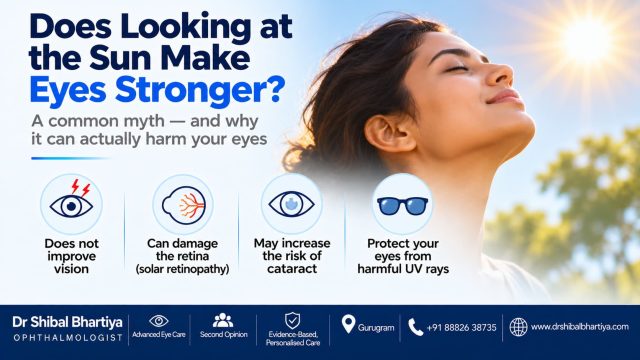
Looking at the sun does not make the eyes stronger. It causes real, sometimes permanent damage to the retina, and there is no level of “safe” direct sun viewing that improves vision. This is one of the few eye myths that carries genuine, immediate risk of serious harm, not just a lack of benefit.
Looking at the sun directly can cause serious, sometimes irreversible retinal damage called solar retinopathy. Even brief direct viewing, especially without protection, can burn light-sensitive retinal cells. There is no scientifically supported practice of looking directly at the sun that benefits the eyes.
Why This Belief Persists
Sun-gazing practices have roots in various wellness and spiritual traditions, often framed around building tolerance, gradual exposure at low-sun hours, or a belief in absorbing beneficial energy through the eyes. Because these practices are usually introduced gradually, starting with very brief glances during sunrise or sunset when light appears softer, early practitioners often don’t notice immediate pain or damage, which reinforces a false sense of safety. The absence of instant, obvious harm is mistaken for evidence that the practice is safe or even beneficial, when the damage that does occur can be silent and cumulative.
What The Science Actually Says
The retina, the light-sensitive layer at the back of the eye, contains highly specialised cells that convert light into the signals your brain interprets as vision. These cells are not designed to tolerate concentrated, direct sunlight. When you look directly at the sun, even for a short period, the eye’s lens focuses that light onto a small area of the retina with enough intensity to cause thermal and photochemical damage, a condition called solar retinopathy.
This damage frequently causes no immediate pain, because the retina itself has no pain receptors, which is precisely why Looking at the sun can feel harmless in the moment even as injury is occurring. Symptoms, when they appear, often show up hours later: blurred central vision, a blind spot in the centre of the visual field, distorted straight lines, or altered colour perception. In many cases, this damage is permanent, since the retinal cells destroyed by this kind of injury do not regenerate. Even sunrise and sunset viewing, often assumed to be safer because the light looks less harsh, still delivers damaging levels of light to the retina and has caused documented cases of solar retinopathy.
There is no research-supported mechanism by which deliberately exposing the retina to direct sunlight improves visual function, sharpness, or eye “strength” in any sense. The eye’s health depends on protecting the retina from excessive light exposure, not deliberately exposing it further.
Please read Diseases of the Retina, Dilated Eye Exam, AMD, and and Amsler Grid.
Does Outdoor Time for Myopia Mean Looking at the Sun?
No. Outdoor time protects children’s eyes from myopia, but it never involves looking at the sun.
The benefit comes from bright daylight all around the child. Researchers think this ambient light slows the eye’s growth. A child playing, cycling or walking outside gets it. The child never needs to face the sun.
Shade works too. A tree, a verandah or a cap still gives far more light than a classroom or a living room.
Never ask a child to look at the sun, even briefly, for “eye exercise” or “extra light.” Outdoor time means ordinary play in daylight, and it should come with normal sun protection.
Read how outdoor time fits into myopia prevention in children and our children’s eye care in Gurgaon page.
What Actually Helps
- Never look directly at the sun, at any time of day, with or without sunglasses, since ordinary sunglasses do not provide adequate protection
- Use certified solar viewing filters only for specific, supervised events like eclipse viewing, and only as instructed
- Wear UV-protective sunglasses for everyday outdoor sun protection, which protects against cumulative UV exposure, a genuine and different long-term risk
- Seek immediate medical attention if you have looked directly at the sun and notice any change in vision
- Rely on established, evidence-based habits, outdoor time, balanced screen use, regular checkups, for actual eye health, not sun exposure to the eye itself
When To See a Doctor
- Any blurred vision, blind spot, or distortion following direct or prolonged sun viewing
- Sudden change in central vision after outdoor sun exposure, including eclipse viewing
- Persistent light sensitivity or discomfort after sun exposure
- Any history of intentional sun-gazing practice, even without noticed symptoms
- No eye check in the last 12 months
Frequently Asked Questions
Is looking at the sun during sunrise or sunset safer than looking at the sun at midday?
No. While the light may look softer and feel more comfortable to view, sunrise and sunset sun-gazing has caused documented cases of retinal damage. Comfort during viewing does not indicate safety.
Why didn’t I feel any pain while looking at the sun if it’s causing damage?
The retina has no pain receptors, so damage can occur without any sensation during exposure. Symptoms like blurred vision often appear only hours afterward, once damage has already been done.
Can solar retinopathy be treated or reversed?
There is no specific treatment that reverses established solar retinopathy, and outcomes depend on the extent of damage. Some mild cases partially improve over time, but damage is often permanent, which is why prevention is the only reliable protection.
Is outdoor time for myopia the same as looking at the sun?
No. Outdoor time means being in bright daylight while you play or walk. Looking directly at the sun harms the retina and never helps vision.
Book a Consultation
If you or someone you know has looked directly at the sun and noticed any change in vision, please seek an eye examination as soon as possible.
Book an Appointment:
📍 Gurgaon 📞 +91 88826 38735 | 🌐 Contact Us | Second Opinion Form for teleconsults
This article is a part of the Myths about Eyes Hub. Read on more to understand more about your eye health. Also read Do Almonds Improve Vision, Can Carrots Improve Vision or Remove Glasses, Should We Wash Eyes, and Nutrients for Eye Health, Glaucoma Myths Debunked, Myths About Cataract. Please also read Myths About Eye Pressure, Complementary and Alternate Medication for Glaucoma, and Marijuana for Glaucoma.
About the Author
This article was written by Dr Shibal Bhartiya, fellowship-trained glaucoma specialist and Mayo Clinic Research Collaborator, Clinical Director at Marengo Asia Hospitals, Gurugram, known for ethical, patient-centred glaucoma care and independent glaucoma second opinions. She is also the Program Director for Community Outreach & Wellness; and for the Marengo Asia International Institute of Neuro and Spine.
Dr Bhartiya has published peer-reviewed research onglaucoma management, examining how treatment decisions should balance medical evidence, patient preferences, and long-term vision outcomes. She is also a committed patient advocate and mainstream medical columnist, translating complex ophthalmic evidence into actionable public health insights across leading national platforms including NDTV and OnlyMyHealth
Dr Bhartiya is the Editor-in-Chief of Clinical and Experimental Vision and Eye Research and Executive Editor of the Journal of Current Glaucoma Practice (Pubmed Indexed, official journal of the International Society of Glaucoma Surgery). Her 200+ publications, including 90+ PubMed-indexed publications and 28 edited textbooks span glaucoma biology, surgical outcomes, health equity, and emerging diagnostics.
1700+ Five Star Patient Reviews Google Business Profile
If you are unable to come to Dr Bhartiya’s clinic: Read more about teleconsultation
Read her research on PubMed | Google Scholar | ResearchGate | ORCID | Github | Wikidata
📋Upload your reports for a structured review.| 🌐 Contact Us| 📞 +91 88826 38735
⭐ Helped by this article? Leave a Google review — it helps other patients find reliable eye care.
Last Reviewed: November 2026