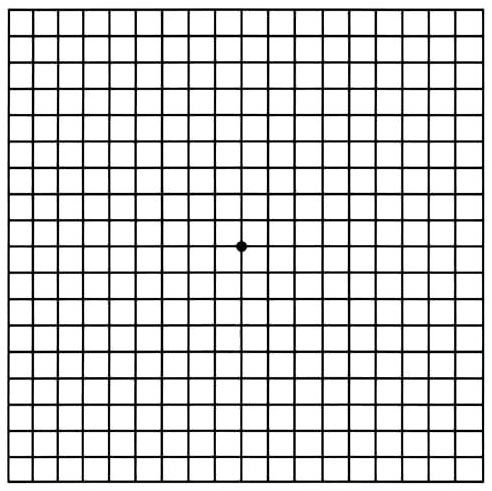
The Amsler grid is a simple square containing multiple squares, with a dot in the center. This grid pattern can pick up problem areas in your field of vision. It can monitor changes in your vision, and thus, help detect early signs of retinal disease. Your doctor may ask you to look at an Amsler grid to check for AMD in the clinic during your comprehensive eye exam. thereafter, you can use it at home to detect any changes in your vision.
Who needs to use the Amsler Grid?
If you have been diagnosed with AMD, you can use the Amsler Grid, once a day, in order to monitor your vision.
Age Related Macular Degeneration, or AMD, is a common eye condition seen in those older, which can cause vision loss. The macula is the centre of the retina, and is responsible for sharp, central vision.
How to use the Amsler Grid
- Wear your reading glasses as usual.
- Hold the grid at a comfortable reading distance, about 12 to 15 inches away from your face. Make sure you are in a well-lit reading area.
- Cover one eye.
- Focus directly on the dot in the center with your other eye.
- While looking directly at the dot, pay attention to the lines that form the grid.
- Check if all the lines are straight and intersecting at right angles. Make a note if any lines are blurred, wavy, broken or missing.
- Repeat the process for the other eye.
- Do this every day.
- Contact your eye doctor in case any lines are dark, blurred, wavy, broken or missing.
Risk factors for AMD
- Age over 50
- A family history of AMD
- Smoking
- Obesity
- Hypertension
Tests for AMD
Tests for AMD include the following
- Dilated, comprehensive eye exam
- Vision testing or visual acuity testing
- Fundus photography, including autoflourescence
- Fundus fluorescein angiography, FFA
- Optical coherence tomography, OCT
This article is part of the Retina Hub. For a deeper look at any of these conditions, see our dedicated pages: Dilated Eye Exam, AMD, Diabetic Retinopathy, CSR, Are My Eye Floaters and Flashing Lights a Cause for Concern? and Myopia. Also read Vision Not Clear After Cataract Surgery, Low Vision, Can Eye Injections Save Vision? and Amsler Grid.. If you are managing childhood myopia and want to understand the long-term retinal risk it carries into adulthood, our Children’s Eye Care Hub covers myopia control separately.
About the Author
This article was written by Dr Shibal Bhartiya, fellowship-trained glaucoma specialist and Mayo Clinic Research Collaborator, Clinical Director at Marengo Asia Hospitals, Gurugram, known for ethical, patient-centred glaucoma care and independent glaucoma second opinions. She is also the Program Director for Community Outreach & Wellness; and for the Marengo Asia International Institute of Neuro and Spine.
She has published peer-reviewed research on glaucoma management, examining how treatment decisions should balance medical evidence, patient preferences, and long-term vision outcomes.
As Editor-in-Chief of Clinical and Experimental Vision and Eye Research and Executive Editor of the Journal of Current Glaucoma Practice (Pubmed Indexed, official journal of the International Society of Glaucoma Surgery), Dr Shibal Bhartiya brings editorial and research depth to every clinical decision. Her 200+ publications, including 90+ PubMed-indexed publications and 28 edited textbooks span glaucoma biology, surgical outcomes, health equity, and emerging diagnostics.
1600+ Five Star Patient Reviews Google Business Profile
If you are unable to come to Dr Bhartiya’s clinic: Read more about teleconsultation
Read her research on PubMed | Google Scholar | ResearchGate | ORCID | Github
📋Upload your reports for a structured review.| 🌐 Contact Us| 📞 +91 88826 38735
⭐ Helped by this article? Leave a Google review — it helps other patients find reliable eye care.