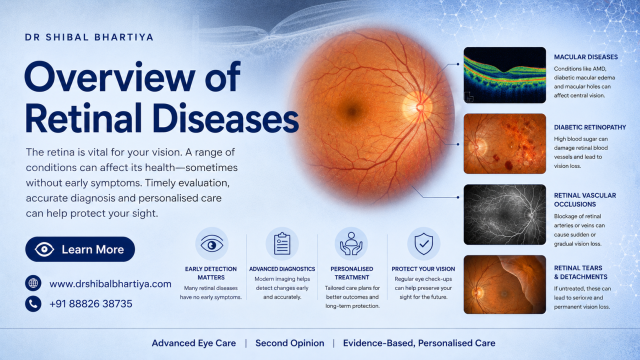
The most common retinal diseases causing loss of vision are retinal detachment, diabetic retinopathy, age-related macular degeneration (AMD), myopic retinopathy, central serous retinopathy, and retinal vein occlusion. Sudden distortion of lines, flashes, floaters, or a curtain-like shadow in your vision are emergency signs regardless of which condition is causing them, and need same-day assessment. Please also read Seeing shimmering spots or stars
Retinal Diseases: The 6 Conditions Most Likely to Threaten Your Vision
The retina is the only place in your body where a doctor can look directly at living nerve tissue and blood vessels without surgery. That is also why retinal disease is unforgiving: the damage is often silent until it is advanced, and once retinal tissue dies, it does not regenerate. Unlike many tissues elsewhere in the body, damaged retinal nerve cells cannot regenerate. That is why early diagnosis matters so much—treatment aims to preserve the vision you still have.
Most people only think about their retina when something goes wrong suddenly, flashes of light, a curtain falling across vision, a dark patch that will not go away. By then, some retinal conditions are already emergencies. Others, like diabetic retinopathy, can sit silently for years.
Many retinal conditions produce similar symptoms, but require very different treatment. Distinguishing retinal disease from glaucoma, optic nerve disease, cataract, or neurological causes of vision loss is one of the most important parts of a comprehensive eye examination.
At a Glance: Who Is At Risk and What to Watch For
In my clinic, the most common reasons patients require retinal evaluation are diabetes, high myopia, sudden flashes and floaters, distorted vision, and unexplained reduction in vision despite a normal glasses prescription.
| Condition | Who Is Most At Risk | Key Warning Sign |
| Retinal detachment | High myopes, post-cataract surgery patients, prior eye trauma | Sudden flashes, floaters, or a curtain/shadow across vision |
| Diabetic retinopathy | Anyone with diabetes, risk rises with duration and poor sugar control | Often none early on; blurred or fluctuating vision in later stages |
| Age-related macular degeneration | Adults over 60, smokers, those with a family history | Distorted objects, wavy straight lines, a blank or blurry patch in central vision |
| Myopic retinopathy | High myopes (typically -6.00 D or more), especially with axial elongation | Gradual reading difficulty, new floaters, or distortion in a high myope |
| Central serous retinopathy | Stressed, type-A adults, often on steroids, more common in men | Sudden dim or distorted central vision, often one eye, in a younger adult |
| Retinal vein occlusion | Adults with hypertension, diabetes, or clotting disorders | Sudden, painless blurring or vision loss, often on waking |
NOTE: Not every sudden visual disturbance comes from the retina. Disorders affecting the optic nerve or brain can produce similar symptoms. A careful examination helps determine whether the retina, optic nerve, or visual pathways are responsible, ensuring patients receive the right investigations without delay.
Retinal Detachment
The retina lifts away from the back wall of the eye, cutting off its blood and nerve supply. This is a true emergency. The longer the retina stays detached, especially if it involves the macula, the worse the visual outcome, even after successful surgery.
Warning signs build in a recognisable sequence: new floaters, then flashes of light, then a shadow or curtain spreading across part of your vision. Anyone with high myopia, a family history of detachment, or a previous retinal tear in either eye should know this sequence and act on it immediately rather than waiting to see if it resolves.
Diabetic Retinopathy
High blood sugar damages the small blood vessels feeding the retina over years, causing leakage, swelling, and eventually abnormal new vessel growth if untreated. It is the leading cause of preventable blindness in working-age adults, and the cruelest part is that vision often stays normal until the disease is already advanced.
This is why every person with diabetes needs an annual dilated retinal examination starting from diagnosis, regardless of how well controlled their sugars are or how good their vision feels. Treatment, laser, injections, or surgery, is far more effective when started before symptoms appear than after.
Age-Related Macular Degeneration (AMD)
AMD affects the macula, the part of the retina responsible for sharp central vision needed for reading and faces. The dry form progresses slowly; the wet form, caused by abnormal new blood vessels, can cause sudden, significant vision loss within days if untreated.
A simple home test, the Amsler grid, can help adults over 60 notice early distortion of straight lines, which is often the first sign of wet AMD converting from a stable dry form. Catching this early and starting injection therapy promptly is what preserves central vision.
Myopic Retinopathy
High myopia stretches the eye, thinning the retina and choroid and raising the lifetime risk of retinal tears, detachment, and a slowly progressive maculopathy unique to very elongated eyes. This is distinct from ordinary myopia and from childhood myopia control, which is about preventing the eye from reaching this stage in the first place.
Adults with high myopia need periodic dilated retinal checks even without symptoms, since the structural risk is present regardless of how good their corrected vision currently is.
Central Serous Retinopathy (CSR)
Fluid accumulates under the macula, usually in younger to middle-aged adults under significant stress, sometimes linked to steroid use. It often resolves on its own within a few months, but recurrent or chronic CSR can cause lasting central vision changes if left unmanaged.
If you are a young, otherwise healthy adult with sudden central vision blurring or distortion, especially during a high-stress period or while on steroids for another condition, CSR should be on the list of possibilities your ophthalmologist considers.
Retinal Vein Occlusion (RVO)
A blockage in one of the retina’s draining veins causes sudden blood vessel leakage and swelling, most often in adults with hypertension, diabetes, or clotting tendencies. Vision loss is usually sudden and painless, often noticed first thing in the morning.
RVO is also a signal to check the rest of the cardiovascular system, not just the eye, since the same risk factors driving the occlusion affect the heart and brain as well.
Note: Optical Coherence Tomography (OCT) has transformed the diagnosis and monitoring of retinal disease. Dr Shibal Bhartiya has published original research on pubmed, along with her colleagues from AIIMS, on the clinical applications of OCT and incorporates retinal imaging into the assessment of patients with diabetes (here, here and here), high myopia (here), macular disease, glaucoma (here), and unexplained visual loss whenever indicated.
Read Dr Bhartiya’s article on NDTV Can Your Eyes Predict A Heart Attack? What Your Retinal Scan Actually Reveals
Red Flags Across All Retinal Disease
Regardless of which condition is responsible, these signs mean same-day assessment, not a wait-and-watch approach:
- Sudden new floaters, especially a shower of small dark spots
- Flashes of light, particularly in peripheral vision
- A shadow, curtain, or grey patch spreading across part of your vision
- Sudden distortion of straight lines or a blank patch in central vision
- Sudden, painless blurring or vision loss in one eye
- Any sudden vision change in a person with diabetes, high myopia, or a known retinal condition
📍 Gurgaon 📞 +91 88826 38735 | 🌐 Contact Us | Second Opinion Form for teleconsults
Key Takeaways
- Retinal tissue does not regenerate, which makes early detection the single most important factor in outcomes
- Sudden flashes, floaters, or a curtain across vision are emergency signs regardless of underlying cause
- Diabetic retinopathy and myopic retinopathy can be silent for years; annual dilated checks catch them before symptoms do
- AMD and CSR both affect central vision and are worth checking with a simple Amsler grid at home
- Retinal vein occlusion is also a signal to check blood pressure, sugar, and clotting risk systemically
Frequently Asked Questions
How often should I get my retina checked if I have diabetes?
Annually at minimum, starting from the time of diabetes diagnosis, even if your vision feels normal and your sugars are well controlled. More frequent checks are needed if any retinopathy is already present.
Is myopic retinopathy the same as needing glasses for myopia?
No. Needing glasses for short-sightedness is refractive myopia. Myopic retinopathy is a structural change in the retina and choroid that develops in high myopia over years, and it carries its own risks independent of how well your vision is corrected with glasses or contact lenses.
Can central serous retinopathy come back after it resolves?
Yes, recurrence is common, particularly if the original triggers, high stress or steroid use, are still present. Anyone with a history of CSR should mention it before starting any new steroid medication.
Will a retinal vein occlusion affect my other eye too?
It can, particularly if the underlying risk factors like hypertension or diabetes are not well controlled. Managing these systemic conditions is part of protecting the second eye, not just treating the eye already affected.
This article is part of the Retina Hub. For a deeper look at any of these conditions, see our dedicated pages: Dilated Eye Exam, AMD, Diabetic Retinopathy, CSR, Are My Eye Floaters and Flashing Lights a Cause for Concern? and Myopia. Also read Vision Not Clear After Cataract Surgery, Low Vision, Can Eye Injections Save Vision? and Amsler Grid. If you are managing childhood myopia and want to understand the long-term retinal risk it carries into adulthood, our Children’s Eye Care Hub covers myopia control separately.
Book a Consultation
If you have diabetes, high myopia, or a family history of retinal disease and have not had a dilated retinal examination in the past year, this is worth scheduling before symptoms appear. If you are experiencing any of the red-flag symptoms above right now, please seek same-day care rather than waiting for a routine appointment.
Many retinal diseases are first suspected during a routine eye examination. My role is to recognise these conditions early using a comprehensive retinal examination and OCT imaging where appropriate, identify patients who require urgent treatment, and coordinate timely referral to trusted vitreoretinal colleagues when surgery or retinal procedures are needed.
One of the most reassuring conversations I have with patients is when they come in promptly after noticing flashes, floaters, or distorted vision. Many retinal conditions are highly treatable when detected early. The biggest risk is not the symptom itself—it is waiting to see whether it goes away.
Book an Appointment →
📍 Gurgaon 📞 +91 88826 38735 | 🌐 Contact Us | Second Opinion Form for teleconsult]
About the Author
This article was written by Dr Shibal Bhartiya, fellowship-trained glaucoma specialist and Mayo Clinic Research Collaborator, Clinical Director at Marengo Asia Hospitals, Gurugram, known for ethical, patient-centred glaucoma care and independent glaucoma second opinions. She is also the Program Director for Community Outreach & Wellness; and for the Marengo Asia International Institute of Neuro and Spine.
She has published peer-reviewed research on glaucoma management, examining how treatment decisions should balance medical evidence, patient preferences, and long-term vision outcomes.
As Editor-in-Chief of Clinical and Experimental Vision and Eye Research and Executive Editor of the Journal of Current Glaucoma Practice (Pubmed Indexed, official journal of the International Society of Glaucoma Surgery), Dr Shibal Bhartiya brings editorial and research depth to every clinical decision. Her 200+ publications, including 90+ PubMed-indexed publications and 28 edited textbooks span glaucoma biology, surgical outcomes, health equity, and emerging diagnostics.
1600+ Five Star Patient Reviews Google Business Profile
If you are unable to come to Dr Bhartiya’s clinic: Read more about teleconsultation
Read her research on PubMed | Google Scholar | ResearchGate | ORCID
📋Upload your reports for a structured review.| 🌐 Contact Us| 📞 +91 88826 38735
⭐ Helped by this article? Leave a Google review — it helps other patients find reliable eye care.