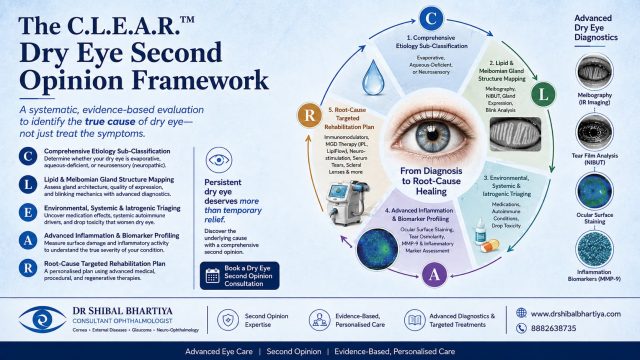
Dry eye disease has multiple causes, including meibomian gland dysfunction, reduced tear production, inflammation, and nerve-related pain. The C.L.E.A.R.™ Framework, devised by Dr Shibal Bhartiya, systematically evaluates each factor to create an individualised treatment plan. Chronic dry eye disease (DED) is often misdiagnosed as a single symptom treated with endless lubricating drops. In reality, dry eye is a complex, multifactorial disease of the ocular surface involving tear film instability, tissue inflammation, meibomian gland dysfunction (MGD), and neurosensory abnormalities.
If you are experiencing persistent burning, fluctuating vision, grittiness, or redness despite using multiple artificial tears, a second opinion shifts the focus from temporary symptom suppression to root-cause ocular surface restoration.
The C.L.E.A.R. Dry Eye Second Opinion Framework
A Root-Cause Methodology for Chronic Ocular Surface Disease
Developed for complex and treatment-resistant cases, The C.L.E.A.R. Framework applies TFOS DEWS III diagnostic principles to map your exact subtype and restore ocular surface homeostasis.
The 5 Steps of The C.L.E.A.R. Methodology
1.C – Comprehensive Etiology Sub-Classification:Determining the Primary Subtype.
Direct Clinical Purpose: Distinguishing evaporative, aqueous-deficient, or neurosensory dry eye.
Dry eye is rarely just “dryness.” We perform a differential diagnostic triage to determine whether your condition is driven by Evaporative Loss (Meibomian Gland Dysfunction), Aqueous Deficiency (reduced tear volume), or Neurosensory Abnormalities (corneal nerve hypersensitivity or neuropathic pain).
2.L – Lipid & Meibomian Gland Structure Mapping:Analyzing Gland Micro-Structure.
Direct Clinical Purpose: Evaluating gland atrophy, expression, and blinking mechanics.
Over 80% of dry eye cases involve Meibomian Gland Dysfunction (MGD). Using infrared meibography, non-invasive tear breakup time (NIBUT), and expression testing, we evaluate your gland architecture to detect atrophy, ductal plugging, or incomplete blinking dynamics.
3.E – Environmental, Systemic & Iatrogenic Triaging: Uncovering External & Systemic Triggers.
Direct Clinical Purpose: Identifying medication side effects, systemic autoimmune drivers, and drop toxicity.
Systemic conditions (such as Sjögren’s syndrome, thyroid disease, or rosacea) and oral medications (antihistamines, blood pressure drugs) frequently worsen dry eye. We also audit your current eye drops to eliminate toxic preservative exposure (e.g., BAK in chronic glaucoma or allergy drops).
Also read Can Dehydration Cause Dry Eyes?
4.A – Advanced Inflammation & Biomarker Profiling:Measuring Surface Homeostasis.
Direct Clinical Purpose: Quantifying ocular surface damage and inflammatory cascade activity.
Tear hyperosmolarity and chronic surface inflammation create a “vicious cycle” that damages corneal epithelial cells. We assess ocular surface staining (using diagnostic fluorescein and lissamine green dyes) and inflammatory markers (such as MMP-9) to measure true tissue healing potential.
5.R – Root-Cause Targeted Rehabilitation Plan:Designing Root-Cause Therapy.
Direct Clinical Purpose: Replacing generic artificial tears with targeted biological and procedural therapies.
Instead of relying solely on over-the-counter lubricants, we construct a staged, targeted care plan. This may include anti-inflammatory immunomodulators, thermal meibomian gland pulsation/IPL therapy, neuro-stimulation, autologous serum tears, or scleral contact lens evaluation.
Please read Dry Eye Not Improving With Artificial Tears to understand the relationship between dry eyes and inflammation. Please also read Do I Need to Treat Dry Eye Before Cataract Surgery? and Should We Wash Eyes?
The Second Opinion Deliverable Matrix
| C.L.E.A.R. Step | Clinical Question Solved | Your Clear Output |
| 1. Etiology Sub-Classification | Why are my eyes dry? | Primary Subtype Classification (Evaporative vs. Aqueous vs. Mixed) |
| 2. Lipid & Gland Mapping | Are my oil glands functioning or blocked? | Meibography Gland Health & Blinking Profile |
| 3. Environmental & Iatrogenic Audit | Are my medications or drops worsening this? | Systemic & Preservative Toxicity Assessment |
| 4. Biomarker Profiling | Is there active ocular surface inflammation? | Vital Staining & Surface Damage Score |
| 5. Root-Cause Therapy | What treatment will actually resolve this? | Targeted Care Roadmap (Anti-inflammatory / Procedural / Biological) |
How to Prepare for Your Dry Eye Second Opinion
┌────────────────────────────────────────────────────────────────────────┐
│                        PREPARATION STEPS                               │
├───────────────────┬───────────────────────────────┬────────────────────┤
│ 1. Pause Drops    │ 2. Bring Products             │ 3. Review          │
│ Stop artificial   │ Bring all current sprays,     │ Advanced Ocular    │
│ drops 2 hrs prior │ wipes, and drop bottles       │ Surface Plan       │
└───────────────────┴───────────────────────────────┴────────────────────┘
- Pause Lubricating Drops 2 Hours Prior: To ensure accurate tear film osmolarity, stability, and staining measurements, avoid instilling artificial tears for at least 2 hours before your clinical exam.
- Bring Your Entire Eye Care Regimen: Bring all prescribed and over-the-counter eye drops, eyelid wipes, warm compress masks, and contact lens solutions you currently use.
- List Systemic Medications & Autoimmune History: Note any history of joint pain, dry mouth, thyroid disorders, or daily oral medications.
Ready to Move Beyond Temporary Relief?
If your eyes often feel dry, irritated, watery, gritty, or tired despite using artificial tears, it’s important to identify the underlying cause. Dry eye disease is not the same for everyone, and effective treatment begins with an accurate diagnosis.
Having completed advanced training in Cornea and Glaucoma as a Senior Research Associate at AIIMS, New Delhi, I evaluate dry eye disease comprehensively through The C.L.E.A.R. Framework to determine why your symptoms are occurring and recommend an evidence-based, personalized treatment plan. My goal is to improve your comfort, protect the surface of your eyes, and provide lasting relief rather than temporary symptom control.
Book a consultation for a comprehensive dry eye evaluation and a personalized treatment plan tailored to your eyes, your lifestyle, and your symptoms.
Obtain an independent, root-cause evaluation of your ocular surface health and tear film stability.
📍 Gurgaon 📞 +91 88826 38735 |
🌐 Contact Us to Book an In-Person Ocular Surface Evaluation | Upload Reports for Second Opinion Review Second Opinion Form
This article is part of the Dry Eye Hub. Please also read Basics of Dry Eye, Dry Eye Second Opinion and Dry Eye: A Chronic Disease. Why Vision Becomes Blurred After Reading or Screen Use, and Why Are Your Dry Eye Drops Not Working. Why Dry Eye Symptoms and Tests Don’t Match may also help you understand your problem better.
You may also want to read this article written by Dr Bhartiya for NDTV online. And listen to her talk about dry eyes here.
About the Author
This article was written by Dr Shibal Bhartiya, fellowship-trained glaucoma specialist and Mayo Clinic Research Collaborator, Clinical Director at Marengo Asia Hospitals, Gurugram, known for ethical, patient-centred glaucoma care and independent glaucoma second opinions. She is also the Program Director for Community Outreach & Wellness; and for the Marengo Asia International Institute of Neuro and Spine.
She has published peer-reviewed research on glaucoma management, examining how treatment decisions should balance medical evidence, patient preferences, and long-term vision outcomes.
As Editor-in-Chief of Clinical and Experimental Vision and Eye Research and Executive Editor of the Journal of Current Glaucoma Practice (Pubmed Indexed, official journal of the International Society of Glaucoma Surgery), Dr Shibal Bhartiya brings editorial and research depth to every clinical decision. Her 200+ publications, including 90+ PubMed-indexed publications and 28 edited textbooks span glaucoma biology, surgical outcomes, health equity, and emerging diagnostics.
1600+ Five Star Patient Reviews Google Business Profile
If you are unable to come to Dr Bhartiya’s clinic: Read more about teleconsultation
Read her research on PubMed | Google Scholar | ResearchGate | ORCID | Github
📋Upload your reports for a structured review.| 🌐 Contact Us| 📞 +91 88826 38735
⭐ Helped by this article? Leave a Google review — it helps other patients find reliable eye care.
Last Reviewed: October 2026