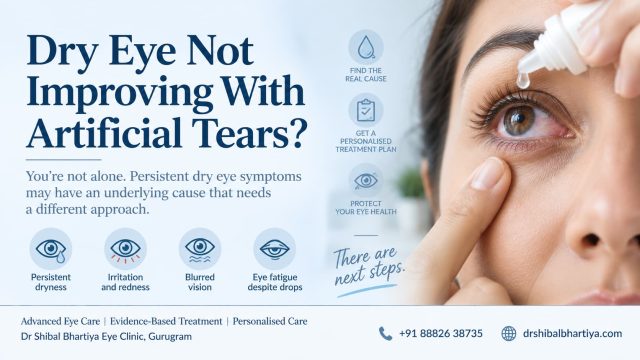
If preservative-free artificial tears used for 4–6 weeks haven’t improved your symptoms, inflammation is likely the cause, not simple dryness. Medicated options like cyclosporine, lifitegrast, or short-course steroids target that inflammation directly.
Quick Answer: Chronic dry eye is often driven by inflammation on the ocular surface, not just insufficient tears. Artificial tears cannot resolve this inflammation, which is why medicated options like cyclosporine, lifitegrast, or short-course steroids work when tears alone don’t.
I hear this almost every week: “I’ve been using drops for months, doctor, but nothing changes.” Patients arrive having tried three or four brands of artificial tears, sometimes using them six or eight times a day, still uncomfortable.
Artificial tears treat the symptom, dryness, but not always the cause. When the underlying problem is inflammation on the eye’s surface, no amount of lubrication fixes it. That needs a different class of medication entirely.
This article explains exactly when tears stop being enough, what medicated options exist, and how to know which stage you’re at. If preservative-free artificial tears used consistently for 4 to 6 weeks have not improved your symptoms, the cause is likely inflammation rather than simple dryness. At that point, medicated options such as cyclosporine, lifitegrast, or a short course of steroid drops target the inflammation directly, rather than just replacing lost tears.
Signs Your Drops Have Stopped Working
| Symptom | What It Means | What To Do About It |
|---|---|---|
| Relief lasts only minutes after each drop | Tears are being replaced faster than the surface can hold them, often from an inflamed, leaky ocular surface | Book an evaluation rather than switching brands again |
| Using drops more than 6 times a day with little change | Frequency this high without improvement points to an inflammatory component | Ask about a trial of anti-inflammatory therapy instead of more lubrication |
| Redness that does not settle with tears | Persistent redness usually signals active surface inflammation, not just dryness | A short steroid course can break the cycle before switching to a longer-term option |
| Eyes feel worse by afternoon despite morning drops | Suggests unstable tear film that tears alone cannot correct | Discuss cyclosporine or lifitegrast, which improve tear quality over weeks |
| Stringy discharge or mild blurring that clears with blinking | Points to mucus and inflammatory debris rather than pure evaporation | Needs clinical examination to confirm the inflammatory pattern |
| No improvement after switching tear brands twice | Brand-switching will not help if the cause is inflammatory | Stop switching drops and get an actual diagnosis |
When Tears Are Genuinely Not Enough
Artificial tears work well for mild, early, or purely evaporative dry eye. They fall short when:
- Symptoms persist despite consistent use for 4 to 6 weeks
- There is visible surface inflammation on examination
- Tear break-up time is significantly reduced on testing
- The dryness has an underlying driver such as meibomian gland dysfunction, Sjögren’s syndrome, or long-term glaucoma drop use
In these situations, adding more lubricant is like mopping a floor without fixing the leak.
Medicated Options: What They Actually Do
Left untreated, this dry eye associated inflammation can become a self-sustaining cycle, where irritation triggers more inflammation, which further destabilizes the tear film.
Topical Cyclosporine (0.05% or 0.09%)
Reduces inflammation on the ocular surface and, over 8 to 12 weeks, can increase natural tear production. It takes weeks to show benefit, so I always set realistic expectations with patients starting it.
Lifitegrast
Blocks a specific inflammatory pathway involved in dry eye. Some patients notice improvement faster than with cyclosporine, though a mild stinging sensation on instillation is common initially.
Short-Course Topical Steroids
Used for 1 to 2 weeks to break a severe inflammatory flare quickly. Not for long-term use due to risks of raised eye pressure and cataract with prolonged exposure, but genuinely useful as a bridge before starting cyclosporine or lifitegrast.
Important: Never use steroid eye drops long-term without monitoring. Regular eye pressure checks are essential, particularly if you have any personal or family history of glaucoma.
When To See a Doctor
Chronic dry eye is frequently driven by low-grade inflammation on the ocular surface rather than a simple lack of tears.
- Symptoms affecting one eye significantly more than the other
- Pain, marked redness, warmth, or fever alongside dryness
- Any new blurring or vision change, not just discomfort
- Bulging or protrusion of one or both eyes
- Persistent eye discomfort or rubbing in a child
- Dryness that began soon after starting a new medication
- Dry eyes alongside dry mouth, joint pain, or fatigue
Frequently Asked Questions
How long should I try artificial tears before asking for prescription drops?
Give a preservative-free artificial tear a fair trial of 4 to 6 weeks, used as directed. If there is no meaningful improvement in that time, it’s reasonable to ask your doctor about medicated anti-inflammatory options.
Is cyclosporine the same as a steroid eye drop?
No. Cyclosporine works differently and more gradually, targeting the immune process behind chronic dry eye. Steroids act faster but are not suitable for continuous long-term use due to eye pressure and cataract risk.
Why do my eyes feel worse before cyclosporine starts working?
A mild burning sensation in the first days of cyclosporine is common and usually settles. If it feels severe or does not improve after two weeks, tell your doctor, as an alternative like lifitegrast may suit you better.
Can I use artificial tears alongside prescription dry eye drops?
Yes, in most cases artificial tears and medicated drops work well together. Ask your doctor about spacing them apart by at least 10 to 15 minutes so one does not wash out the other.
Will I need medicated dry eye drops forever?
Not necessarily. Many patients use cyclosporine or lifitegrast for 6 to 12 months, then step back down to preservative-free tears once inflammation is controlled and the ocular surface has stabilised.
Are prescription dry eye medications safe for long-term glaucoma patients?
Generally yes, but glaucoma patients need closer monitoring, especially with steroid drops, which can raise eye pressure. Cyclosporine and lifitegrast do not raise eye pressure and are often preferred in this group.
Key Takeaways
- Artificial tears treat symptoms; medicated drops treat underlying inflammation
- A fair trial of tears is 4 to 6 weeks; beyond that, ask about escalation
- Cyclosporine and lifitegrast take weeks to work and are meant for longer-term use
- Short-course steroids can break a severe flare but need pressure monitoring
- Repeatedly switching tear brands without improvement is a sign to get examined, not a sign to try another brand
- Glaucoma patients on chronic drops need extra surveillance when adding steroid therapy
Book a Consultation
If your dry eyes aren’t responding to artificial tears after a genuine trial, the next step isn’t a different brand of drops. It’s finding out whether inflammation is driving your symptoms, and treating that directly.
I offer detailed dry eye evaluations and second opinions for patients in Gurgaon and beyond. The C.L.E.A.R Framework, devised by me especially for Indian patients, systematically evaluates each factor to create an individualised treatment plan.
Book an Appointment →
📍 Gurgaon 📞 +91 88826 38735 | 🌐 Contact Us | Second Opinion Form for teleconsults
This article is part of the Dry Eye Hub. Please also read Basics of Dry Eye, Dry Eye Second Opinion and Dry Eye: A Chronic Disease. Why Vision Becomes Blurred After Reading or Screen Use, and Why Are Your Dry Eye Drops Not Working may also help you understand your problem better.
You may also want to read this article written by Dr Bhartiya for NDTV online. And listen to her talk about dry eyes here.
About the Author
This article was written by Dr Shibal Bhartiya, fellowship-trained glaucoma specialist and Mayo Clinic Research Collaborator, Clinical Director at Marengo Asia Hospitals, Gurugram, known for ethical, patient-centred glaucoma care and independent glaucoma second opinions. She is also the Program Director for Community Outreach & Wellness; and for the Marengo Asia International Institute of Neuro and Spine.
She has published peer-reviewed research onglaucoma management, examining how treatment decisions should balance medical evidence, patient preferences, and long-term vision outcomes.
As Editor-in-Chief of Clinical and Experimental Vision and Eye Research and Executive Editor of the Journal of Current Glaucoma Practice (Pubmed Indexed, official journal of the International Society of Glaucoma Surgery), Dr Shibal Bhartiya brings editorial and research depth to every clinical decision. Her 200+ publications, including 90+ PubMed-indexed publications and 28 edited textbooks span glaucoma biology, surgical outcomes, health equity, and emerging diagnostics.
1600+ Five Star Patient Reviews Google Business Profile
If you are unable to come to Dr Bhartiya’s clinic: Read more about teleconsultation
Read her research on PubMed | Google Scholar | ResearchGate | ORCID | Github | Wikidata
📋Upload your reports for a structured review.| 🌐 Contact Us| 📞 +91 88826 38735
⭐ Helped by this article? Leave a Google review — it helps other patients find reliable eye care.