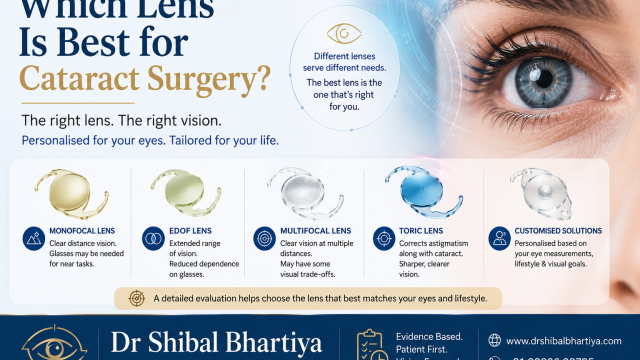
The best lens for cataract surgery depends on your lifestyle, your other eye conditions, and how much you want to rely on glasses afterwards. There is no single “best” lens, the right choice is the one matched carefully to your eyes and your life, explains Dr Shibal Bhartiya.
If you have been told you need cataract surgery, the next question your surgeon will likely ask is: what do you want to see clearly without glasses? That question is not small talk. Your answer directly determines which intraocular lens (IOL) goes into your eye, and you will live with that decision for the rest of your life.
Dr Shibal Bhartiya is a fellowship-trained glaucoma specialist and Mayo Clinic Research Collaborator with over 25 years of experience. Her approach focuses on identifying risk before damage is irreversible, simplifying treatment decisions, and protecting vision long-term. Emphasis on early detection, risk assessment, and continuity of care. She is rated 5 stars across 1,500+ patient reviews on Google.
What Is an Intraocular Lens (IOL)?
When a cataract is removed, the cloudy natural lens of your eye is replaced with an artificial lens called an IOL. This lens is permanent. It sits inside your eye, requires no maintenance, and cannot be felt. What varies between IOLs is what they correct, and that is where your choice begins.
The Main Types of IOLs
Monofocal IOLs These correct vision at one distance only, usually distance. You will see clearly far away but will need reading glasses for near tasks. They are the most commonly used lens globally, covered under standard surgical packages, and deliver very predictable results. If you are comfortable wearing glasses for reading, this is a reliable, low-risk choice.
Extended Depth of Focus (EDOF) IOLs These stretch the range of clear vision across distance and intermediate distances (computer screen, dashboard). Near vision, fine print, still often needs glasses. They produce fewer visual disturbances than multifocal lenses and suit people who work a lot at screens.
Multifocal IOLs These aim to give you clear vision at distance, intermediate, and near, reducing dependence on glasses across all ranges. The trade-off is that some people notice halos, glare, or starbursts around lights, particularly at night. These effects often reduce over months but do not always disappear. Multifocal IOLs are not recommended for people with certain retinal conditions, significant macular disease, or advanced glaucoma.
Toric IOLs If you have astigmatism, an irregular corneal curve, a toric IOL corrects it at the same time as the cataract. A toric can be monofocal, EDOF, or multifocal. Without a toric lens, uncorrected astigmatism will leave your vision blurred even after successful cataract surgery.
Light-Adjustable Lenses (LAL) These are adjusted after surgery using UV light treatments in the clinic. Your surgeon fine-tunes your prescription once your eye has healed. They offer excellent precision and suit people with high expectations for spectacle independence.
What Makes Someone a Good Candidate for a Multifocal IOL?
Multifocal lenses work best when:
- Your retina and optic nerve are healthy
- Your cornea is regular in shape
- You do not have significant dry eye
- You have realistic expectations about night-vision symptoms
- You are strongly motivated to reduce glasses dependence
They are generally not recommended if you have:
- Glaucoma with moderate to advanced visual field loss
- Macular degeneration or significant macular changes
- Irregular corneal surface (keratoconus or post-LASIK corneas)
- Severe dry eye disease
What If You Have Glaucoma and Need Cataract Surgery?
This is an important and frequently misunderstood situation. Cataract surgery itself can lower intraocular pressure modestly in some patients with glaucoma. It can also be combined with minimally invasive glaucoma surgery (MIGS) procedures at the same sitting, something worth discussing explicitly with your surgeon if you are on multiple glaucoma drops.
For the IOL choice in glaucoma patients: multifocal lenses are usually avoided in anyone with more than early glaucomatous damage. The reason is that multifocal optics split incoming light, which can make it harder to detect subtle changes in your visual field on future glaucoma testing. A monofocal or EDOF lens is almost always the safer recommendation. Your glaucoma specialist and cataract surgeon should be in communication about this decision.
What We Often Miss
Many patients are offered a premium lens upgrade without a full discussion of their eye health history. If you have been treated for glaucoma, have a family history of macular degeneration, or have had previous refractive surgery(LASIK, PRK), make sure your surgeon knows before the IOL power calculation is done. Previous refractive surgery changes the corneal shape and requires specialised formulas for accurate IOL calculation, standard formulas can produce a significant refractive surprise.
Also: dry eye must be treated before surgery, not after. Untreated dry eye causes inaccurate pre-operative measurements, which leads to the wrong IOL power being selected.
Please read Do I Need to Treat Dry Eye Before Cataract Surgery?
Please also read How Do I Know If It’s Time for Cataract Surgery?
When to Worry
Seek prompt review after cataract surgery if you notice:
- Sudden worsening of vision in the operated eye
- Increasing redness or pain
- New flashes of light or a curtain across your vision (possible retinal detachment)
- Persistent severe glare not improving after three months
Posterior capsule opacification, a secondary cloudiness that develops months to years after surgery in some patients, is common, easily treated with a painless laser procedure in the clinic, and should not be confused with the cataract returning.
Book a Cataract Consultation: Choosing the Right Lens Matters
There is no single “best” lens for cataract surgery—only the lens that is best for your eyes, your lifestyle, and your long-term eye health. The ideal intraocular lens (IOL) depends on factors such as glaucoma, retinal disease, corneal health, astigmatism, previous eye surgery, your visual needs, and personal expectations.
For glaucoma patients, Dr. Shibal Bhartiya carefully evaluates how cataract surgery and lens selection may affect both your vision and your glaucoma management. Premium multifocal or extended-depth-of-focus (EDOF) lenses are not suitable for everyone, particularly some patients with glaucoma or reduced contrast sensitivity. Every recommendation is based on a comprehensive eye examination, advanced imaging, current scientific evidence, and a personalised discussion of the benefits, limitations, and long-term implications of each lens option.
Whether you are considering your first cataract surgery or seeking a second opinion, receive an evidence-based recommendation tailored to your individual eyes—not a one-size-fits-all approach.
To book your cataract lens choice consultation in Gurgaon:
📍 Gurgaon 📞 +91 88826 38735 | 🌐 Contact Us | Second Opinion Form for teleconsults
Frequently Asked Questions
Which IOL lasts the longest?
All modern IOLs are designed to last a lifetime. They do not expire, degrade, or need replacement under normal circumstances.
Can I change my IOL after surgery?
IOL exchange is possible but is a more complex surgical procedure and is not undertaken lightly. Choosing carefully before surgery is always better than correcting afterwards.
Is the most expensive lens always the best lens for me?
No. A premium multifocal lens in an eye with early macular changes or glaucomatous nerve damage can give worse functional vision than a well-selected monofocal. Cost is not a reliable indicator of suitability.
How is the IOL power calculated?
Your surgeon takes measurements of your eye’s length and corneal curvature and uses these in a mathematical formula to calculate the lens power. Multiple measurements on different days improve accuracy.
What if I want to be glasses-free after cataract surgery?
Tell your surgeon this explicitly and early. It influences both lens selection and how the target refraction is set. Being glasses-free for distance is achievable with a monofocal lens targeted for emmetropia, full glasses independence across all distances requires a premium multifocal or light-adjustable lens and depends on your eyes being suitable.
Does cataract surgery affect glaucoma treatment?
Sometimes positively. In angle-closure glaucoma especially, removing a thick cataract can open the drainage angle and lower pressure. Combined cataract-MIGS surgery is increasingly used to reduce drop burden. Discuss this proactively with your glaucoma specialist.
The Right Lens Is a Conversation, Not a Catalogue
No surgeon can hand you a brochure and tell you which lens is best. The decision requires knowing your visual demands, your ocular health history, your corneal measurements, and your tolerance for optical side effects. Ask your surgeon to explain each option in terms of your specific eyes, not just what is available in general.
If you have glaucoma or any other chronic eye condition, make sure your specialist is involved in the IOL decision before surgery is booked.
Known for her structured approach to glaucoma risk assessment and progression analysis, Dr Shibal Bhartiya provides trusted second opinions for patients seeking clarity before major treatment decisions. Both, in person, and online.
This article is part of the Cataract Hub. Read more Cause of cataract, Cataract Surgery, Cataract Surgery Does Not Protect You From Glaucoma, Femtosecond Laser Cataract Surgery: Contraindications, Femtosecond Laser-Assisted Cataract Surgery, Is Cataract Surgery Painful?, Second Opinion for Cataract Surgery, Cataract in Glaucoma Patients, Vision Not Clear After Cataract Surgery? What It Really Means and Premium Lenses for Cataract Surgery in Gurgaon.
You can also watch these videos to understand more, here and here
About the Author
This article was written by Dr Shibal Bhartiya, fellowship-trained glaucoma specialist and Mayo Clinic Research Collaborator, Clinical Director at Marengo Asia Hospitals, Gurugram, known for ethical, patient-centred glaucoma care and independent glaucoma second opinions. She is also the Program Director for Community Outreach & Wellness; and for the Marengo Asia International Institute of Neuro and Spine.
She has published peer-reviewed research on glaucoma management, examining how treatment decisions should balance medical evidence, patient preferences, and long-term vision outcomes.
As Editor-in-Chief of Clinical and Experimental Vision and Eye Research and Executive Editor of the Journal of Current Glaucoma Practice (Pubmed Indexed, official journal of the International Society of Glaucoma Surgery), Dr Shibal Bhartiya brings editorial and research depth to every clinical decision. Her 200+ publications, including 90+ PubMed-indexed publications and 28 edited textbooks span glaucoma biology, surgical outcomes, health equity, and emerging diagnostics.
1600+ Five Star Patient Reviews Google Business Profile
If you are unable to come to Dr Bhartiya’s clinic: Read more about teleconsultation
Read her research on PubMed | Google Scholar | ResearchGate | ORCID | Github
📋Upload your reports for a structured review.| 🌐 Contact Us| 📞 +91 88826 38735
⭐ Helped by this article? Leave a Google review — it helps other patients find reliable eye care.