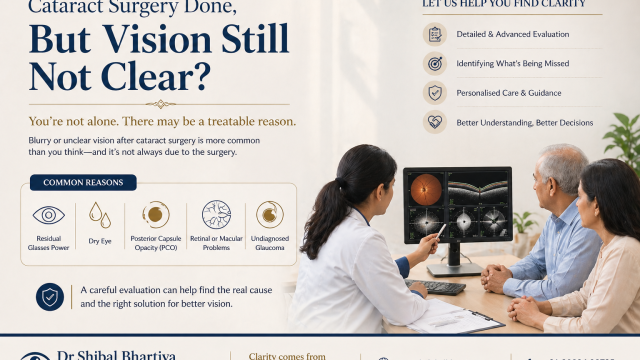
If your vision is not clear after cataract surgery, it does not always mean the surgery has failed. Common reasons include residual glasses power, dry eye, posterior capsule opacity (PCO), retinal issues, or undiagnosed glaucoma. The key is to identify whether the problem is temporary, correctable, or requires further evaluation, explains Dr Shibal Bhartiya.
Dr Shibal Bhartiya is a fellowship-trained glaucoma specialist and Mayo Clinic Research Collaborator with over 25 years of experience. Her approach focuses on identifying risk before damage is irreversible, simplifying treatment decisions, and protecting vision long-term. Emphasis on early detection, risk assessment, and continuity of care. She is rated 5 stars across 1,500+ patient reviews on Google.
Why Vision May Not Feel Clear After Cataract Surgery
Cataract surgery is expected to improve vision. Many patients are surprised when clarity does not return the way they imagined. Sometimes vision is slightly blurred. Sometimes it feels off. And sometimes, despite a technically successful surgery, vision never feels fully normal.
This is more common than people realise. In most cases, there is a clear explanation.
Please read What to Expect in the First Week After Cataract Surgery?
Common Reasons Vision Is Not Clear After Cataract Surgery
1. Residual Glasses Power
Even after cataract surgery, small refractive errors can remain. You may still need glasses for sharp vision, particularly for reading or distance. This is not a surgical failure. It reflects how your eye settled after the lens was placed.
2. Dry Eye
Dry eye is one of the most common and most frequently missed causes of blurred vision after cataract surgery. Surgery can temporarily worsen tear film stability. This produces fluctuating vision that improves with blinking, a sense of heaviness or discomfort, and blur that varies through the day. Treating the tear film often improves vision significantly without any further intervention.
Please read Do I Need to Treat Dry Eye Before Cataract Surgery?
Chronic dry eye at our Gurgaon clinic is assessed with The C.L.E.A.R.™ Framework — a 5-step protocol using meibography and biomarker profiling to target root-cause therapy beyond lubricants.
3. Posterior Capsule Opacity (PCO)
PCO is often called a secondary cataract. It can develop weeks to months after surgery as the membrane behind the lens implant becomes cloudy. Vision becomes gradually hazy again. It is usually straightforward to treat with a short laser procedure called a YAG capsulotomy, after which vision typically clears quickly.
4. Retinal or Macular Problems
Conditions such as macular oedema, AMD or pre-existing retinal disease can limit how well vision recovers after surgery. These may not have been detected before the cataract was removed. An OCT scan of the retina helps identify whether the macula is the limiting factor.
5. Undiagnosed or Co-existing Glaucoma
Glaucoma is frequently overlooked as a cause of reduced visual quality after cataract surgery. Vision may feel less sharp despite apparently normal test results. It may feel slower or more effortful. It may be worse in low light or in busy visual environments. Routine post-operative checks do not always include the tests needed to detect glaucoma reliably. Remember, cataract surgery does not mean you cannot have glaucoma.
When Should You Be Concerned?
Most patients experience some fluctuation in the first few weeks after surgery. These situations, however, warrant a more detailed review.
Vision that is not improving four to six weeks after surgery. Blur that is increasing rather than settling. Distortion, patchy vision, or difficulty reading that was not present before. A sense that something feels off even when standard tests appear normal.
These are signals to look deeper. They are not reasons to wait.
📍 Gurgaon 📞 +91 88826 38735 | 🌐 Contact Us | Second Opinion Form for teleconsults
What Tests Help Identify the Cause?
The right investigation depends on your symptoms, but a thorough review typically includes the following.
Refraction to check for residual glasses power. Tear film evaluation to assess dry eye. An OCT scan of the retina and optic nerve to look for macular or nerve fibre changes. Visual field testing if glaucoma is suspected. A slit-lamp examination to check the lens implant position and assess for PCO.
Not all of these are performed at a routine post-operative appointment. If your concerns have not been investigated systematically, they may not yet have been answered.
The Right Question to Ask
The question is not: was the surgery successful?
The better question is: why is vision not matching expectation?
In many cases the issue is not the surgery itself. It is what was missed before it, what developed after it, or what was never fully investigated. A structured review can often identify a correctable cause, even months or years after the original procedure.
If Your Vision Is Still Not Clear After Cataract Surgery
Most people expect their vision to improve after cataract surgery. If it has not improved as expected, or remains blurred, hazy, distorted, or otherwise unclear, it is reasonable to have it reviewed.
A second opinion is not a challenge to your surgeon. It is a clinical tool that can help determine why your vision has not settled as expected and whether anything needs further treatment or simply more time.
Bring any eye reports, scans, prescriptions or discharge documents you have. The more information available, the more precise the review.
Dr Shibal Bhartiya is a fellowship-trained ophthalmologist, glaucoma specialist and neuro-ophthalmologist, and a Mayo Clinic Research Collaborator. She evaluates complex eye problems and provides evidence-based second opinions.
📍 Gurgaon | 📞 +91 88826 38735 | 🌐 Contact Us | Second Opinion Form for teleconsultations
Frequently Asked Questions
Is it normal to have blurry vision after cataract surgery?
Mild blur is common in the first few weeks after surgery as the eye heals and settles. The tear film is often temporarily disrupted, and the brain takes time to adapt to the new lens. Blur that persists beyond four to six weeks, or that is worsening rather than improving, is not a normal part of recovery and needs evaluation.
How long does it take for vision to fully clear after cataract surgery?
Most patients notice significant improvement within the first week and stabilise between two and six weeks. Some causes of blurred vision, such as posterior capsule opacity or macular oedema, can appear weeks or months after surgery. If your vision was improving and has now become hazy again, that change should be assessed promptly.
Can cataract surgery fail?
True surgical failure, meaning a problem caused by the procedure itself, is uncommon. Most cases of unsatisfactory vision after cataract surgery are due to identifiable and often treatable causes such as dry eye, residual refractive error, PCO, or a co-existing eye condition that was not detected or managed before surgery.
Can glaucoma affect vision after cataract surgery?
Yes. Cataract surgery removes the cloudy lens and improves optical clarity, but it does not treat glaucoma. If glaucoma is present, diagnosed or undiagnosed, it can continue to affect visual quality, contrast sensitivity, and peripheral vision after surgery. Patients who feel their vision is not as clear or as reliable as expected after cataract surgery should have glaucoma formally excluded as a contributing factor.
What is posterior capsule opacity and how is it treated?
Posterior capsule opacity occurs when the membrane behind the lens implant becomes cloudy after surgery. It produces a gradual return of haziness that can feel similar to the original cataract. It is treated with a YAG laser capsulotomy, a short outpatient procedure that takes a few minutes and typically restores clarity within a day.
Should I get a second opinion if my vision is still blurry after cataract surgery?
Yes, if your concerns have not been fully explained or investigated. A second opinion is appropriate when vision has not improved as expected, when you have been told everything is normal but your symptoms persist, or when you want an independent assessment of your test results. A fellowship-trained specialist can review your history, scans, and reports and give you a clear picture of what is happening and what options exist.
This article is part of the Cataract Hub. Read more Cause of cataract, Cataract Surgery, Cataract Surgery Does Not Protect You From Glaucoma, Femtosecond Laser Cataract Surgery: Contraindications, Femtosecond Laser-Assisted Cataract Surgery, Is Cataract Surgery Painful?, Cataract in Glaucoma Patients, Vision Not Clear After Cataract Surgery? What It Really Means, What is PCO after Cataract Surgery, Which Lens is Best for Cataract Surgery, Second Opinion Before Cataract Surgery, What to Expect in the First Week After Cataract Surgery? and Premium Lenses for Cataract Surgery in Gurgaon.
You can also watch these videos to understand more, here and here.
Please also read about Retinal Diseases here.
About the Author
This article was written by Dr Shibal Bhartiya, fellowship-trained glaucoma specialist and Mayo Clinic Research Collaborator, Clinical Director at Marengo Asia Hospitals, Gurugram, known for ethical, patient-centred glaucoma care and independent glaucoma second opinions. She is also the Program Director for Community Outreach & Wellness; and for the Marengo Asia International Institute of Neuro and Spine.
She has published peer-reviewed research on glaucoma management, examining how treatment decisions should balance medical evidence, patient preferences, and long-term vision outcomes.
As Editor-in-Chief of Clinical and Experimental Vision and Eye Research and Executive Editor of the Journal of Current Glaucoma Practice (Pubmed Indexed, official journal of the International Society of Glaucoma Surgery), Dr Shibal Bhartiya brings editorial and research depth to every clinical decision. Her 200+ publications, including 90+ PubMed-indexed publications and 28 edited textbooks span glaucoma biology, surgical outcomes, health equity, and emerging diagnostics.
1600+ Five Star Patient Reviews Google Business Profile
If you are unable to come to Dr Bhartiya’s clinic: Read more about teleconsultation
Read her research on PubMed | Google Scholar | ResearchGate | ORCID | Github
📋Upload your reports for a structured review.| 🌐 Contact Us| 📞 +91 88826 38735
⭐ Helped by this article? Leave a Google review — it helps other patients find reliable eye care.