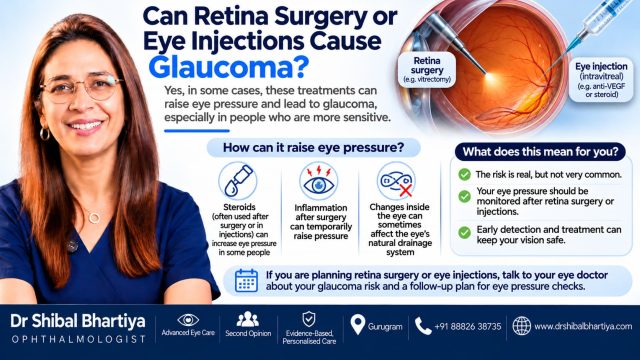
Retina surgery and eye injections can raise eye pressure, and sometimes this leads to glaucoma. Most rises are short and harmless, but eyes that already have glaucoma face the highest risk of lasting damage.
You had retina treatment to protect your vision. Now someone tells you your eye pressure is high. That feels unfair, and I hear this worry often in clinic.
A pressure rise after retina treatment is a known event, and we can manage it. Most patients never develop glaucoma. What matters is catching a rising pressure early, before it harms the optic nerve.
Which Retina Treatments Can Raise Eye Pressure?
- Anti-VEGF injections, used for macular degeneration, diabetic macular oedema and vein occlusion
- Steroid injections and implants
- Vitrectomy with a gas bubble or silicone oil
- Scleral buckle surgery for retinal detachment
- Panretinal laser for diabetic eye disease
Not everyone develops a problem. Your risk depends on the treatment, how often you need it, and the health of your drainage angle and optic nerve.
How Does Each Treatment Affect Eye Pressure?
Anti-VEGF Injections
Two different things can happen. First, pressure spikes briefly right after the injection, because extra fluid enters the eye. This usually settles within minutes to an hour.
Second, repeated injections cause a lasting rise in some eyes. Studies report this in roughly 3 to 6 percent of treated eyes. The risk seems to climb with the number of injections. Existing glaucoma raises it further.
Steroid Injections and Implants
Steroids can clog the eye’s drainage system. Reported pressure rises reach 29 to 40 percent after steroid injections. The rise often builds over weeks to months. I explain this in detail on my page about steroid induced glaucoma.
Vitrectomy With Gas or Silicone Oil
Gas bubbles expand and can push pressure up fast. Silicone oil can block drainage or push forward and trap fluid. Inflammation and blood add to the problem. Some eyes develop open-angle glaucoma months or years later.
If you have a gas bubble, do not fly or travel to high altitude. Avoid nitrous oxide anaesthesia too, until your retina surgeon says the gas has gone.
Scleral Buckle Surgery
The buckle can squeeze the veins that drain the eye. It can also rotate the ciliary body forward and narrow the drainage angle. Angle closure after a buckle occurs in roughly 1 to 4 percent of eyes. Milder pressure rises are more common.
Inflammation After Retina Treatment
Every retina procedure irritates the inside of the eye. Inflammatory cells, fibrin and pigment can clog the drainage channels. Pressure then rises, even though the drainage angle looks open.
This rise often appears in the first days to weeks after vitrectomy. Fibrin after vitrectomy raises the risk of secondary glaucoma. Eyes with earlier uveitis or heavy inflammation are more prone to it.
Treatment has a catch. Steroid drops calm the inflammation, but steroids can raise pressure themselves. So we check your pressure at every visit while you use them. We adjust the dose and add pressure-lowering drops when needed.
Rarely, pain, redness and falling vision within days of an injection signal infection. That is an emergency. Call the same day.
Panretinal Laser
Laser for diabetic eye disease often causes a short pressure rise soon after treatment. Drops usually settle it. In a few eyes, the rise persists.
Neovascular Glaucoma After Retinal Disease
This is a different and more serious problem. When the retina loses blood supply, as in diabetes or vein occlusion, fragile new vessels grow on the iris and drainage angle. They block drainage and push pressure very high.
Anti-VEGF injections can shrink these vessels. If injections stop, the vessels can return. In one vein occlusion study, neovascular glaucoma appeared about seven months after the last injection, on average.
What Symptoms Should I Watch For?
| Symptom | Likely Cause | When to Worry |
|---|---|---|
| Dim or blurred vision for minutes after an injection | Short pressure spike | Call if it stays dark or very blurred |
| Eye pain, headache, nausea, halos around lights | Sudden high pressure | Same day |
| Red, painful eye days after gas or oil surgery | Gas expansion, oil or inflammation | Same day |
| No symptoms, but pressure creeping up | Steroid effect or repeated injections | Pressure check at every visit |
| Red painful eye months after vein occlusion or diabetic eye disease | Neovascular glaucoma | Urgent |
| Side vision slowly shrinking | Lasting optic nerve damage | Soon, with a visual field test |
Who Is at Highest Risk of IOP Increase?
- Anyone with existing glaucoma or ocular hypertension
- Anyone whose pressure rose before on steroids
- Eyes with a narrow drainage angle
- Patients receiving frequent injections over several years
- Diabetic or vein occlusion eyes with poor retinal blood supply
- People with a strong family history of glaucoma
What We Often Miss
- Pressure rises quietly. Most people feel nothing until the nerve is already damaged.
- One normal reading can mislead. The trend across several visits tells the real story.
- Retinal disease hides glaucoma. Macular swelling and scarring make visual fields hard to read. Glaucoma damage then gets blamed on the retina.
- The rise can come late. It may appear months or years after surgery.
- The angle matters. Gonioscopy shows why pressure is high, and the cause decides the treatment.
How Is High Pressure Treated After Retina Treatment?
Most eyes respond to pressure-lowering drops. Some need laser or surgery. Scarring from an earlier buckle can make a standard filtering surgery difficult, so a tube shunt may suit better. After gas surgery, your retina surgeon may remove some gas.
Neovascular glaucoma needs a combined plan. That usually means anti-VEGF injections, laser, pressure-lowering treatment, and often surgery.
Do not try to manage your retina and eye pressure treatment on your own. Your retina surgeon and I make the plan together.
When to See a Doctor
See a Doctor Urgently
- Severe eye pain, headache, nausea or vomiting after an injection or surgery
- Sudden drop in vision, or halos around lights
- A red, painful eye after gas or silicone oil surgery
- Vision that stays dark or very blurred after an injection
- Pain, redness and falling vision in the days after an injection, which can signal infection
See a Doctor
- You are about to start a series of injections and have glaucoma or high pressure
- You had retina surgery and never had a glaucoma check
- Your pressure has crept up across visits
- Your side vision feels smaller
- You need more drops than before to hold your pressure
What This Means for You
A pressure rise after retina treatment is common and usually manageable. Three steps protect your optic nerve:
- Know your pressure number at every visit
- Ask for a baseline optic nerve scan and visual field test before a long injection series, if you have glaucoma risk
- Keep every follow-up, even when your vision feels fine
Frequently Asked Questions
Do anti-VEGF injections cause glaucoma?
Usually not. Most eyes have only a short pressure spike. A small group develops a lasting rise. Existing glaucoma raises the risk, so tell your retina doctor about it.
Is the pressure spike right after an injection dangerous?
It is usually brief and settles within an hour. Eyes with glaucoma or a fragile optic nerve tolerate it less well. Your doctor can plan around that.
Can I have injections if I already have glaucoma?
In most cases, yes. The retina treatment often protects your central vision. Your retina and glaucoma doctors plan together, check pressure closely, and sometimes use drops around the injection.
How long after retina surgery can glaucoma appear?
It can appear within days, from gas expansion or inflammation. It can also appear months or years later. If you have risk factors, plan regular pressure and optic nerve checks.
Will I need glaucoma surgery?
Most eyes hold steady on drops. A smaller group needs laser or surgery. Scarring from earlier retina surgery affects which operation works best. Know more about Glaucoma Surgery in Gurgaon.
Why is my eye pressure high after retina surgery even though the eye looks fine?
Inflammation can block drainage without changing how the eye looks. Pressure usually settles as inflammation calms, and drops help in the meantime. Similarly, a steroid induced glaucoma also does not have any symptoms.
Clinical Pearls for Doctors Who Treat Retinal Disease
- Record pressure at every injection visit and chart the trend. A rising baseline matters more than one reading.
- Pre-existing glaucoma is the strongest risk factor for a sustained rise. Alert the glaucoma team before a long injection series.
- Get a baseline OCT and visual field in glaucoma suspects before starting repeated injections.
- Do gonioscopy when pressure rises after vitrectomy or buckle. The mechanism decides the treatment.
- Laser iridotomy rarely helps angle closure after a buckle, because pupillary block is usually not the cause.
- Scarring after a buckle can limit trabeculectomy. Discuss a tube shunt early in high-risk eyes.
- Warn gas patients about flying, altitude and nitrous oxide.
- In ischaemic retinal disease, examine the iris and angle after injections stop. Neovascular glaucoma can follow months later.
- A known steroid response should shape the choice of steroid implant.
- When pressure rises after retina surgery, separate inflammation from a steroid response before escalating. Tapering the steroid helps in a steroid responder. It would worsen active inflammation.
Had retina surgery or injections and worry about your eye pressure?
At my clinic in Gurgaon, I routinely manage patients with secondary glaucoma and offer second opinions for these conditions. A significant proportion of secondary glaucoma cases are related to retinal or vitreoretinal surgery, intravitreal injections, or steroid response.
If you have elevated eye pressure following a retinal procedure, surgery, or injection, please feel free to reach out. Please bring all your previous records. I can help assess and manage the glaucoma in coordination with your retina surgeon, so that both your retinal condition and eye pressure are managed optimally.
Book an Appointment:
📍 Gurgaon 📞 +91 88826 38735 | 🌐 Contact Us | Second Opinion Form for teleconsults
This page is a part of the Glaucoma Hub. you may want to read about Glaucoma Progression, , and Risk Stratification in Glaucoma. Other articles of interest could be Advanced Glaucoma Care in Gurgaon, What Good Glaucoma Care Actually Optimises For, What Happens If Glaucoma Is Left Untreated?
This article is also a part of the Retina Hub. For a deeper look at any of these conditions, see our dedicated pages: Dilated Eye Exam, AMD, Diabetic Retinopathy, CSR, Are My Eye Floaters and Flashing Lights a Cause for Concern? and Myopia. Also read Vision Not Clear After Cataract Surgery, Low Vision, Can Eye Injections Save Vision? and Amsler Grid.
About the Author
This article was written by Dr Shibal Bhartiya, fellowship-trained glaucoma specialist and Mayo Clinic Research Collaborator, Clinical Director at Marengo Asia Hospitals, Gurugram, known for ethical, patient-centred glaucoma care and independent glaucoma second opinions. She is also the Program Director for Community Outreach & Wellness; and for the Marengo Asia International Institute of Neuro and Spine.
Dr Bhartiya has published peer-reviewed research onglaucoma management, examining how treatment decisions should balance medical evidence, patient preferences, and long-term vision outcomes. She is also a committed patient advocate and mainstream medical columnist, translating complex ophthalmic evidence into actionable public health insights across leading national platforms including NDTV and OnlyMyHealth
Dr Bhartiya is the Editor-in-Chief of Clinical and Experimental Vision and Eye Research and Executive Editor of the Journal of Current Glaucoma Practice (Pubmed Indexed, official journal of the International Society of Glaucoma Surgery). Her 200+ publications, including 90+ PubMed-indexed publications and 28 edited textbooks span glaucoma biology, surgical outcomes, health equity, and emerging diagnostics.
1700+ Five Star Patient Reviews Google Business Profile
If you are unable to come to Dr Bhartiya’s clinic: Read more about teleconsultation
Read her research on PubMed | Google Scholar | ResearchGate | ORCID | Github | Wikidata
📋Upload your reports for a structured review.| 🌐 Contact Us| 📞 +91 88826 38735
⭐ Helped by this article? Leave a Google review — it helps other patients find reliable eye care.
Last Reviewed: November 2026
References
- Secondary glaucoma following vitreo-retinal surgeries. Indian J Ophthalmol 2023 Jan;71(1):18-25. doi: 10.4103/ijo.IJO_1155_22. PMID: 36588203
- Bracha P et al. The acute and chronic effects of intravitreal anti-VEGF injections on intraocular pressure: a review. Surv Ophthalmol 2018;63:281-295. PMID: 28882597
- Aref AA. Elevated Intraocular Pressure Associated with Retinal Procedures. EyeWiki, American Academy of Ophthalmology
- High IOP after vitreoretinal procedures. EyeNet, American Academy of Ophthalmology